Rachel Kurzius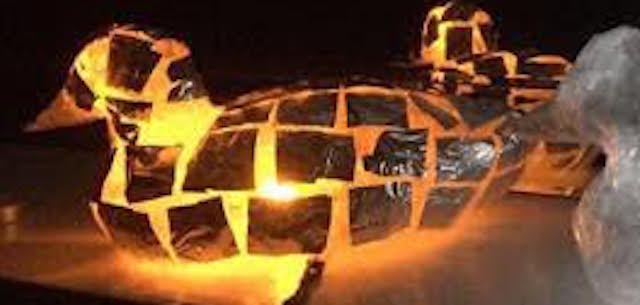
Update:
DUCK LOCATION!!!!!!!!! Wisconsin Avenue and Nebraska Ave, NW. Come check them out at 6pm. #100DucksDC pic.twitter.com/mh15D0Dsg3
— Theodore Carter (@theodorecarter2) February 17, 2017
Original: For the past 15 months, Theodore Carter has been enlisting the help of friends and family to make 100 ducks out of packing tape, topped with materials like bottle caps, tissue paper, bathroom tiles, paint, googly eyes, expired birth control pills, and horse hair.
All of these ducks have been sitting in his basement, waiting for tonight. This evening, Carter will place lights in the sculptures and launch them onto a grid that he’s assembled in a visible location in D.C.
Because the project is not permitted, he’ll post the location on his Twitter and Facebook at 5:30 p.m., when he and a group of 20 will install the ducks.
By 6 p.m., “hopefully it’ll look like 100 ducks with lights inside in a grass lot,” the Takoma Park resident says.
Why, exactly, has Carter spent more than a year on this project?
“People assume if you’re doing something large and unexpected it must be for political reasons,” he says. But this project is not a form of protest. “I think meaningless things that have no monetary gain are beautiful and important. In this city, where people are very serious, it’s important to do things that are absurd.”
This isn’t Carter’s first foray into street art. In 2012, he placed glittery sea blobs at District intersections, largely as a guerrilla publicity campaign for his collection of short stories The Life Story of a Chilean Sea Blob and Other Matters of Importance.
One day, Carter and his son sat across from one of the sea blobs, observing who noticed it and who didn’t. “The people who stopped—that interested me,” he says. “I was watching this and realized those are my people. Those are the people I want to write things and do things for.”
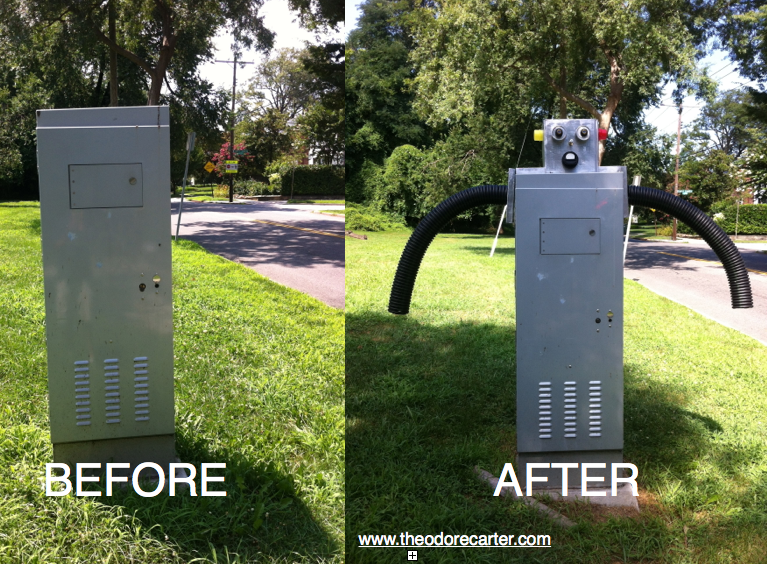
And so the blob bit him. Carter created other projects, like a packing tape sculpture of his wife reading the book in Dupont Circle and converting a traffic box into a robot and a skyscraper.
“Passersby are the people I’m most interested in,” he says. “Disrupting their walk home and giving them something fun and unexpected that they might not encounter otherwise.”
But there’s another benefit to using packing tape rather than words to express himself. “The ducks are more social. I can include my family,” says Carter. “It’s something I can do at the breakfast table, whereas with writing, I have to go alone to the basement.”
The original wooden duck used as a model is an an antique wooden duck decoy that belonged to Carter’s grandfather. He says he chose the duck because of its familial ties and because “it’s a simple shape that’s easy to make a packing tape mold out of.”
And why 100? “If I make one duck it’s probably not going to be that impressive,” says Carter. “But I can make 100 ducks and that’s pretty fun, and I think, somewhat significant.”
He didn’t invent the packing tape technique. He learned it from online tutorials posted by D.C. street artist Mark Jenkins. While Carter is inspired by the D.C. street art scene, he says he is not a part of it. “I’m a suburban dad who’s kind of a voyeur into what is happening.”
The plan is to keep the installation up through Sunday, Carter says, at which point he’ll post something so folks can take a duck, “if all goes well and no one tells me to get rid of it earlier.” Who can forget when someone called the bomb squad on a work of street art downtown last March?
In watching a bevy of others contribute to the store of ducks, Carter has one big takeaway.
“Adults are really scared of creating because they’re not trained and they think they’re not going to be good,” Carter says. “Kids aren’t like that. They’re not scared. I’m trying to be more like that and I think other people might want to give it a shot, too.”
This story has been updated.