Rachel Kurzius
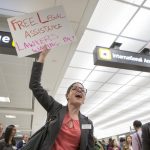
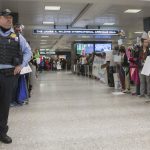
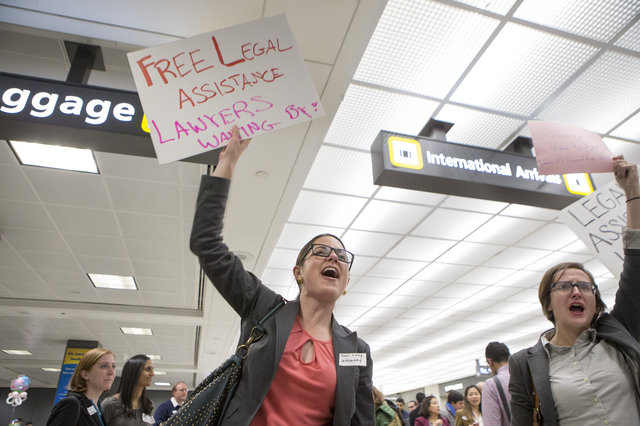 Lawyers and advocates have been posted up at Dulles International Airport since late January, when President Donald Trump signed the first travel ban. (Photo by Alex Edelman)
Update: A federal judge in Hawaii blocked President Donald Trump’s revised travel ban from being implemented at 12:01 a.m. on Thursday by issuing a temporary restraining order against the executive order.
Original: Barring court intervention, President Donald Trump’s revised travel ban goes into effect on Thursday at 12:01 a.m. and volunteers with Dulles Justice are prepared for it.
A coalition of lawyers, translators, and activists who came together in the wake of an executive order in late January, Dulles Justice has kept up a constant presence at the airport since then, in what one volunteer describes as “the calm before the storm.”
“Our presence on the ground has been about being supportive of family members and staying ready,” says Sirine Sebaya, a D.C. civil rights attorney and coordinator for Dulles Justice. While the group doesn’t directly represent anyone, people from Dulles Justice will greet travelers, provide information, and, if necessary, connect them to lawyers.
“We’re ramping up numbers of volunteers for tomorrow,” says Sebaya, adding that “we’re hopeful that the courts will stay the new executive order.”
Sebaya was in the Maryland court room today, where a federal judge is deciding whether to pause the new executive order before it is implemented, one of several legal challenges to the new ban.
The first travel ban blocked people from seven majority-Muslim countries—Iraq, Iran, Syria, Libya, Somalia, Sudan, and Yemen—from entering the U.S. for 90 days and suspended the refugee admissions program for 120 days.
“I am establishing new vetting measures to keep radical Islamic terrorists out of the United States of America,” Trump said while signing it. “We don’t want them here.”
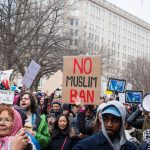
It went into effect immediately, causing chaos and tears at airports. Some people had taken off before the ban was signed, and it was unclear at the outset whether it applied to legal permanent residents, people with dual citizenship, or those who had already obtained visas. It revoked tens of thousands of visas. Opponents called it a Muslim ban, because it focused on countries with majority-Muslim populations.
Immediately facing lawsuits from groups like the American Civil Liberties Union and a number of state attorneys general, the ban did not fare well. It is currently blocked.
The new order, signed by Trump on March 6, is tailored to withstand these legal challenges. It stops the U.S. from issuing visas to people from Iran, Lybia, Somalia, Syria, and Sudan (though not Iraq, as the first one did) for 90 days and halts the refugee program for 120 days.
“The new order, just like the old order, is still a Muslim ban,” says Sebaya. “It’s true that the scope of the order is more targeted, but the targets are completely unjustified from a national security standpoint. Every bit of information we have about intent of this order continues to be discriminatory.”
More than 2,000 people have signed up to volunteer with Dulles Justice, and the coalition welcomes more help. Additionally, there will be a protest at the Virginia airport on Saturday.
Sebaya says that “people should know that if they have valid entry documents, they should not be turned away. We understand that people are concerned. That’s why we will be there.”