Rachel Kurzius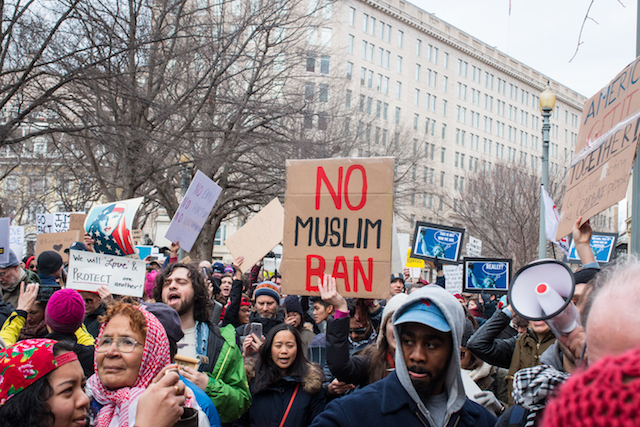
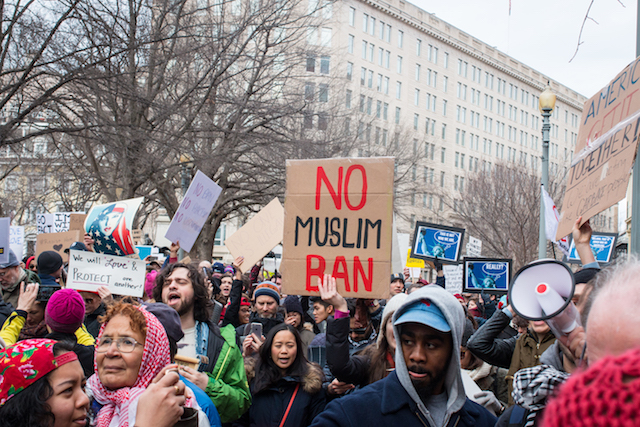 A demonstration after the signing of the first travel ban. (Photo by Liz Lemon)
A federal judge in Maryland has suspended part of President Donald Trump’s revised travel ban in a decision on Thursday.
The decision from U.S. District Judge Theodore D. Chuang follows a federal judge in Hawaii, who issued a temporary restraining order that halted the ban hours before it was set to take effect.
The new order, signed by Trump on March 6, halts the U.S. from issuing visas to people from Iran, Libya, Somalia, Syria, and Sudan for 90 days and pauses the refugee program for 120 days.
Chuang’s decision is more narrow than that of his colleague in Hawaii, taking issue specifically with the provision that stopped the U.S. from issuing visas to the six majority-Muslim countries. The case was brought by three organizations and six individuals.
“The history of public statements continues to provide a convincing case that the purpose of the Second Executive Order remains the realization of the long-envisioned Muslim ban,” Chuang said in the decision.
Those statements include Rudy Giuliani saying on television that Trump called him up to figure out how to legally enact a Muslim ban, White House Adviser Stephen Miller promising the new order would be “fundamentally” the same as the previous one, and Trump’s own statements on the campaign trail calling for a “total and complete shutdown of Muslims entering the United States until our country’s representatives can figure out what is going on.” (The press release is still on the campaign website.)
The executive order is another attempt after Trump’s previous order fared poorly in the courts, which blocked it. The first stab also applied to Iraq, in addition to the six majority-Muslim countries included in the revised ban. It went into effect immediately after Trump signed it in late January, and led to detentions and confusion at airports when it revoked tens of thousands of visas and border officials applied it to legal permanent residents.
The Trump administration is not pleased with the court’s response so far. At a rally in Nashville on Wednesday night, Trump called the decision from Hawaii “terrible” and described the revised executive order as “a watered-down version of the first one.”
The Justice Department in a statement vowed to continue defending the executive order after the Hawaii decision came down. “The Department of Justice strongly disagrees with the federal district court’s ruling, which is flawed both in reasoning and in scope. The President’s Executive Order falls squarely within his lawful authority in seeking to protect our Nation’s security, and the Department will continue to defend this Executive Order in the courts,” Justice Department spokesperson Sarah Isgur Flores said in a statement.
A federal judge in Washington state—who issued a temporary restraining order against the first ban in February—also heard arguments about the executive order.
Local activists have vowed to keep up the pressure, with a rally at Dulles International Airport planned for Saturday.