In 1958, black women were closed off from much of American society. Among other indignities, the law forced them to to use separate bathrooms, sit in separate sections of school buses, attend separate schools, and eat at separate lunch counters.
But it couldn’t stop them from taking to the runway.
Eunice Walker Johnson founded the Ebony Fashion Fair in hopes that black women could gain entry to a fashion world that offered no space for them. Her gamble paid off: the show lasted five decades, gained national recognition and opened new doors for people from marginalized groups. Now, a few years after it closed its doors for good, George Washington University Museum and the Textile Museum are celebrating its achievements in social justice and high fashion with the exhibit, Inspiring Beauty: 50 Years of Ebony Fashion Fair.
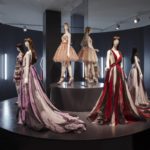
Visitors can gaze upon 40 dresses and 100 objects from the shows, as well as archival images and interviews with Fashion Fair participants. Camille Ann Brewer, the museum’s curator of contemporary art, relished the opportunity to showcase this landmark program as her first exhibit since starting her job in October, she told reporters at a press preview Thursday.
To re-create the unique experience of the Fashion Fair, curators of the Chicago History Museum teamed up with the Johnson Publishing Company, founded by Eunice’s husband John, to secure key dresses from the show’s history, and to bone up on Eunice and John Johnson’s biographies.
They also consulted proud veterans of the fashion show, like Shayla Simpson, whose eagerness lit up the room as she toured the exhibit’s two floors during Thursday’s preview. Simpson beamed as she shared fond memories of her days as a commentator for the show, which involved far more than just narrating into a microphone. She and her colleagues worked 9 a.m. to 9 p.m. on show days, as many as six days per week, in different parts of the country each day. On off days, they traveled the world in search of cutting-edge designs, spurred on by Eunice, who wanted the show’s participants to see fashion as a calling, not a frivolous pastime.
“She saw fashion as art,” Simpson says.
The Fashion Fair, an offshoot of the publishing company’s wildly popular Ebony Magazine, also created much-needed job opportunities where none existed before. In addition to 13 or so models per show, Eunice Johnson hired photographers, editors, musicians, and makeup artists—most of them black women, earning a salary for pursuing their craft. Now, such an endeavor seems more commonplace. In the ’50s and ’60s, when Jim Crow segregation laws were in full swing, it was anything but.
Racism in its ugliest forms was impossible to avoid, Simpson says. In unfamiliar cities, models would sleep over at private residences rather than risking a night in a hotel. Some Southern towns wouldn’t even let the Fashion Fair perform. Simpson recalls one instance where a fair-skinned model, who passed for Caucasian, ventured out to buy snacks for all of her colleagues, whose darker skin would have attracted open derision and hostility.
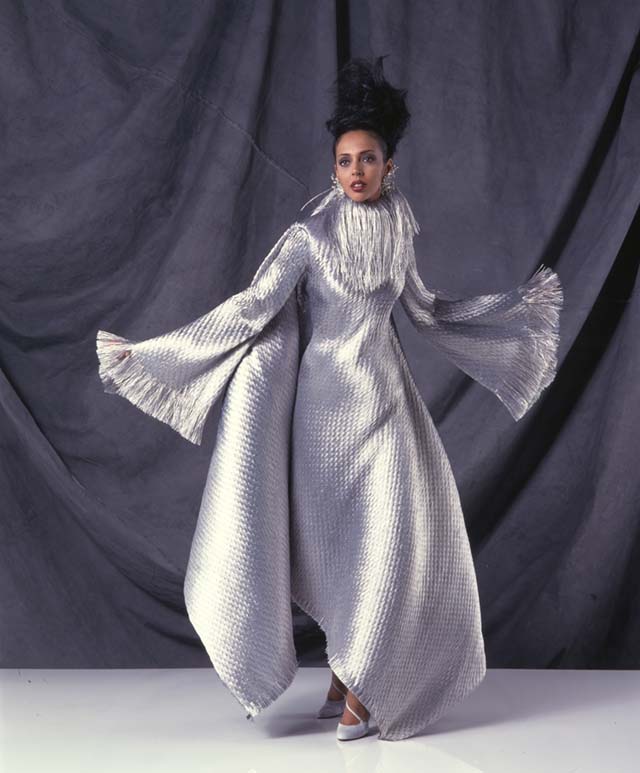
But the obstacles proved surmountable. The event showcased designs from fashion icons still relevant today, including Yves Saint Laurent, Alexander McQueen, and Karl Lagerfeld. At least one lavish piece from each is on display on mannequins in the exhibit; a few of them stand tall in front of a shimmering backdrop. They broke new ground with materials like plastic discs and metal chain mail, and designs like a Pierre Cardin “accordion” dress.
The Ebony Fashion Fair set other precedents as well: showcasing plus-size women before most comparable shows; inspiring a line of cosmetics that catered to an underserved market for women with darker skin tones; and prompting the creation of FLAIR, a non-profit fundraising organization that encourages fledgling fashion talent.
Now the event has an exhibit of its own. The show shuttered in 2009, the Johnson Publishing Company sold Ebony, and its sister publication Jet folded last year. John Johnson died a few years before the Fashion Fair ended; Eunice, two years afterwards. Brewer said she thinks the event might return someday in a different form, but the original remains firmly in the past.
The exhibit will travel elsewhere once it wraps its D.C. run, but Brewer said it’s particularly well-suited for its current location, given that the Textile Museum employs numerous conservators with acute experience. “It’s a special show for this museum,” Brewer says.
It was a special show for those who ran it, too. Simpson grew reflective as she recalled the empowerment that her bosses transferred on to her. She learned a lesson early on, she says.
“I asked him, ‘Mr. Johnson, what is my budget? How much may I spend on my dress?’” Simpson said. “He stopped and said, ‘Have I ever told you there was a limit? … Your job is to go out and find the best fashions in the world. Use your judgment, bring them back to me and we’re going to exhibit them.’”
“It was a wonderful job,” Simpson added. “A labor of love.”
Inspiring Beauty: 50 Years of Ebony Fashion Fair is on display from March 18-July 24 at the George Washington University and The Textile Museum, 701 21st Street, NW. Suggested donation is $8. Museum hours are Friday 11 a.m.-5 p.m., Saturday 10 a.m.-5 p.m., Sunday 1-5 p.m., Monday 11 a.m.-5 p.m., Wednesday and Thursday 11a.m.-7 p.m. The museum is closed on Tuesdays.