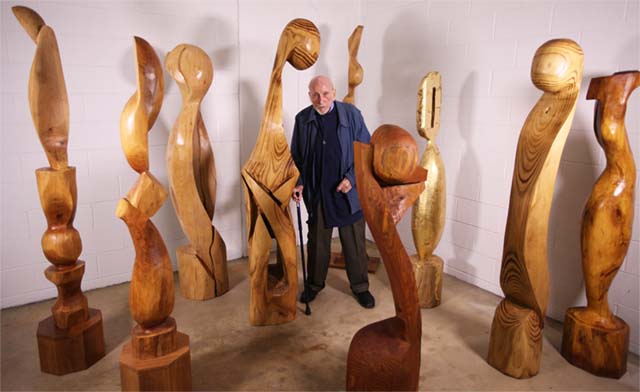
Dr. Lionel M. Bernstein is a retired gastroenterologist. In his spare time, he used a chainsaw to make sculptures in his backyard. Now 93 years old, after making art for more than three decades, Bernstein is about to enjoy the first ever gallery exhibit of his works.
Born in Chicago in 1923, Bernstein moved to Washington in 1967, where he had a long career at the Veterans Administration and the National Institute of Health. He made his first sculpture after a trip to London with his wife Jodie.
It was 1970. In the Tate’s sculpture garden, Bernstein was struck by a particular Henry Moore piece, Upright Motive No. 2 . He told his wife, “when I get home I’m going to have to make one of these, because I’m never going to make enough money to buy one.
Pointing to a photo of himself brandishing a chainsaw beside his six-foot high Moore copy, Bernstein explains, ‘This is the origin of the dilemma.”
Bernstein, then 46 and working at the Institute of Arthritis and Metabolic Diseases at NIH, had never sculpted before. In fact, he had never created any art before at all. (“I may have drawn a circle in third grade,” he admits). He began to chip away at a six-foot high piece of oak with chisels but at the rate he was going it seemed he’d never finish, and he threw his tools up in the air in frustration.
That’s when he had a eureka moment: as he watched the tools flying above him, he knew he had to use a more brutally efficient device: a chainsaw.
While most mid-career professionals might be reluctant to take on a new project, Bernstein dove into sculpture. In his many endeavors, he always sought out creative solutions. At the Medical Nutrition Laboratory in Denver’s Fitzsimmons Army Hospital, he determined that the most effective food source for soldiers in remote areas, was a box of Chuckles candies, which provided a perfect mix of high calories in an easy-to-carry package. In 1979, he anticipated Uber when he spoke to The Washington Post about his concept of “semi-taxis,” private cars that would be available for hire during rush hour.
The raw materials his first sculpture fell in his lap, or rather in his yard, after the city cut down two large, dead oak trees on Bernstein’s Chevy Chase lawn. Soapstone for his stone sculptures came from nearby Rock Creek.
Frustrated with what he saw as his slow progress as a sculptor, Bernstein took a sculpture class at the Corcoran with 11 other adult students. He vividly remembers the first class critique; teacher Slaithong Schmutzhart went around the room evaluating his classmates’ work in clay, but said nothing about Bernstein’s work. When other classmates pressed their teacher for a comment, Schmutzhart simply said of Bernstein, “He knows what to do.” His teacher then presented him with huge plates of sheet metal, which Bernstein turned into a series of reclining figures which some say is the best work he ever made.
Considering his career in medicine, it’s easy to see human anatomy in Bernstein’s abstract sculptures. But he insists that they’re abstract. Still, one particular sculpture has an ingenious organic solution to a knot-hole that extends through the length of a tree-trunk; the finished sculpture is a kind of portrait, the wood holes matching up approximately to human orifices.
Friends have asked Bernstein to show his work over the years, ever since he made that Moore copy. The demand was such that the doctor wrote to Moore asking permission to show the work. “It is not too bad a copy,” Moore wrote back, but asked that it not be exhibited, preferring that Bernstein keep it “for your own satisfaction.”
Bernstein kept Moore’s letter, and modestly insists that it’s worth more than all his sculptures put together. But the work by this self-taught artist will soon meet a public that will find satisfaction in it, too.
Note: This article originally referred to Bernstein’s wife as Joan, but she prefers to be called Jodie.
An exhibit of Lionel M. Bernstein’s wood sculptures will be on display from March 25-May 17 at 410 GooDBuddy, 410 Florida Ave. NW. Opening reception March 25 4-7 p.m.