Rachel Kurzius
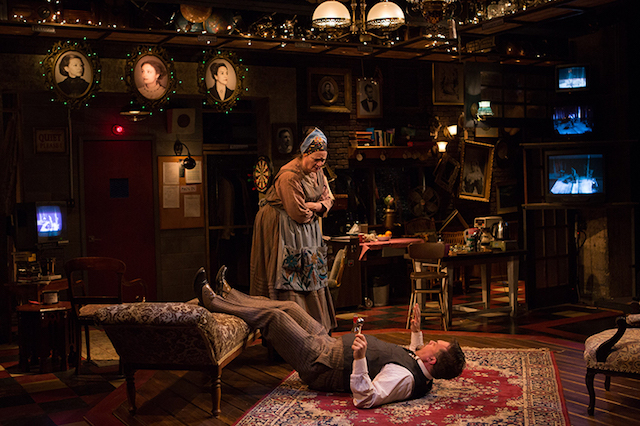 Nancy Robinette and Ryan Rilette in No Sisters as Three Sisters unfolds over the monitors and downstairs. (Photo by Teresa Wood)
One thrill of live theater is the knowledge that, before gracing the stage, actors are waiting in the wings or their dressing rooms in preparation for their big entrance.
But that pleasure is intensified in Studio Theatre’s new take on Three Sisters, where the majority of actors aren’t waiting at all, but are instead rushing up and down the stairs to perform in the world premiere of No Sisters at the very same time.
No Sisters is playwright Aaron Posner’s latest foray into the world of Anton Chekhov, following Stupid F*cking Bird, a stab at The Seagull, and Uncle Vanya adaptation Life Sucks. But it’s the first time that the original play is unfolding simultaneously one floor down.
“I’ve had to build the entire play around who is available to me,” Posner, who also directs No Sisters, says. He compares the process to a cooking competition show “where they say, ‘You have these seven ingredients—good luck.’ I have these characters. I have these themes. I have this amount of time.”
As far as Studio Theatre can tell, this is the first time two such plays—a classic and an original inspired by it—have been performed with the same run-time, sharing an intermission, the bulk of their actors, and even their playbill (which gets flipped to show the other show). The closest is a duo of linked though self-contained plays called House and Garden, which are meant to be staged simultaneously and show the same cast of characters inside and outside the same country estate.
This concept wasn’t always the plan for Posner’s take on the 1901 play about disappointment and longing. Initially, he says, he started working on something about the three eponymous sisters 20 years after the curtain falls. (“Maybe I’ll still write that one,” Posner muses.) It was his wife who suggested a play that happened concurrently, and Studio Theatre decided to take on the challenge, hiring Jackson Gay of New Neighborhood to direct Chekhov’s original.
“It’s just a crazy undertaking,” says Gay, who studied as an undergrad with Posner and has since collaborated with him many times. “Every time Aaron does something in No Sisters, it affects everything.”
The collaborative process between Gay and Posner began with casting the plays. Because Posner is essentially working with whoever isn’t on stage for Gay’s show, the minor characters of Three Sisters become the stars of the action upstairs. That means D.C. luminaries like Nancy Robinette fill small roles downstairs like Anfîsa, the home’s old servant, knowing they have much meatier parts to play when they climb the stairs.
“We decided to start integrating [the two shows] sooner rather than later,” says Gay. To get the performance in their muscle memory, the eight actors in both shows “were already running upstairs to see what it was like, and then running back down.”
The shortest transition for an actor belongs to Biko Eisen-Martin, who plays moody (to say the least) soldier Solyôny. He has “however long it takes to walk up the stairs” in between his exit from Three Sisters and his entrance in No Sisters. He begins his monologue while still ascending, says assistant stage manager Lauren Pekel. (The staircase is slightly uneven too—I tried it.)
She adds that the stage managers are using light and sound cues as back-ups for the actors in case someone is running late. If everything goes right, though, the people attending Three Sisters would watch what’s happening in and around the sisters’ home in a provincial town in Russia as the twentieth century begins, with no inkling of the play underway one floor up.
That’s not the case for those watching No Sisters. The stage is flanked by monitors, so audience members can track what’s unfolding downstairs as they see the action live in what the playbill describes as a “weird-ass existential Chekhovian green room,” which Gay says makes explicit what Chekhov has as subtext.
“The characters in Three Sisters don’t know they’re in a play,” says Posner. “The characters in No Sisters know they’re in two plays and know they have an audience.”
Gay describes it as the characters saying “‘I gotta go, I’m supposed to be on stage’ and then you see them burst onto the stage on the monitor.”
The characters upstairs have a fair amount of interaction with the audience, too. “There’s truly no fourth wall at all,” says Posner. “We didn’t break it—we just never built it.”
For Posner, it’s part of an ongoing fascination with how plays should incorporate the fact they’ve got a live audience. “I’ve spent a shocking amount of my life in dark theaters with people pretending I’m not there. That feels like to me, that you’re throwing away an opportunity,” he says.
But mounting both plays makes even the most rudimentary aspects of directing more complicated. As the Three Sisters began to perform in previews, Gay and Posner were unsure of exactly how to tackle curtain calls.
Still, they say it’s worth it to have the opportunity to have the plays in conversation with one another.
Posner says No Sisters adds a new spin to what he found so stark in Three Sisters: “These strong veins of real striving and hoping and longing, and it just not going well at all, so a lot of broken hearts, a lot of people with big hearts and wanting a lot and hoping for a lot and not getting a lot.”
Gay agrees. Three Sisters is “a play about small tiny moments that, in the end, add up to a whole lifetime,” she says. “When time passes, it doesn’t do so in a quiet, still way. It’s full of craziness and drama and laughing and crying and heartbreak. It’s actually kind of loud.”
So what’s the recommended order for seeing the plays with and without sisters? Audiences “should just spend their life ping-ponging between the two plays,” Posner jokes. “If people don’t know Three Sisters very well. I do believe at this point its probably better to see Three Sisters first, though I don’t know if that’s right. Each one talks to the other in really interesting ways.”
Three Sisters and No Sisters run through April 23 at Studio Theatre. Tickets are available here.