Rachel Kurzius
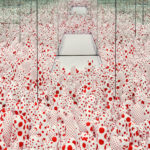
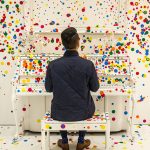
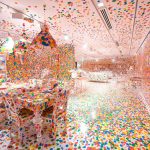
The first inkling that the Yayoi Kusama tickets would be a hot commodity is the fact that the Hirshhorn issued the timed passes to begin with. Following in the footsteps of the Smithsonian’s National Museum of African American History and Culture, which has released tickets for visitors since its opening, the immersive installations from the Japanese artist require passes for entry to allow for some one-on-one time between the viewer and the exhibit. Every Monday at noon, the Hirshhorn website makes a new batch available for the following week, which get gobbled up within minutes. This past Monday, for instance, 57,000 people tried to score 6,000 tickets, which were claimed within two minutes. The Hirshhorn is tweaking the ticketing, but the record-setting crowds remain. So if you’ve got slow fingers or bad luck, we’ve compiled ways to ape different aspects of the Kusama experience without the record-setting crowds or potential for art-damaging selfies.
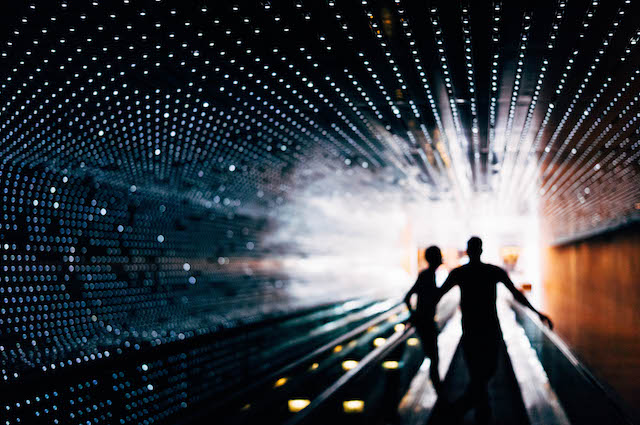 Multiverse at the National Gallery of Art. (Photo by David Nagy)
NATIONAL GALLERY OF ART LIGHT TUNNEL: Have your social media feeds been inundated with selfies of people in the light-filled rooms, as if Mirror Master did a lot of speed before putting up the Christmas decorations? If you want a similar shot, minus the many selves reflected back, head to the Leo Villareal-designed light tunnel that connects the East and West Buildings of the National Gallery of Art. Called Multiverse, the light sculpture boats around 41,000 computer-programmed LED nodes in the underground walkway. Imagine one of those carrier belts at an airport, only instead, it’s in a sexy space station of the future. Now pose.
The National Gallery of Art is located at 6th & Constitution Ave NW
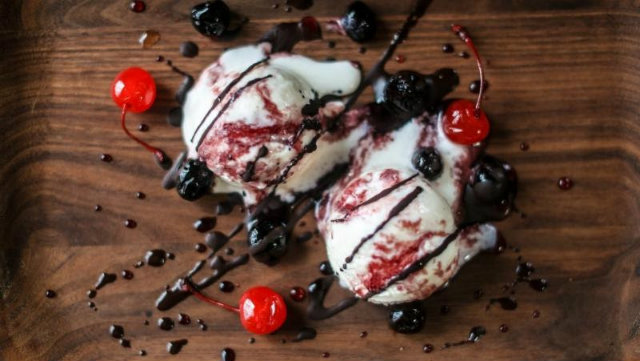 Photo courtesy of Dolcezza
KUSAMA-THEMED GELATO: Coffee and gelato purveyor Dolcezza has a pop-up operating in the Hirshhorn, but you don’t have to see all those lucky ticketholders in order to score some Kumama-themed frozen treats. Inspired by both the artist and the cherry blossoms, the new flavor is vanilla gelato with chocolate flakes, a triple-cherry swirl with luxardo, and amaretto-spiced cherries. It’s available at the region’s nine shops and markets through May 14, when the exhibit closes. It’ll take longer for the gelato to melt than you’ll get to spend in any of the individual infinity rooms, anyway, so you can ponder the fleeting nature of existence and ice cream as you eat it.
Dolcezza has multiple locations in the area.
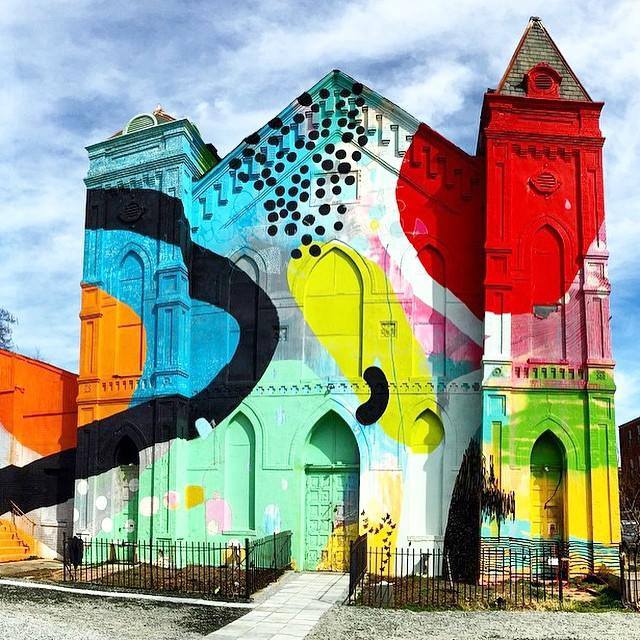 Blind Whino. Photo via Facebook.
BLIND WHINO: The home of the SW Arts Club puts new faith in an old, formerly abandoned Baptist church building, covering it in bright, swirling murals. Beyond the striking exterior, it’s totally free to meander inside and check out galleries and works of some 1,200 artists from around the globe. Plus, the interior belies a great event space, with an avant-garde touch that would make Kusama feel right at home.
Blind Whino is located at 700 Delaware Avenue SW.
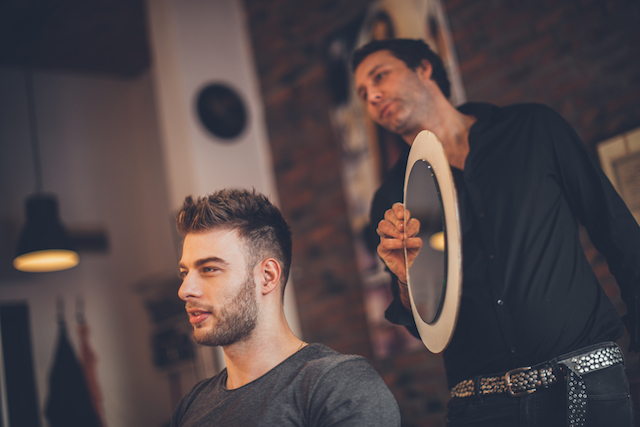 Image via Shutterstock.
GET A HAIRCUT You know the part at the end of a haircut when the barber/stylist swivels around the chair and holds up a smaller mirror so that you can see what they’ve done with the back of your head? Well, that experience just happens to mimic the sensation of a Kusama infinity room. Another benefit: there’s something to look forward to after the scalp massage. (Bargain bonus tip—you can try this at home! Hold up a mirror to another mirror and presto! You’re in an infinity room of your own creation!)
Here’s our list of the best hair salons and barbershops in D.C.
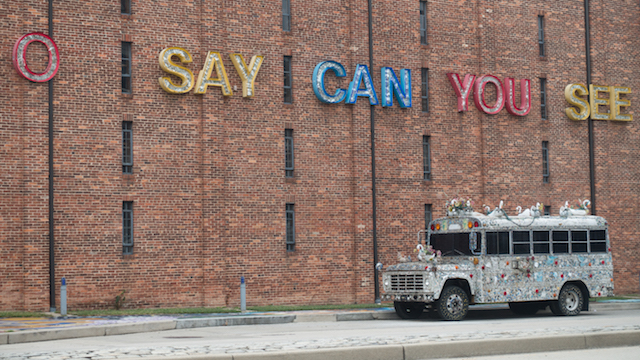 The exterior of the American Visionary Art Museum. (Photo by John Sonderman)
AMERICAN VISIONARY ARTS MUSEUM: To be clear, Yayoi Kusama isn’t entirely a self-taught artist (she trained in Nihonga, a Japanese style of painting) and she has certainly been welcomed by the art world, but I defy you to read this description from the Baltimore museum and not think about Kusama’s repetitive, eccentric, deeply personal, self-obliterating work: “Visionary art as defined for the purposes of the American Visionary Art Museum refers to art produced by self-taught individuals, usually without formal training, whose works arise from an innate personal vision that revels foremost in the creative act itself. In short, visionary art begins by listening to the inner voices of the soul, and often may not even be thought of as ‘art’ by its creator.” If you’re really in it for Kusama’s imaginative art, as opposed to the admittedly awesome Instagram opportunities, hop on MARC and spend the afternoon at the eclectic American Visionary Art Museum. You’ll find works by plenty of kindred spirits.—Rachel Sadon
The American Visionary Art Museum is located at 800 Key Hwy in Baltimore, Md.
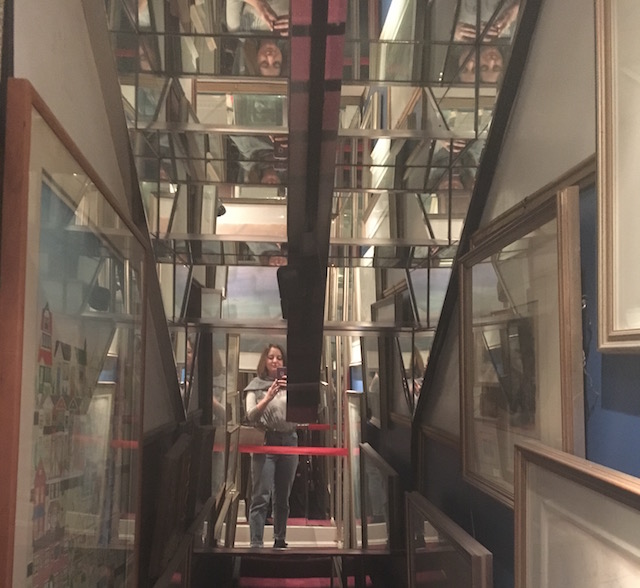 A staircase only accessible through one of The Mansion On O’s secret doors. (Photo by Rachel Kurzius)
MANSION ON O STREET: Kusama is known for her “kaleidoscopic environments,” many of which are on display at the Hirshhorn. But The Mansion on O Street, where a series of “secret” doors and passageways connect five Dupont rowhouses, features its own versions of a kaleidoscope … if you can find them. The rooms are stuffed with all manner of knickknacks and collectibles (for sale, incidentally), sometimes themed like a log cabin, other times with huge, elegant chandeliers. You might even find a guitar signed by Vanilla Ice. In a similarly immersive way, visitors are invited to find the secret doors, hidden behind mirrors, bookshelves, and more. They could lead to a room filled entirely with dolls or a staircase to a new wing encased in mirrors. It’s like a dusty kaleidoscope you’d find in an old relative’s attic, and boy is it pretty when you hold it up and shake it.
The Mansion on O Street is located at 2020 O Street NW.
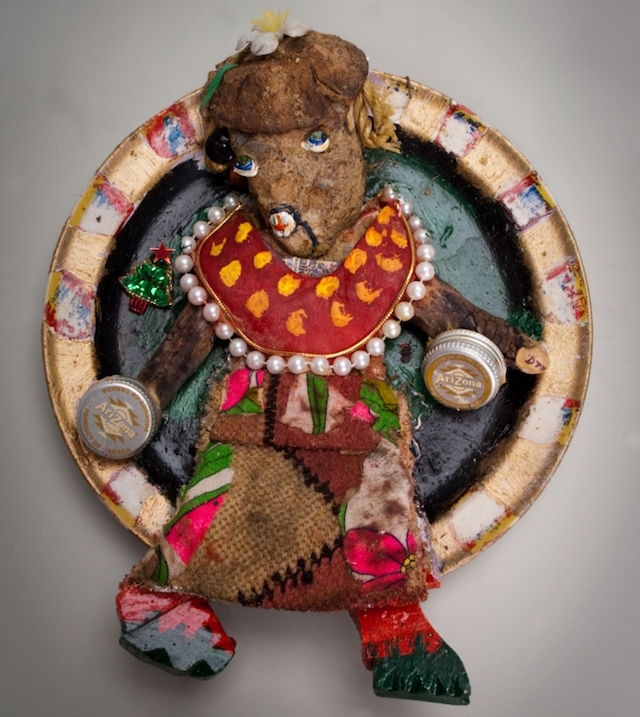 “Plate Lady” by Derek Webster. (Photo by Susana Raab / Smithsonian Anacostia Community Museum)
ANACOSTIA COMMUNITY MUSEUM: This Smithsonian spot is not on the National Mall, which makes it one of the institution’s lesser visited locations. People who do come to the Anacostia Community Museum find thoughtful exhibits about American urban experiences. Our critic said that Kusama achieves “a strange balance between whimsy and discomfort,” a sensation shared in “The Backyard of Derek Webster’s Imagination,” one exhibit on display until April 23. The self-taught Webster turns basic objects into people, monsters, and totems, decorating the whimsical sculptures with house paint and costume jewelry.
The Anacostia Community Museum is located at 1901 Fort Place SE.
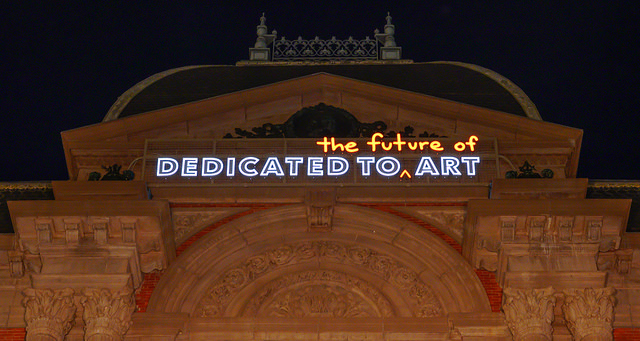 Photo by Victoria Pickering.
RENWICK GALLERY: Remember when the newly renovated Renwick, rather than the Hirshhorn, was the Smithsonian-helmed institute with record-breaking crowds? While the exhibit WONDER, which enticed folks to wait on lines that curved around the block, has closed, the gallery is displaying items from its permanent collection that elevate the notion of “craft.” It’s also putting the spotlight on a pioneering female artist who broke all the rules when it came to enameling. The retrospective of June Schwarcz features nearly 60 of her works, ranging from 3D objects to wall-mounted plaques.
The Renwick Gallery is located at 1661 Pennsylvania Ave NW.
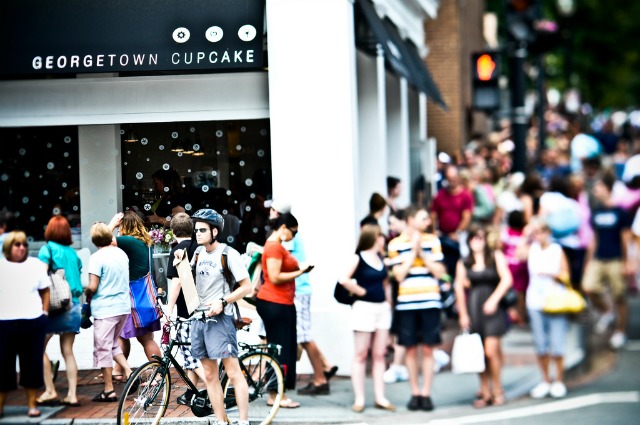 Photo by Chris Rief
OTHER LINES AWAIT: They say that the journey is better than the destination, and, in that vein, perhaps the feeling of anticipation while waiting to enter each Kusama room tops even being in the room. You don’t have to limit that thrill to the Hirshhorn! D.C. is filled with places where people willingly wait for hours on line for a chance to say they did something. Give Rose’s Luxury, Georgetown Cupcake, Bad Saint, or the cherry blossom pop-up bar on 7th a try (bribes won’t work). If you enjoy standing in place for a while, then moving up a foot or so before waiting a little more, you’ve got some serious options!
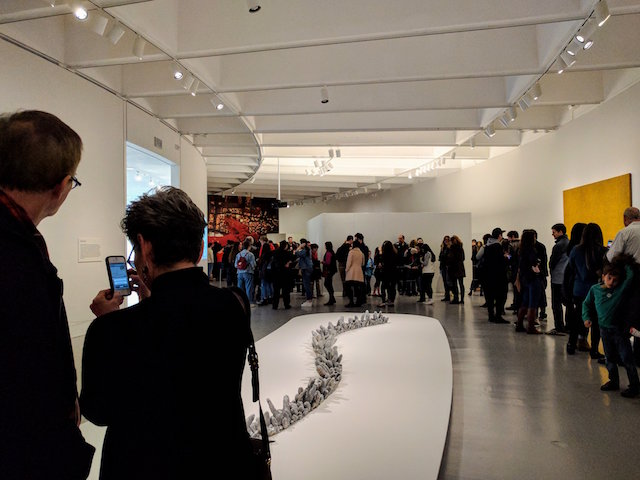 The line to get into the Kusama exhibit at the Hirshhorn. (Photo by jl22205)
BUT I WANT KUSAMA! Fine, fine. The only way to really satisfy a Kusama fix is to, well, see the exhibit. Here are some tips, via the Hirshhorn’s Alison Peck, about how to score tickets, specifically the walk-up passes that have become a larger part of the museum’s plan for managing visitors. Now, hundreds are available on the day of. (The only real tip for getting online passes is to use a computer with a fast internet connection.)
- Mondays, Tuesdays, and Wednesdays are best for free walk-up passes
- Distribution for walk-up passes begins at 10 a.m., though on some mornings people line up as early at 7 a.m.
- Wednesday evenings have extended hours, through 8 p.m., with passes available both online and at the door