Rachel Kurzius
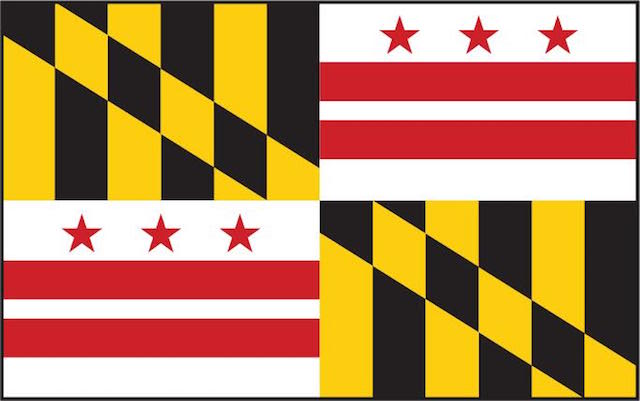 David Krucoff says that this mock-up wouldn’t have to be the flag for Douglass County, Md., which could retain the D.C. flag. (Image courtesy of David Krucoff)
Ask David Krucoff about D.C. statehood and he’ll tell you he’s all for it. But what he imagines is different than what Washingtonians saw on the ballot in November.
There wouldn’t be two new senators, or a transformation of the mayor into a governor. No 51st star on the U.S. flag, either. Instead, as far as vexillology goes, Krucoff sees the union of D.C.’s red and white bars and stars with the heraldic banner of Lord Baltimore.
Meet Douglass County, Maryland: Krucoff’s vision for how D.C. residents could score representation in the halls of Congress.
He says his solution is “obviously more feasible than the 51st state. Why not take something that can be achieved and let go something that is not going anywhere?”
Right now, residents of D.C. don’t have a voting member of the House or Senate, and bills passed by the city must pass a congressional review before they become law. Despite the fact that D.C. pays more taxes than 22 states and has a larger population than two, members of Congress from other jurisdictions often try to change D.C. policies through laws and budgets.
“It’s appalling that this condition exists and I’m here to change it,” says Krucoff, a real estate executive and third generation Washingtonian. He believes that turning most of D.C. into Maryland’s newest county would be a win-win for both the District and the Old Line State.
“For D.C., you get a congressperson, you get to have senators, and you get to have home rule—you get everything you want,” he says. “The gain for residents of the state of Maryland is a little bit tougher, but not too tough. D.C. is a $45 billion economy. Why would you not want to have these things within the confines of your state?”
Another benefit, he says, would be that D.C. could shrink the size of its local government. “The DMV is a perfect example. There’s a Maryland DMV and a D.C. DMV. Guess what? Now we only have to have one DMV,” he says, before clarifying, “I’m not trying to take jobs away from people who work in the city. I’m trying to give people in D.C. their rights.”
Krucoff is the president of the Douglass County, Md. non-profit, which is currently focused on grassroots organizing. He describes his efforts as talking to people to “just provide awareness of a solution that could easily be affected” to lay the groundwork for “more direct engagement with political process in the future.” Just like if it were to become its own state, the county would be named after abolitionist and D.C. resident Frederick Douglass.
Retrocession isn’t a new idea. Indeed, the District of Columbia was cobbled together with land from Virginia and Maryland in 1790. The people white men who lived in the federal district were able to vote for a congressional representative in either Maryland or Virginia (depending which state the place they lived used to be in) until the Organic Act of 1801.
Then, about half of that land—Arlington County and parts of Alexandria—was returned to the commonwealth in 1846, motivated in great part by the growing movement in D.C. to ban slavery. The U.S. Congress passed legislation to return the land to Virginia, which was transferred after a referendum. All of the people who live there today enjoy full representation.
The idea of doing that dance again got some renewed attention when House Oversight Committee Chair Jason Chaffetz (R-UT) said last month that he was “exploring” having the residential portions of D.C. annexed by Maryland. (His office has not responded to requests for comment about how that exploration is going.)
D.C. Delegate Eleanor Holmes Norton scoffed at the idea, saying that more than 80 percent of voting Washingtonians already chimed in by approving a plan to make D.C. the “State of Washington, Douglass Commonwealth,” with two senators and one House member.
“It is clear that residents want to become their own state rather than be adopted by Maryland, whose residents and officials have never indicated support for retrocession,” Norton said over email. “D.C. has a better chance of becoming the 51st state than convincing Maryland, which has only one large city, to have another.”
A PPP poll from last April found that 28 percent of Marylanders supported annexing D.C., compared to 44 percent who opposed the idea.
Mayor Muriel Bowser, who pushed to get statehood on the ballot in November, is “100 percent opposed to the idea of Washington D.C. becoming a part of Maryland in order to secure the same rights that are afforded to all other Americans,” according to Kevin Harris, her director of communications. “Suggesting we join Maryland or any other state as a condition for equal rights is insulting to the hardworking residents of the District.”
Krucoff, who moved to Bethesda so his son could access better special education opportunities and plans to move back to D.C. this summer, is used to hearing politicians poo-poo his idea. While he says 51st statehood would be “fantastic,” he still gets audibly frustrated about how the idea dominates discussions of D.C. voting rights.
For instance, he called a 2014 Senate hearing on statehood “the most appalling piece of garbage hearing I’ve ever seen in my life. It was disgusting to see these smart people from all over the District, these people who have law degrees and know things better than me, not mention anything else but the 51st state.” (Retrocession did get a fleeting mention from a Cato Institute scholar who opposes statehood.)
Currently, there are partner bills in the House and Senate to admit the State of Washington, Douglass Commonwealth “into the Union on an equal footing with the other States in all respects whatever,” but even when they were introduced, District politicians acknowledged their slim chances of passage.
One major issue for D.C.’s statehood bid is how it’s seen through a partisan lens, rather than as a voting rights issue. For a city that went 90 percent for Hillary Clinton and whose Democratic primaries are more important than Election Day, Republicans view the possibility of D.C. senate seats as more opportunities for blue legislators. “It would mean “more votes in the Democratic Party,” Ohio Governor John Kasich said to explain his opposition to statehood. (Krucoff adds another concern—”102 [senators] is a strange number.”)
But it seems unlikely that Republican officials in Maryland, like Governor Larry Hogan, for instance, would want the infusion of so many Democrats, either.
Krucoff describes his own politics as “economically conservative, and socially liberal, like most people if you really get down to it. At least, most people I know.”
He focuses most of his ire on District politicians who he thinks only oppose his solution because it means they’d have to admit defeat in their struggle. “In the end, this is more about them than it is about their constituents, and that’s the way it is for most politicians, unfortunately,” he says. “That’s not the way it is for me. It could be, maybe, but we’ll see.”
So does that mean Krucoff’s retrocession plan is a way for him to launch his own political career? “I’m not going to comment on that at this point,” he says.