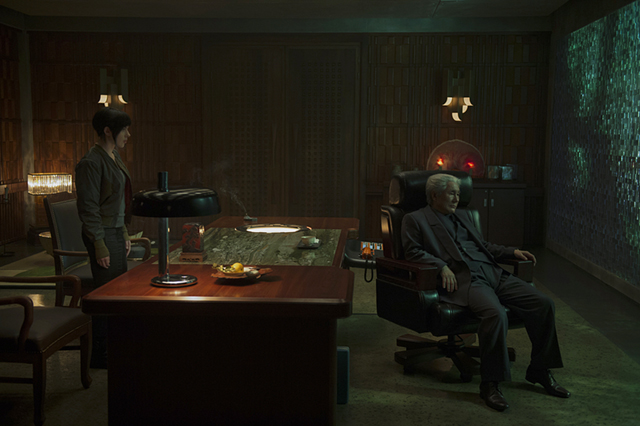
 “Yeah, it makes me sleepy too.” Scarlett Johansson and “Beat” Takeshi Kitano (Paramount)
Director Rupert Sanders’ adaptation of the popular Japanese manga Ghost in the Shell was not previewed for critics. This is not always a bad sign, but in this case, there was good reason.
When director Mamoru Oshii’s animated adaptation was released in 1995, the cyberpunk dystopia predicted by Blade Runner in 1982 still seemed like the distant future. Computers were prevalent in the world of 1995, but ordinary people had yet to carry around powerful computers in their pockets. The anime vision of a stark technological future seemed prescient.
In 2017, that future looks like old hat, with robots. Frankly, that viral video of a little girl mistaking a discarded water heater for a robot is more entertaining, and a more chilling commentary on humanity’s willingness to embrace our cold technological overlords.
In a world where human brains can be transplanted into synthetic bodies, Major (Scarlett Johansson) survived a car crash and emerged as a cybernetic soldier, ready to be dispatched for the efficient elimination of criminals, wearing nothing but a skin-tight white body suit. (The body suit tones down the 1995 anime version of this material, which couched its quasi-metaphysics in pure adolescent male fantasy: a tough robotic woman who’s defiantly naked through much of the film and endures violence to the point of dismemberment and beheading.)
Major does what she’s programmed to do, but she’s haunted by the vision of pixelated glitches which suggest a past that she no longer remembers. Much like you will no longer remember the movie next week.
While stiff performances seem de rigeur in a movie populated by technologically enhanced semi-humans, one wishes something, anything would click. As much as I love “Beat” Takeshi Kitano, who has starred in and directed some impressively violent movies in his time, his deadpan presence doesn’t quite work amid the chaos. But fans of his work will be happy to know that he still has that air of repressed rage ready to explode, and when it inevitably does he provides one of the film’s few sparks.
Unfortunately, much of the film is talky and ponderous. While it’s only 25 minutes longer than the 1995 film, it seems easily twice as long. Part of the problem may be that what seemed cool and exciting in 1995 doesn’t pack the same punch more than 20 years later.
One of the key lines in the 1995 film comes from Corinthians: “When I was a child, my speech, feelings, and thinking were all those of a child; now that I am a man, I have no more use for childish ways.” Tellingly, the line is nowhere to be found in this latest Shell, replaced with something less resonant about not being defined by our memories but by our actions. Fine; you probably won’t want to define yourself by seeing this movie, and if you have seen it its memory will soon fade.
—
Ghost in the Shell
Directed by Rupert Sanders
Written by Jamie Moss, William Wheeler, and Ehren Kruger, based on the manga by Masamune Shirow
With Scarlett Johansson, “Beat” Takeshi Kitano, Juliette Binoche
Rated PG-13 for intense sequences of sci-fi violence, suggestive content and some disturbing images
Opens today at area theaters.