 Rachel Sadon
(!) #WMATA is breaking the cardinal rule of Brutalism by painting the vault at Union Station. pic.twitter.com/P6vhQho8wE
— Matt’ Johnson, AICP (@Tracktwentynine) March 28, 2017
For all the tweets grousing about Metro that get sent out in any given week, it was one about white paint that set off a citywide conversation that is still going on days later.
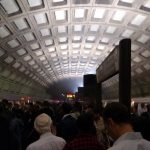
A transportation planner noticed that the Union Station vault was like a split screen, with fresh white counterposed by dirty beige—the result of years of grime on otherwise virgin concrete. Shortly thereafter, there were sober explanations counterposed by stories with headlines like Keep Metro Bleak! and Why Painting the Union Station Metro Cheapens an Architectural Masterpiece. Now the U.S. Commission on Fine Arts and the local chapter of the American Institute of Architects have also weighed in.
“We are concerned that the work, however well-intentioned, creates a substantial change to the architectural character of this exemplary transit system,” Thomas Luebke, secretary of the U.S. Commission of Fine Arts, wrote in a letter to WMATA on Friday.
That character, specifically, is Brutalist, and it’s merit is one of the city’s most polarizing topics (which is really saying something). In addition to hulking masses, one of the architectural style’s most fundamental tenets is keeping surface materials raw; indeed, the name is derived from the French for raw concrete.
“Covering up the surface of the concrete warps a fundamental principle of this design philosophy,” writes Amanda Kolson Hurley in the Washington City Paper. “There can be no doubt that whitewashing is hostile to [Harry] Weese’s design and the ambience he created inside stations.”
The D.C. chapter AIA echoed the complaint in a letter on Friday and focused in on other more quotidian concerns: “By painting the concrete, every stain or flaw will show,” the group’s president and executive director write, echoing a complaint from one of the station’s original designers that the paint will only serve to highlight future wear and tear.
“You’re going to see every little problem in the future,” Bill Gallagher told CityLab. “Especially this station. It’s going to be filthy within weeks.”
In an email to DCist, Metro spokesman Dan Stessel counters that “if anything, [paint] makes removal of dirt easier.”
For artist Sam Husseini, that’s exactly the problem.
“Nature asserts itself and we keep pretending that it doesn’t,” he says. “I certainly understand keeping the structural integrity of the trains, but there’s this wanting to cover up the fact of nature, and it’s childish. It’s a way of pretending that you control things that you don’t or can’t.”
He’s found such beauty in the striations and growth on the walls that he undertook a personal photography project to document them about a decade ago, calling it “Concrete Expressionism.”
In the abstractions on Metro’s walls, he sees shades of the works of Sam Gilliam, Joseph Turner, and Clyfford Still. The Mt. Vernon station particularly reminds him of Rothko’s Chapel. “The walls are beautiful,” he says. “People should actually look at them.”
“I like to see the world for what it is, and if everywhere that I go it is covered up, that’s a sanitized non-reality,” he says. “Just walking though downtown D.C., I go to the office and the architecture is all facade. The people drop bubblegum on the street and that can’t stay—they’ve got people scraping off the bubble gum every two weeks.”
But whereas Husseini finds beauty in the breakdown, many Metro customers are siding with the transit agency. Nearly 60 percent of people who responded to a Washington Post poll said that they favored painting the stations.
According to Stessel, brightening the stations is a “top priority” for customers, and power washing alone doesn’t do much to that effect. In addition to the paint job, which will remain ongoing for a few weeks despite the brouhaha, WMATA also added new lighting to the station.
Though they do it infrequently, this is hardly the first time that a Metro station has gotten a coat of paint. But when asked if the transit agency was surprised at the outrcy, Stessel responded, “No, we understand that there are differences of opinion” and diplomatically left it at that.
AIA DC Response to Metro Paint by RachelSadon on Scribd