Rachel Kurzius
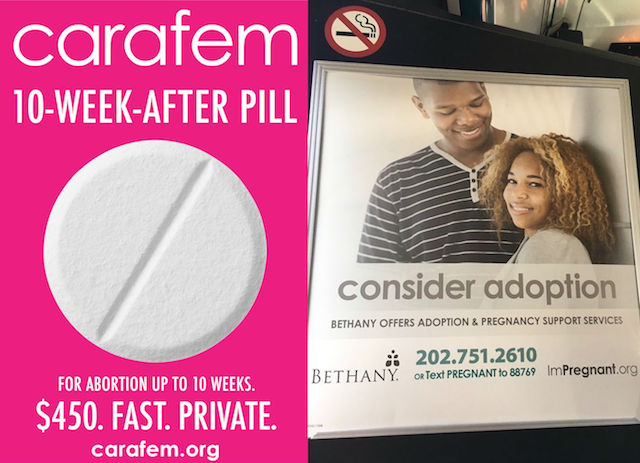 Left: Carafem ad rejected by Metro (Image courtesy of Carafem), Right: Bethany ad spotted on 79 bus (Photo by Michela Masson)
Metro acknowledges a mistake was made in posting advertisements for a faith-based adoption services on WMATA buses, after rejecting advertisements for an abortion pill from Carafem, a local women’s health clinic.
Metro rider and Carafem advocate Michela Masson saw an ad that said “Consider adoption” on the 79 bus over the weekend. The ad was for Bethany Christian Services, a global nonprofit that pledges to “equip families to be the answer for children in need—as Christ intended.”
Now, Metro says its third-party vendor screwed up in posting the ad for Bethany, which “does not meet Metro’s advertising standards,” according to spokesperson Richard Jordan.
“The ads were mistakenly installed on buses by the contractor about a week ago,” says Jordan, and the contractor has been instructed to remove them from display. The campaign featured 125 posters that appeared on WMATA buses. He declined to say how much the campaign cost, calling it confidential and proprietary.
Bethany Christian Services is based in Michigan, and has locations in D.C. and Fairfax. Representatives did not return requests for comment about its advertising campaign with WMATA.
The ads violate one of the same guidelines that befell Friendship Heights clinic Carafem when it sought a $23,520 ad campaign for the “10-Week-After Pill” in December. The advertisement called the pill “$450. Fast. Private.” Like another Carafem ad campaign, which ran at Metro stations in 2015, the text was atop a bright pink background.
“It’s part of our ongoing effort to normalize the message about abortion services and advertise them as physicians would advertise any other medical services,” says Melissa Grant, vice president of Carafem.
Metro denied the second round of ads through its vendor, OutFront Media, citing two guidelines. One of them, Guideline 4, only allows medical statements provided or approved by government health organizations. Carafem’s description of the abortion pill as “fast” is what ran them afoul of that guideline.
It’s the other guideline that’s a bit stickier. “The ad attempts to influence members of the public regarding an issue on which there are varying opinions, which is a violation of WMATA Commercial Advertising Guideline 9,” Metro spokesperson Sherri Ly said in January.
The earlier Carafem campaign, which ran ads in Metro that said, “ABORTION. Yeah, we do that,” was approved in error, according to Ly.
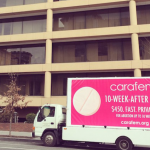
Carafem has still been able to advertise on bus shelters, which are owned by the city rather than WMATA, and hired a truck to ride around D.C. with the original ad on a billboard, along with the words “Banned By Metro! See the abortion pill ad Carafem wasn’t allowed to run.”
Metro permanently changed its advertising policy in November 2015 to close “WMATA’s commercial advertising space to any and all issue-oriented advertisements, including, but not limited to, political, religious, and advocacy advertising.”
The change came shortly after Islamophobic activist Pamela Geller, who submitted an ad that depicted an image of the prophet Muhammad. Geller was no stranger to WMATA—she was awarded $35,000 from the transit agency after a federal judge ordered that they could not refuse posting advertisements that equated Muslims with savages, and her previous ads prompted WMATA to add disclaimers.
But what exactly makes an advertisement “issue-based”? Are weapons systems, like those advertised at stations like Capitol South and Pentagon City, “an issue on which there are varying opinions”? Metro’s general counsel makes the final determinations as to which ads make the cut for a cash-strapped system that generates about $20 million annually through advertisement revenue.
In the case of Carafem’s ad, a letter from Donna Murray, Metro’s manager of advertising and marketing, said that, “because your ad addresses the controversial topic of abortion and promotes a particular abortion product, it is issue-oriented.”
In a letter from its lawyers, Carafem responded that “By deciding which health-related products and services are ‘controversial’ and which are not, Metro has run afoul of the most basic tenet of the First Amendment.” The clinic requested that the Metro Board reverse the decision.
WMATA declined to do so. “WMATA’s new policy barring issue-oriented advertising is viewpoint neutral,” general counsel Patricia Y. Lee wrote in a letter to Carafem. “WMATA does not make any distinctions among potential messages or messengers, because it has created a blanket exclusion for issue-oriented advertising.”
Seeing the Bethany ads on buses made Carafem further question whether Metro was employing blanket exclusion. “Obviously the message is strongly targeting women who are facing unintended pregnancies with the idea of pursuing adoption,” said Grant of Carafem.
Turns out, Metro agrees. “The ad was not submitted to Metro for review prior to being displayed,” says Jordan. “Metro’s Office of General Counsel has since determined that the ad does not comply to current guidelines.”
Grant would have preferred that Metro allow both sets of ads rather than deny them. “Adoption and abortion are both legitimate healthcare needs for women,” she says. “I don’t think either one is overly controversial. They’re both just basic needs in the lives of women.”