Rachel Kurzius
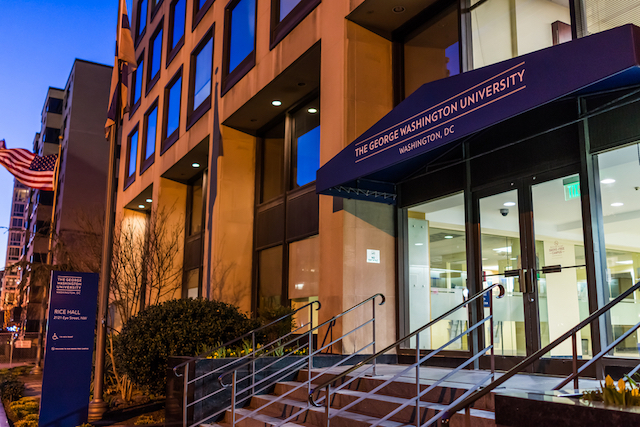 Image via Shutterstock.
A student at George Washington University is demanding changes to the way the school handles sexual assault cases after she experienced a frustrating process that ended with a sentence for her assailant that she believes is far too lenient.
Aniqa Raihan, a senior at GW, says she was sexually assaulted in the spring of her freshman year at an on-campus dorm by a fellow student she considered a friend at the time. She reported the incident to the school in the fall of 2016, kicking off a hearings process that ended last month when her assailant was determined to have violated the Student Code of Conduct by committing an act of sexual violence.
His punishment leaves him ineligible to seek on-campus or university-owned housing, makes him a “persona non grata” at all residence halls, and requires meetings with the school’s Title IX coordinator. But his suspension is deferred, meaning he will graduate this spring as long as he isn’t found violating university policy for the remainder of his time as a student.
“For GW to know and acknowledge that there is a rapist on campus and they’re going to do nothing about it—it’s infuriating,” Raihan says. “I’m just so angry at GW for failing me like that.”
Now, Raihan has launched a petition with series of demands: the immediate expulsion of her assaulter; the implementation of mandatory suspensions for students found responsible for acts of sexual violence, weekly updates for survivors during the reporting and judicial process, a commitment to passing judgement on sexual violence cases in two months or less, and a separate appellate board for appeals (while GW allows for an appeals process for a hearing’s outcome, it does not include one for the punishments).
The petition, first reported by The GW Hatchet, launched on Sunday and, less than a week later, has more than 1,550 signatures.
While GW declined to comment on this specific incident, citing respect and concern for the privacy of those involved, university spokesperson Maralee Csellar says the school ” is working hard to create a university culture in which every member of our community understands that sexual misconduct and sexual violence is unacceptable. The university is also committed to fully supporting survivors of such acts and treating appropriately those who are found to have committed them.”
A campus climate survey released in early 2015 found that 22 percent of GW undergrads had first-hand experience with unwanted sexual behavior at GW. Only 10 percent of undergrads said they reported improper behavior towards themselves, 35 percent of whom said that the university did not adequately respond.
Raihan says that since she’s come forward with the petition, four other students have gotten in touch with her privately and told her that her alleged assaulter also abused them. “There’s no reason that this guy should be able to be on campus and be able to graduate from a top tier university,” she says. In addition for calling for his immediate suspension, she’s also planning an email campaign to get him terminated from his on campus job.
Csellar, GW’s spokesperson, says that the university does not have mandatory minimums in its Code of Student Conduct, and “each case is reviewed on its own merit based on available information at the time of the hearing.”
But even before the verdict came down, Raihan was frustrated with a process she describes as “invasive and uncomfortable and difficult” and says her experience “exposed all these loopholes” in the process.
Specifically, she notes the more than three months between the end of the hearing and when she heard the verdict. “In those 95 days, no one ever once reached out to me, not even to check in on me,” Raihan says. “Someone checked in with him monthly but no one checked in with me.” Her petition asks for weekly updates. “Even if there is no update, even if it’s just checking in, to know where the process is at,” she says.
Additionally, the petition calls for judgments within two months, following the recommendations (though not binding regulations) of the Title IX guidelines from the U.S. Department of Education.
She says she spoke with four separate lawyers and the members of the university’s chapter of Students Against Sexual Assault before publishing the petition.
“These are specific asks that would make not only my case, but the whole process, better for other survivors,” she says.
The attention from the petition led to a meeting between Raihan and Peter Konwerski, the GW dean of student affairs, though she said it did not result in any concrete promises to meet the petition’s demands.
GW, like many universities nationwide, has sought in the past few years to more adequately address instances of sexual assault on campus, including a formal reassessment of its policies. The school faced a federal lawsuit in 2015 alleging it violated Title IX by failing to help a student harassed, stalked, and assaulted by a peer.