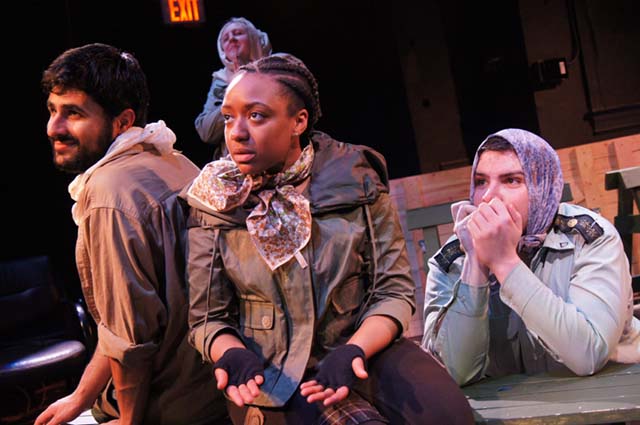
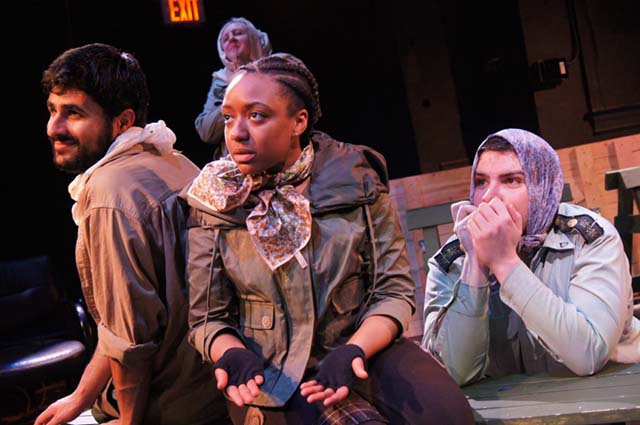
 Niusha Nawab, Wyckham Avery, Natasha Gallop, Robert Pike (Tori Boutin)
Hamilton. Othello. Matilda. Oliver! Buy a ticket to one of these plays and you can expect a storyline centered on the name splashed across your program—usually. In its latest production, D.C. theater company We Happy Few takes Shakespeare’s history play Henry V and turns the spotlight away from the man sending soldiers to war, focusing instead on the people fighting it.
“So much of the play is obviously Henry’s story when you see it in full,” says Artistic Director Raven Bonniwell, “And we wanted to draw on how war and leadership affected the people and not just the leader.”
This unusual approach required research into not only veterans’ experiences, but also the class relationships at play in English society.
“Other works use the perspective of the soldiers,” says director Kerry McGee, but that’s not something that gets done with [Henry V] a lot, so the responsibility feels heavier,” she says. “It’s not like if we mess it up someone’s doing it next week.”
That focus on accuracy drove McGee and dramaturg Keith Hock to seek out conversations with veterans and books on war, class, and the punk movement of the 1970s—a style choice in this show that highlights the attitude of a beleaguered working class.
“Class is a huge deal in England and it has been for hundreds of years,” Hock says. He explains that class is to England as race is to America, in the way that “things that are blamed on race [in the U. S.] are the things that get blamed on class and background in England.”
The production creates clear lines between the ruling class, the middle class of career military leaders like by-the-book Captain Fluellen (Bonniwell), and the lower class of soldiers who McGee calls “the merry pranksters.” Each group interacts with and responds to war differently. “There’s a lot of glory at the top of the class and a lot of work ethic in the middle and then just this resigned need to be there” at the bottom, McGee says.
“We do land on this idea that the people understand, the lower class especially, understands that this is not a war for them,” Hock says. “They may profit by it—Pistol certainly is profiting by it, or would have—but this is not a war that they are especially keen to fight.”
Bonniwell clarifies that it’s not necessarily an anti-war play. “In this play and in this version, some of your favorite characters that you’re following are going to die,” she says. “Whether it’s just or not is totally a matter of how you look at it.”
It’s taken We Happy Few five years to produce the play that provided its name, but Bonniwell says the timing is right for Henry V. “We feel like it’s a play that really speaks to the current political situation with a cyclical nature of war and what it means to be a leader, what it means to follow this one person, and what that does to the common man,” she says.
“This was a story we wanted to tell before the election, but as the election came out certain things became very clear,” McGee says, adding that an election night statement by none other than Glenn Beck struck a chord with her as she worked on the play. “He had the most sane thing to say that night, and it was about how the leadership in America had lost touch with what the people wanted.”
McGee says she wants audience members to ask themselves if what’s good for the whole is good for the individual. “In addition to asking themselves what is the cost of war, I’d like for them to think about the questions,” she says. “What is our responsibility to each other in times of turmoil or distress, and are our leaders responsible for looking out for the good of our nation or the individuals that comprise it?”
Audience members who leave seeking a deeper connection to the individuals who serve in modern-day battles might pay a visit to the National Portrait Gallery. A new exhibit called The Face of Battle: Americans at War, 9/11 to Now features portraits in a range of media, including video, drawing, and photography, all of which personalize the experience and toll of war.
Henry V runs through April 29th at Capitol Hill Arts Workshop. Buy tickets here.