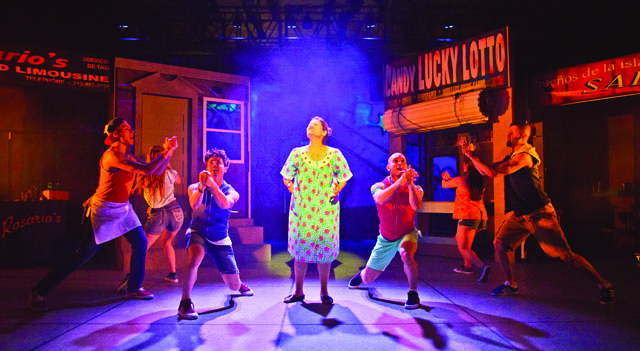
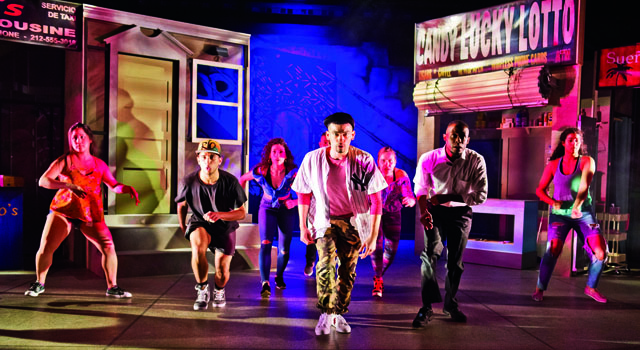
 Ximena Salgado, Rafael Beato, Gabriella Pérez, Juan Luis Espinal, Scheherazade Quiroga, Vaughn Ryan Midder, Melinette Pallares (Stan Weinstein)
By DCist contributor Leigh Giangreco
It’s a golden spring day in the Heights, where a man is selling 16 flavors of ice just outside a pupuseria. Inside the petite restaurant, the clinking sounds of glass Coke bottles mingle over a soccer match playing on television, as portraits of Jesus and Pope Francis stare down at a man eating beef soup. The diminutive pupuseria is dwarfed by an encroaching army of shiny condos. In the summer, ladies sell spicy mangoes in the shadow of a Target complex. The Central American bakery up the road now shares the block with a French patisserie. As rents go up, small businesses are ceding their way to Giants.
Welcome to Columbia Heights, Washington, D.C. Or maybe it’s Washington Heights, NYC? The lines seem to blur when it comes to the story of a largely Latino neighborhood threatened by gentrification. This week, GALA Theatre stages the Spanish U.S. premiere of Lin-Manuel Miranda’s musical, In the Heights. It tells a story of gentrification about a New York neighborhood—but it could equally apply to the neighborhood around GALA.
In Miranda’s Washington Heights, a Dominican neighborhood just north of upper Manhattan, longtime residents struggle with the everyday problems of paying for school, rent, and their businesses as their neighbors pack up and move to cheaper pastures. Besides changing the language from the original, GALA has injected a more multicultural flavor to its production with references to El Salvador and Mexico to reflect the local community, says GALA’s co-founder and producer, Hugo Medrano.
Medrano has lived in the Mt. Pleasant area since 1971 and found Miranda’s narrative resonated for many of his neighbors. While some of the shows’ characters rejoice in leaving the area, others resent the intrusion of newcomers, he says.
“They want to still be in the barrio with all the ambiance of the barrio, all the people, the little stores,” he says. For Medrano, the “barrio” does not take on the negative connotation that it sometimes carries in the show. It’s where he lives, works, shops, and sees his friends and relatives. “People here in Columbia Heights, they really deeply felt the absence of the little stores. Keeping up those little stores, it’s impossible.”
Over in Mt. Pleasant, a village exists within the city. The main strip boasts all the necessities: a hardware store, a salon, a modest grocery. Medrano worries about the fate of the locally owned shops on that block, especially as their owners age and the prospect of larger apartment construction appears imminent. As Usnavi puts it in the show, “In five years, when this whole city’s rich folks and hipsters, who ‘s gonna miss this raggedy little business?”
Medrano chose the musical for its parallels to GALA’s own barrio, but his production of In the Heights also capitalizes on the popularity of Lin-Manuel Miranda’s second and more extraordinary Broadway success, Hamilton. Though In the Heights garnered the Tony award nine years ago for best musical, it’s easy to dismiss the tale of a bodega owner winning the lottery as Miranda’s freshman hit compared to the epic tale of America’s first secretary of the treasury.
Yet in both musicals, Miranda’s immigrant protagonists reflect on themes of legacy and mortality. The stakes may seem higher in Hamilton, where soldiers are fighting for the fate of the republic, but that doesn’t diminish the battle the Heights residents are waging for their identity and their home.
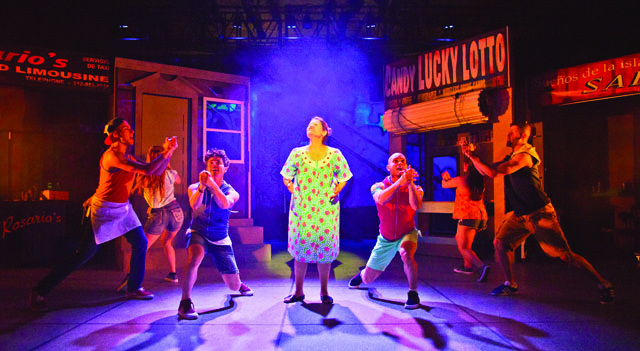 Felix Marchany, Amaya Perea (back), Aaron Cobos, Michelle Ríos, José Ozuna, Ximena Salgado (back), Héctor Flores Jr. (Stan Weinstein)
“The way it’s written, the legacy is what abuela left us,” says Luis Salgado, the show’s director and choreographer. “My mother came to visit me and she cooked rice and beans, and I was like, ‘this reminds me of abuela.’ Those things seem unimportant to the rest of the world but the essence of my existence relies on those memories.”
Manuel’s Hamilton may be known as his most political piece, but in its Spanish incarnation, In the Heights has taken on more activist overtones. In D.C., the Spanish speaking community is present but not felt vibrantly, Medrano says. By staging a show where the cast speaks Spanish most of the time, that power dynamic is flipped on its head. Anglos in the audience must catch up.
When Hispanics assert themselves as the vocal majority in the show, they’re sending a message not only to their neighbors in Columbia Heights, but to a certain resident at 1600 Pennsylvania Avenue. Laura Lebron, who plays Nina, relished a line preserved from the original show namechecking Donald Trump as someone’s caddy. The line now seems like an even sweeter way for the cast to embrace the role reversal the Spanish production emphasizes.
“Doing this show in Spanish, in Washington, D.C. right next to Donald Trump is a statement,” Lebron says. “We’re hard workers. We come here to make ourselves better, make the community around us better and make the country better. It’s not about taking anyone’s space, it’s about sharing the space we’re all building together.”
Medrano adds the show is not employing Spanish as a gimmick to appear more authentic, as a 2009 production of West Side Story attempted with varying success, but rather to reflect real conversations in places like Washington Heights. The musical comes even closer to the truth with its lead, Juan Luis Espinal, a Dominican born actor who has lived in Washington Heights for three years and plays the Dominican bodega owner, Usnavi.
“In West Side story you not only have Latinos, you have the Jets,” Espinal says. “Here, we’re talking about the Latino community. If you did this story in real life, it would be in Spanish.”
Part of the success of In the Heights has come from its ability to accurately portray the everyday life of Hispanics in America. Its characters run piragua carts, taxicab services and hair salons, but for actors like Espinal, Salgado and Lebron, those roles were groundbreaking compared to the Latino stereotypes trotted out in pop culture. And in the face of Trump, staging a musical about Hispanics who are not gang members still (unfortunately) comes off as fresh.
“As a director, I think it’s a great exercise to simply celebrate who we are without having to limit ourselves to drug dealers,” Salgado says. “We’re celebrating the truth of these people being who they are. For me in the atmosphere that we’re living in today, that is political, because we have to ask ourselves, ‘what is it to be an American?’”
In the Heights runs from April 20 through May 21 2017 at GALA Theatre (3333 14th Street NW). Tickets are $60.