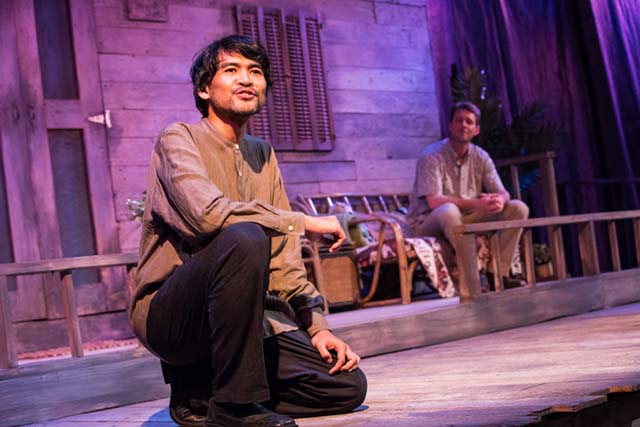
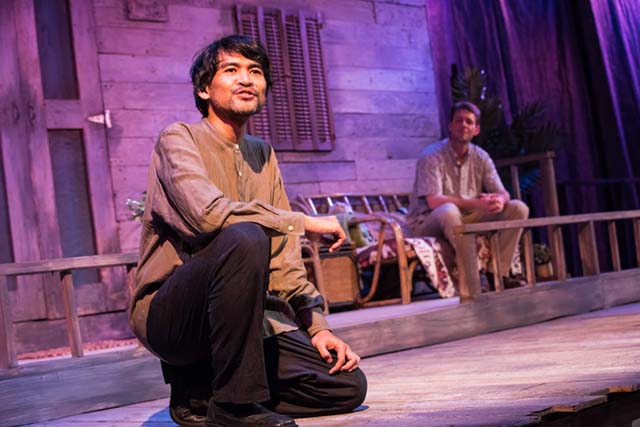
 Rizal Iwan and Sun King Davis (DJ Corey Photography)
Forgotten Kingdoms is not a show that would represent a toning down for most theater companies. But Rorschach is not like most theater companies. They’ve cut their teeth on action-packed fairy tales set in realities quite different from our own, so much so that Neil Gaiman saw fit to sanction an adaptation of his story Neverwhere on their stage.
Set in Indonesia, Forgotten Kingdoms trades whimsy for magic realism and action for extended dialogue and deep character dives. What makes Rorschach special doesn’t completely survive the experiment, but it’s worth watching.
Much of the show’s world-building comes from Deb Sivigny’s gorgeous set design, almost worth the price of admission itself. Every scene takes place on the same raised pier, surrounded by (fabric) water and capped by the wooden home of American missionaries David (Sun King Davis), his wife Rebecca (Natalie Cutcher) and their son Jimmy (Jeremy Gee). It creates a clever juxtaposition as the humble hut towers over the audience on realistically water-damaged stilts, and while the show never leaves that location, the sheer detail and novelty of the set means that it never feels static.
The action revolves around David’s conflict with Yusuf (Rizal Iwan), a young and skeptical Indonesian Muslim who seeks David’s spiritual healing at the request of his ailing father. An Indonesian native himself, Iwan’s appearance was coordinated through the Indonesian embassy, and his Yusuf ably provides the emotional anchor of the show. Davis and Cutcher round out the fine performances, maintaining the illusion they’ve built up in their mission and revealing the darker humanity behind it as the show progresses.
Unfortunately, the gorgeous set and skillful work of the actors don’t overcome the central challenge of a script that never quite knows what it wants to be. Forgotten Kingdoms is a story with a number of interesting cultural strings to pull on: white American Christians alone in a country populated mostly by Muslims but very much influenced by even older traditions. At the same time, it’s a deeply personal biography: playwright Randy Baker wrote it based on stories of his grandfather, who also worked as a missionary in Indonesia.
The dichotomy does not always serve the show well, as its cultural and religious elements often seem to serve as character motivations rather than fleshed-out themes. We don’t see first-hand much of how the larger cultures interact, we just see how they influence the actions and reactions of the narrow cast of characters.
The “magic” part of the magical realism also suffers: rather than diving headlong into it as Rorschach tends to do, Forgotten Kingdoms threads it subtly and just under the surface—but it doesn’t add up to a satisfactory conclusion. The company has occasionally suffered from trying too hard, but if anything, Forgotten Kingdoms is guilty of not trying hard enough.
To an extent, this is not a flaw so much as it is a missed opportunity. In writing a zoomed-in, deeply human story influenced by magical elements, Baker has largely succeeded, as has the Rorschach team in producing it. Still, one can’t help feeling that a lot more could have been done with the show’s setup. Forgotten Kingdoms is a world premiere, so hopefully subsequent iterations can broaden the scope, because there’s a lot to remember here.
Forgotten Kingdoms runs through May 21st at the Atlas Performing Arts Center on H Street. Buy tickets here.