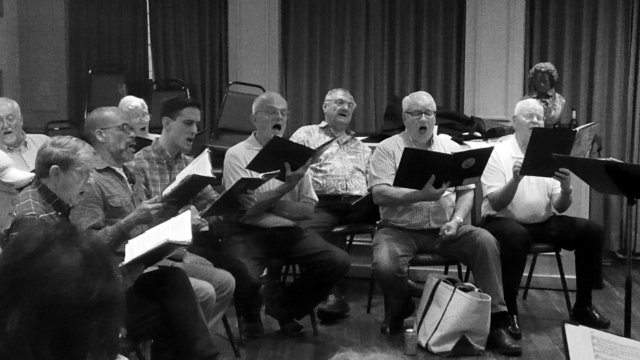
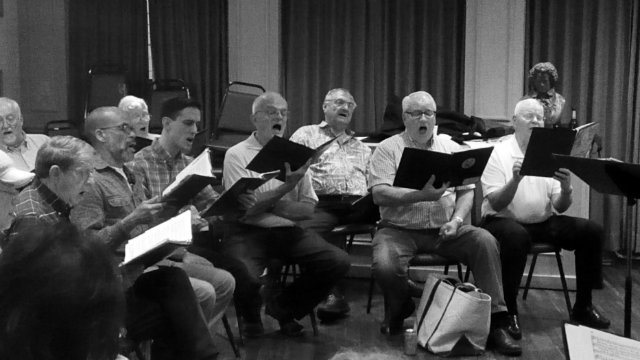
 The Washington Saengerbund practices ahead of its spring concert. (Photo by Rachel Kaufman)
At the second-to-last rehearsal before the Washington Saengerbund’s big spring concert, there is more than a little nervousness in the room. While the roughly 20-person chorus sounds pretty good to me, they’re concerned about nailing a few of the details.
“You guys had this last week, remember?” pleads conductor Nick Brown. The room is silent. “Those are some… deathly blank stares,” he notes, before taking the group back through Jacques Offenbach’s “Infernal Galop” from the top. (You may know this song as “the can-can song,” but there are actual lyrics, and no, they are not “Can you, can you do the can-can?”)
Eventually, with much coaching from Brown, they’ll get it. And they’ll come back again next week, and the week after, and the week after… just as the members of the Washington Saengerbund have done for more than 150 years.
The Washington Saengerbund (German for “singing club”) is the oldest, and likely the only remaining, German singing society in the Washington area. It was originally founded in 1851 and with a few exceptions has been continually operating ever since. They sing classical music—think Bach and Beethoven and Franz Lehar—music that was practically contemporary when the group was first founded.
The saengerbund meets—where else—on the second floor of Old Europe restaurant. There’s actually a long complicated history here that I’ll get into later, but long story short, if you love Old Europe, you will love its second floor. Up here, there is another bar, with decorative steins on shelves behind it. Parade flags advertising the saengerbund’s history hang on the walls. There’s a bust of Beethoven in the rehearsal space, and when I get up to take a photo, I bump into a rack of wooden swords whose purpose I never discover.
The Washington Saengerbund started out of a church at 20th and G (the church is still standing and still gives sermons in German twice a month) in 1851. The men of the church planned to enter a regional singing contest later that year, but it became clear they weren’t ready. Quickly that changed, though.
In 1896, the group hired a conductor who had been a musical prodigy as a child and was just as good as an adult, according to Al Wentzel, the group’s official archivist and a member of the group since 1970. “Then began what I call the golden years of the saengerbund,” he says. The group was widely considered among the greatest choruses in the region. They gave multiple performances at National Theater, got written up in the newspapers. They were famous in Germany.
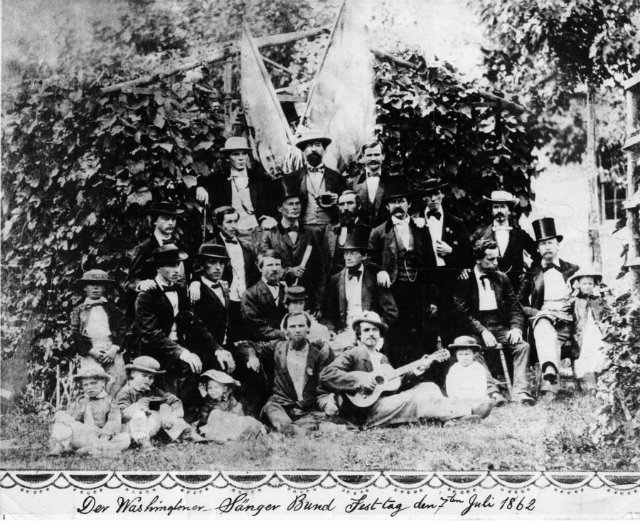 The saengerbund in 1862, a decade after its founding. (Courtesy of the Washington Saengerbund)
High off this success, the group built a clubhouse on C St NW that also included a restaurant and bowling alley and 500-person ballroom. Beer sales in the restaurant helped fund the saengerbund.
Then Prohibition struck, and the restaurant stopped paying the bills. By the late 1920s, the saengerbund was broke. A number of German businessmen pooled their money and bought the clubhouse for $10, assuming the debts and forming the Concord Club (this becomes important later). But the saengerbund faded anyway, perhaps because, as Wentzel says, “a German singer without a beer is not a singer.”
After the end of Prohibition, a number of German-Americans restarted the saengerbund. But in the meantime, the clubhouse had been taken by the District through eminent domain and torn down; they paid the Concord Club a modest sum of money in exchange. With the cash on hand from the sale of the building, the club’s new president found the Glover Park building and bought it as a headquarters for both the club and the saengerbund. Concord Club now leases the restaurant space to Old Europe, so really you can thank a bunch of German-Americans from 150 years ago for your schnitzel.
The saengerbund has stayed in existence ever since, though its membership is rather diminished from its “golden age” a hundred years ago. But they are still an enthusiastic bunch, and occasionally they get incredibly prestigious gigs. The saengerbund even performed at the White House in 1995 in honor of German Chancellor Helmut Kohl’s visit to the U.S.
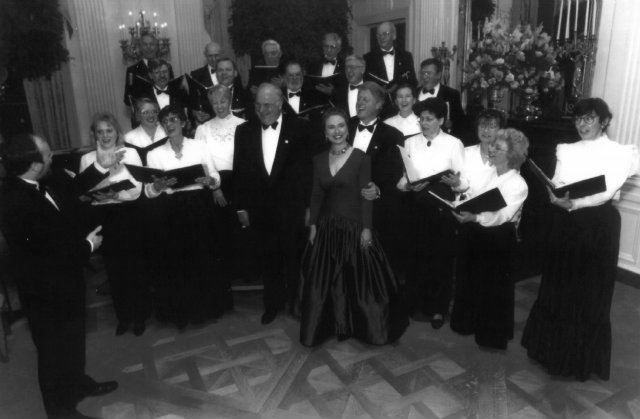 Why yes, that is the saengerbund performing for Bill and Hillary Clinton in 1995. (Courtesy of the Washington Saengerbund)
The members who have stuck with the saengerbund for so long have done so because they love the music. Wayne Thaemert sings in his church choir, too, but “we don’t sing challenging music at church anymore,” he says. “Here, we sing stuff that is really important.” When I ask him what he sings at church, he laughs and says, “Milquetoast.”
“I just enjoy myself so much every Monday night,” says Erica DeJoannis, a newer member of the chorus. “I lose myself in the music.”
DeJoannis says the choir is a “nonaudition choir that strives for quality,” but which makes room for singers of all levels. It’s open to everyone, not just people of German heritage or German speakers, though membership does seem to trend toward the Teutonic. Many members are first-generation immigrants whose first language is German.
Others join because they just like German, like Maurice Schroder, a polyglot who was born in Jamaica. “I’m a language person. I speak Chinese,” he says while tucking into a Chipotle burrito before the rehearsal. “What better way to keep my limited German than to sing in German?”
Saengerbund president Hans Endrikat concurs. “Here, you can intermingle with people who are native German speakers.” This does lead to disagreements, Brown says, over the correct pronunciation of certain words—many members speak various dialects and not necessarily the “Hochdeutsch” that is considered “standard.”
“In other choirs, the conductor makes the decisions,” Brown chuckles.
The Saengerbund‘s annual spring concert is May 13 at 8421 Arlington Boulevard in Fairfax. They’ll also be performing at a Memorial Day service at Prospect Hill Cemetery, a historic German-American cemetery on North Capitol Street. And they’re always looking for new singers—rehearsal is every Monday night at 2434 Wisconsin Ave NW.