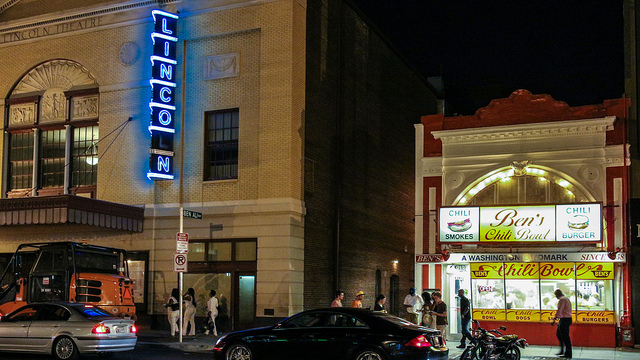
 Photo by Clif Burns
About a week in to promoting his book about the gentrification of some of D.C.’s most buzzed-about neighborhoods, Derek Hyra wants to make it clear that the evolution of the Shaw and U Street communities “is much deeper and more complex” than people may first assume.
His book, Race, Class, and Politics in the Cappuccino City, isn’t just a tale of friction between newcomer whites and some long-time black residents “who resent everything,” Hyra, an associate professor and founding director of American University’s Metropolitan Policy Center, tells DCist. It is also about the division between people of different sexual orientations, income-levels, and age groups—within all races.
Hyra, who’s white, studied the historically black neighborhoods from 2009 through 2014. During the first year, he volunteered with the non-profit ONE DC.
When he approached the advocacy group, one of its lead organizers said that he didn’t know enough about the city and “we’re not going to just work with you,” Hyra recalls. While he’d previously written about gentrification in Harlem and Chicago’s Bronzeville community, he wasn’t familiar with the inner-workings of D.C., Hyra admits. So he spent the next few months researching and building trust with ONE DC staff. Eventually they let him in.
Hyra’s research process also included formally interviewing 60 Shaw and U Street residents, developers, political leaders, and business owners; attending countless community meetings; frequenting neighborhood restaurants, bars, and coffee shops; and playing basketball at the Kennedy Recreation Center, among other things.
In his account, the story of D.C.’s “Black Broadway” of the early-to-mid 1900s begins to change with an influx of gay residents in the 1990s, followed by white millennials in the 2000s. African Americans went from making up 90 percent of the neighborhood in 1970 to 30 percent in 2010. And most blacks who still live in the community are considered low-income and live primarily in subsidized housing.
One of the reasons Hyra decided to study gentrification in Shaw and U Street is because as the District loses its black majority and “chocolate city” moniker, the neighborhoods remain some of the city’s most racially and economically diverse.
But Hyra found that placing different people next to one another doesn’t mean they’re all getting along and it’s “magically working for everybody,” he says. Instead, Hyra says during his six-year ethnographic study, he observed micro-level segregation between different sexual orientations, classes, ages, and races.
Among several vignettes throughout the book, Hyra details clashes between religious leaders and gay business owners, a black male developer and a black woman who owns a hair salon, and newly-appointed civic leaders and longtime residents.
“You have political displacement and cultural displacement going on at the same time as the neighborhood is redeveloping,” he says, explaining the myriad things that have contributed to segregation among proximally close neighbors.
These micro-level segregations aren’t uncommon to tales gentrification in other cities though, Hyra notes. But what he aimed to do in his book is explain more comprehensively why it happens and what can be done about it.
And while delving into the “why,” Hyra uncovered some things that he hadn’t seen during explorations of gentrification in Harlem and Bronzeville. In those neighborhoods—which saw a notable influx of affluent black gentrifiers—there was “black branding” prompted by mostly black people.
But in the District, he says, the preservation of Shaw/U Street’s black history is being commodified by mostly white developers and white-led organizations. Major residential developments like Langston Lofts and the Ellington are named for iconic poet Langston Hughes and composer Duke Ellington, and Cultural Tourism DC leads black history walking tours throughout the neighborhood.
“So maybe the way the stories are told by whites combined with the back-to-the-city movement” is the reason D.C. has experienced a white-led gentrification, he says, adding that there was also a lure through job openings in D.C. that white millennials were not finding in other urban cities.
Hyra also found it unique that some white newcomers to the neighborhood seemed to be drawn to its grit, even as crime declined during those years.
He coins it a “living the wire” complex. “Some whites think they’re moving to the ghetto (as displayed in HBO’s The Wire’s depiction of Baltimore) and they think they’re cool and hip because they’re in a community that has some diversity and occasionally has some crime—they feel that they’re in an authentic community, so they’re authentic,” he says.
“I noticed this and I was like I’ve never heard of this, I’ve never seen this, I’ve got to write about this because this is what people don’t quite know and understand and then they wonder why there’s so much segregation in this community…. it’s because some newcomers are ‘living the wire’ and other long-term residents who are majority African Americans are ‘living the drama’ and concerned about crime.”
Meanwhile, most of the newcomers’ interests—bike lanes, dog parks, third wave coffee shops—aren’t priorities for many longtime residents. But D.C. mayors developed initiatives to attract newcomers with these types of amenities. And those newcomers are making sure they happen by flocking to civic associations and neighborhood political positions. And this shift in politics lengthens the divide between neighbors.
In the book, Hyra provides several recommendations to address the nuances he’s found in the social, cultural, and political aspects of Shaw/U Street’s gentrification. One possible solution is to find ways to help long-term, low-income residents maintain a say in their local government. He writes that communities can also ensure that longtime residents’ preferences are incorporated into new developments, and neighborhood organizations can work to unite new and existing populations.
“I hope the book elevates some things that help people think about how do we do more equitable gentrification—it sounds like an oxymoron—but I think there’s a way to do equitable gentrification, development, and pro-growth in a way that benefits the lives of long-term residents and makes more cohesive and inclusive communities,” he says.