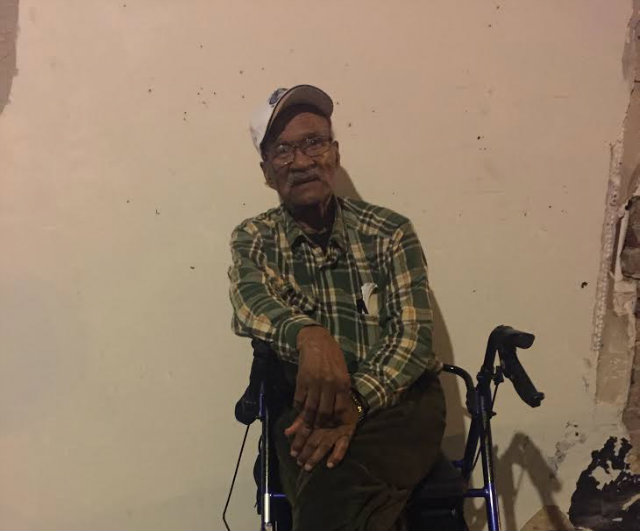
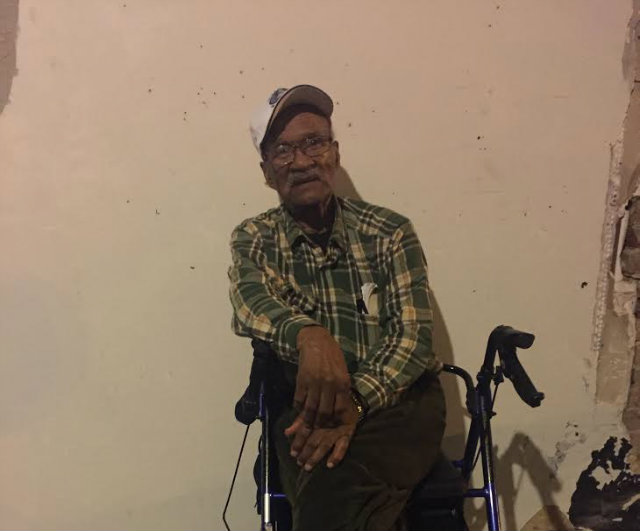
 Midtown Youth Academy Founder, Eugene R. Hughes (Photo by Sriram Gopal)
On a recent Sunday night, I walk by the Midtown Youth Academy on 14th Street NW and nod my hello to Eugene R. Hughes, the patriarch of a center that uses boxing to help at-risk youth, bringing them into a space with educational opportunities that would keep them off the street. Hughes is often sitting in a wheelchair at the building’s entrance and observing the goings-on in the neighborhood.
I notice a big change the space: it’s totally empty. The musty room that used to be filled with a boxing ring, books, and decades of memories, lies barren. Is the Midtown Youth Academy, which has been open for 40 years and at this location for nearly 30 years, about to close? Did a developer make Mr. Hughes an offer that he couldn’t refuse?
Thankfully, no.
“This building is going to stay open until they throw dirt in my eyes,” says Hughes, with more than a little fire in his 84-year old eyes. To the people who still make him offers to buy MYA, he says, “No, No. You can’t have Midtown. Midtown is a place to develop kids from group homes, the welfare department, and things like that. You can’t have that.”
He can say this with confidence, for now, because the non-profit behind MYA owns the building, but that doesn’t mean that Academy doesn’t need help. Mr. Hughes estimates that the building needs about $250,000 in improvements, ranging from structural to plumbing, to get back to where it needs to be, hence its current emptied state. Hughes has found other gyms to take his kids while things get sorted out at MYA.
I first met Hughes back in 2008. He is a man with many stories—before founding MYA, he caddied for senators and generals, spent time with the Black Panthers, and has served time behind bars.
Nearly a decade after that conversation, Mr. Hughes continues to be a presence on his block of 14th Street, and has defiantly kept MYA open in spite of the area’s rapid gentrification and the huge sums of money he is being offered for the building.
Hughes is quick to point out the success MYA has had over the years in keeping kids out of trouble. He drops a list of names that includes boxing champions “Sugar” Ray Leonard and Lisa Foster, alongside former Richmond Police Chief Marty Tapscott, as well as an untold number of kids that received tutoring at MYA and went on to graduate high school.
One of those success stories is Glenn Jordan, a city transit worker who walks into Midtown during my interview with Mr. Hughes. Jordan gives some of the history behind his connection to Midtown.
“I was out on the street, didn’t know which way to go, selling nickel bags up here on 14th and Chapin,” Jordan says. “I walked down here and had a buddy. We went to his father’s place at 14th and Swann and had to climb over junkies to get to his father’s place. After that, we went to the [Midtown] gym, I could hear the punching bag and Gene’s voice. The buddy that took me there didn’t stay. I stayed. The buddy that took me there is doing life in the penitentiary right now.”
While the neighborhood has changed drastically since those days, Jordan notes that there are still kids that need help. He also offers a gentle reminder that those of us who are taking advantage of the development boom may owe some of the local economic resurgence to people like Hughes.
“People in this neighborhood, they walk up and down here happy right now, going to the clubs and this and that, but a lot of blood was shed in this neighborhood,” Jordan says. “Gene held his ground and he’s still holding his ground with this building. We see all the pretty stuff now, but we know from the grit and grind how it got to be pretty.”
If he raises the money, Hughes hopes to renovate the space and make it an educational center that stands alongside the boxing and other physical activities that he’s run for decades. More than that, he hopes that Midtown will serve as a focal point to build the community bonds that have become frayed over the past decades.
“It was like a family. I don’t care about nationality, but it was a family,” Hughes says. “I want the neighborhood to get back like that. It’s about group conversation and communication, not just me, me, me.”
To that end, the Academy is seeking out community partnerships and donors for monetary support, and also any volunteer help that people are willing to provide, ranging from installing drywall to administrative assistance.
“If you really look at what’s happening, all of a sudden in the late ‘80s, ‘90s, and early 2000s, more guns came into Washington, D.C. than what I’ve ever seen in my life. Then right after that, this happens,” Jordan recalls, referring to gentrification. “The neighborhood needs to give Mr. Hughes the support that he needs because this is really a very special place.”
Those interested in helping the Midtown Youth Academy should visit its website for more information.