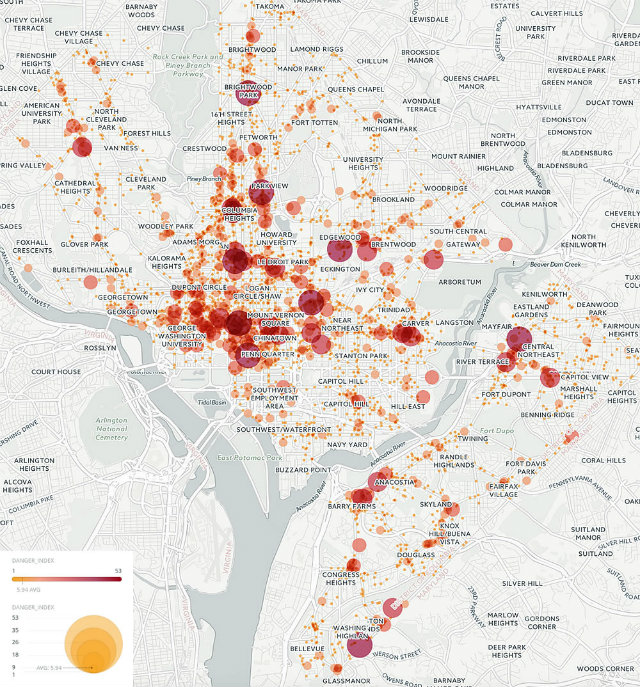
 The highest concentration of pedestrian collisions took place downtown, followed by Dupont Circle and Columbia Heights, according to data collected by Trombly & Singer. (Map via the law firm’s report.)
As the District updates its plans to eliminate traffic-related injuries and fatalities within seven years, a local law firm has released interactive maps and rankings that show D.C.’s most dangerous neighborhoods and intersections for pedestrians.
After gathering crash records from the D.C. Department of Transportation in February, Trombly & Singer found that there were 5,291 traffic incidents involving pedestrians in the District from 2009 through 2015. They worked with Point 21 Interactive to create the interactive maps, which were first reported by Washingtonian.
The report’s authors say that pedestrians are struck by vehicles in D.C. nearly three times every day, according to their findings.
Based on that seven-year period, the firm identified D.C.’s downtown area as having the highest concentration of pedestrian crashes. For this report, downtown is comprised of Chinatown, Penn Quarter, Mount Vernon Square, and a segment of North Capitol Street NW. In that region, there were a total of 333 incidents on record.
Downtown was followed by Dupont Circle (along with Connecticut Avenue and K Street NW) and Columbia Heights (also including Mount Pleasant, Pleasant Plains, and Park View).
 There were 333 pedestrian collisions in the Downtown, Chinatown, Penn Quarter, Mount Vernon Square, North Capitol Street neighborhoods—which collectively has the highest concentration of pedestrian-involved crashes. Map courtesy of law firm Trombly & Singer.
In a more narrow view, the firm says D.C.’s most dangerous place for pedestrians is the intersection of Minnesota Avenue and Benning Road NE, which saw 10 collisions involving pedestrians and 14 injuries between 2009 and 2015.
This location is followed by 800 Southern Avenue SE near Southview Drive, which borders D.C. and Maryland—that spot saw eight crashes and 11 injuries. And the intersection of 12th Street and Pennsylvania Avenue NW rounds out the top three most dangerous places for pedestrians with seven collisions and 13 injuries.
While no one died due to collisions at these locations during those seven years, they were ranked on the “danger index” based on varying weights assigned to numbers of crashes, major injuries, minor injuries, and fatalities.
Coming in at number 13, the intersection of Benning Road and East Capitol Street NE had six collisions—one of which resulted in a fatality. And 1310 Southern Avenue SE, which ranked number 19, saw two collisions, including Emebet Kebede in August 2015.
Last November, Kebede’s colleagues at United Medical Center reflected on her death during a press conference announcing the Street Smart campaign—a bi-annual safety campaign organized by the Metropolitan Washington Council of Governments.
“I received a call from my colleague,” said Charletta Washington, chief operating officer at United Medical Center, recounting how she heard the news of Kebede’s death. “That phone call would shake me to my core—it would shake this community and this hospital to their core as well.”
The Street Smart campaign is comprised of police and transit officials from D.C., Maryland, and Virginia, who educate residents about traffic laws and enforce penalties to those who violate them.
After hitting Kebede, 32-year-old Rahveed Comford fled the scene, but he was arrested a month later for involuntary manslaughter.
The regional campaign coincides with Mayor Muriel Bowser’s Vision Zero plan, which she described in December 2015 as an effort to reach zero traffic-related deaths or injuries by 2024.
The D.C. Department of Transportation released new data and gave updates about Vision Zero in March.
According to the progress report, there were 28 traffic fatalities in 2016, nine of which involved pedestrian deaths—that’s an increase of two traffic fatalities from 2015. Additionally, crash injuries increased in D.C. last year to include 439 incidents in which “serious injuries” were reported.
To reach zero traffic-related deaths, the city needs a 35 percent reduction each year through 2024, according to the report.
Among other things, Mayor Bowser said that city officials have also looked at data on where these traffic-related incidents have taken place and are identifying streets with potential safety risks to make changes “before those intersection or areas can result in death.”
Here’s Trombly & Singer’s complete list of the top 25 most dangerous areas for D.C. pedestrians.
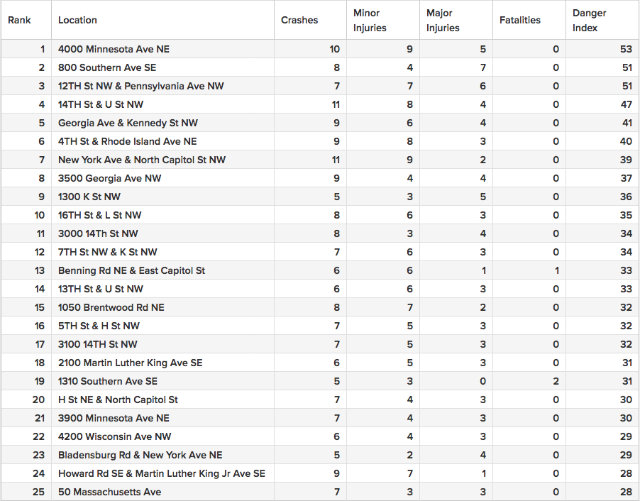 The most dangerous place for pedestrians is the intersection at Minnesota Avenue and Benning Road, with 10 collisions and 14 injuries. Graph courtesy of law firm Trombly & Singer.