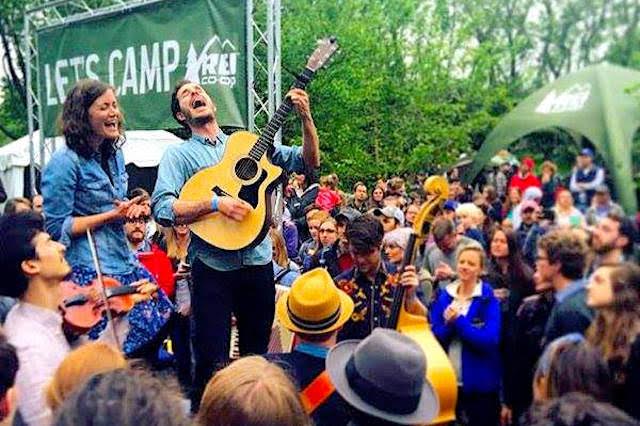
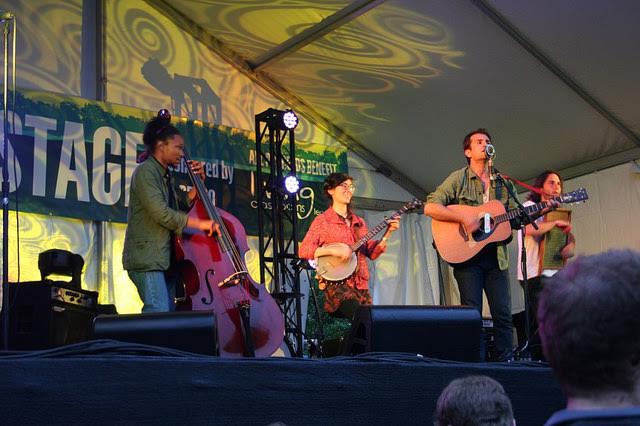
 Spirit Family Reunion plays the 2016 Kingman Island Bluegrass & Folk Festival (Photo courtesy of Living Classrooms).
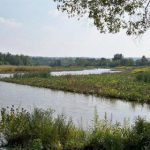
A short drive down Benning Road from the edge of the H Street Corridor puts you at Kingman Island, a destination Lee Cain of Living Classrooms describes as “acres of natural paradise right in the middle of Washington D.C.” Sitting at the north-south border of the Anacostia River, the island accommodates more than 100 species of birds, as well as fox, turkey, deer, and rare plants growing near its freshwater wetlands.
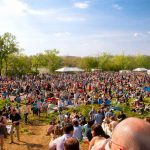
This Saturday, that serene setting will undergo its annual transformation into a concert venue unlike any other in the city. The Kingman Island Bluegrass and Folk Festival returns that day for an eighth straight year, with nearly 40 bluegrass, Americana, and folk artists slated to play before an expected crowd of 10,000-plus concertgoers.
By design, all proceeds from the festival go to its chief sponsor, education nonprofit Living Classrooms of the National Capital Region. The event also features a zero-waste policy for the second year running, with a goal to compost all trash and a rule that picnicking attendees can bring only reusable containers for food.
Artists say the setting couldn’t get much better. “The natural environment has a transportive element, the way that you want music to be,” says Chris Ousley, guitarist and banjoist for the Sligo Creek Stompers. “It takes you someplace else.”
This year’s headliners are the high-energy Asheville, N.C., string band Town Mountain, D.C.-area powerhouse quartet Frank Solivan and Dirty Kitchen, Grammy-winning singer-songwriter Don Flemons, and Walter Martin, formerly of The Walkmen and now fresh off his third solo studio release. An array of mostly local performers will join them, from soloists like Julie Outrage and Sarah Cortana to ensembles like the Stompers, The Woodshedders and Moose Jaw.
The festival will have five stages: Two main ones, respectively, for bluegrass and more Americana sets, a third called the Fraser Stage, another dubbed the Half-Shell Stage on a dock (think oysters) and a singer-songwriter stage a short walk away to connecting Heritage Island.
Daniel Buchner, an attorney by day and a member of the six-person D.C. bluegrass group By and By, has volunteered as an organizer for five of the festival’s eight years. Most of his work entails booking bands and setting the lineup. With the exception of his own band, which plays every year, he says he tries to pick new artists each time, so as to expose attendees to new bands and vice-versa.
“If I can help find new music and bands that haven’t played before and that are just kind of starting to get out there, then everybody benefits,” he says.
The festival was the brainchild of former Ward 7 councilman and current D.C. Department of Energy and Environment Director Tommy Wells and his assistant, Daniel Connor. Speaking with DCist last year, Wells described touring the island shortly after he had been sworn into office in 2007 and envisioning a festival there to get more people out on the river.
Buchner recalls its early days: “I think the first year maybe 200 people showed up, then the second year a few more.” But attendance slowly built, and it kept growing after he came on as an organizer. He says it really exploded in the last four years, becoming a festival that “regularly pulls 10,000 people.”
With rapid growth comes growing pains. Recent festivals saw long lines at beer stations, ticket booths and restrooms, Buchner says.
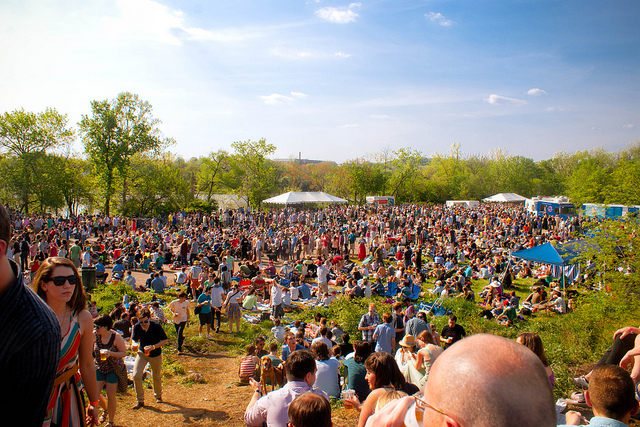 The Kingman Island Bluegrass and Folk Festival in 2013. (Photo by Caroline Angelo)
Since the beginning, Living Classrooms has underwritten the festival. To help with some of those issues Buchner highlighted, the nonprofit last year brought in an event management firm to digitize ticketing and help with other logistics. It helped, and even with the third-party assistance, Buchner says it didn’t take away from the DIY feel.
“It still feels like a bunch of musicians brought their instruments out to this beautiful spot on a spring day and just decided to play.”
Cain, who’s also playing this Saturday with his band Blue Plains, was hired last year as director of Kingman Island programs for Living Classrooms. Throughout the year, he regularly brings D.C. students to the island for educational activities and constantly looks for ways out to keep improving the space, such as leading volunteers remove invasive species or devising plans to install trail signs.
“I’m more of the caretaker of the island,” he says.
Given his role, Cain says an event drawing thousands to the island can be stressful. “I’ve been to my share of festivals, and at the end of the day, you’re just sitting in a pile of red plastic solo cups or whatever trash is laying on the ground.”
Before the festival adopted a zero-waste policy in 2016, Kingman Island endured some of that carnage. “A week later, I’d bring a school group out and there’d still be so much trash because thousands of people had just partied,” he says.
Last year, the D.C. Department of Public Works and DOEE worked with organizers to implement a new set of rules, requiring food trucks to use compostable packaging and asking attendees to bring only non-throwaway containers. They also had work crews there ready to collect compost on the spot to prevent it becoming contaminated with regular trash.
It worked, Cain says. When a group of volunteers from watershed-protecting nonprofit Anacostia Riverkeeper went out to pick up after everyone, they were happily surprised. “They cleaned up less than 20 bags of trash on the entire island,” he says. “They went out with 20 volunteers and they got it done in like 10 minutes. It was awesome.”
For the artists, playing an all-day outdoor concert filled with picnicking families presents an opportunity to expand their fanbases.
“You get a wide range of people that you probably wouldn’t normally get at a three-day [festival], the people who either A) don’t want to spend the money or B) pack the kids up and haul ‘em away for three days,” says Matt Meade, manager for The Woodshedders. “This is awesome because people can ride the Metro and come to a festival.”
Of course, all that traffic would be a lot for the ecosystem of Kingman Island to withstand on a regular basis. “It’s a double-edged sword,” says Cain. “It helps put D.C. on the map and frankly, it’s probably the reason that people know Kingman Island exists…but we have yet to see what the impact is.”
But once a year, he’s happy to have everyone come out to partake in a day filled with some homegrown music on D.C.’s hidden gem of an island.
“The color green, it actually makes people healthier,” Cain says. “It’s gonna be lush on May 13.”
Tickets for the Kingman Island Bluegrass and Folk Festival are on sale for $30 online, not including drink tickets and other add-ons. The festival will take place Saturday, May 13, from 12-8 p.m. Doors open at 11:30 a.m. Kingman island is located at 575 Oklahoma Avenue NE.