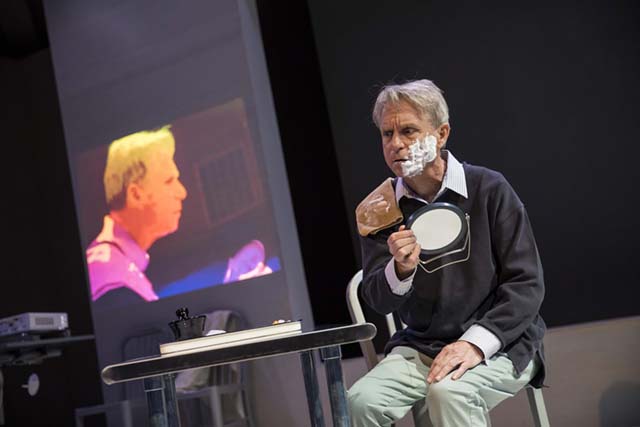
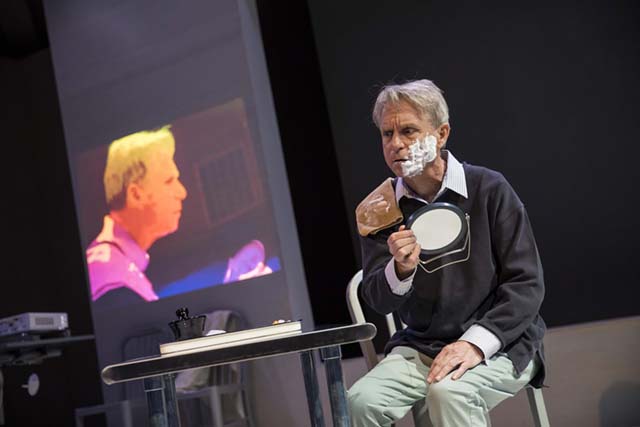
 David Gaines (DJ Corey Photography)
When you see a play that features a cast of mentally ill characters, you often brace yourself for a strong political message—the mental institution as an allegory for an oppressive government, for example. This isn’t the case with The Man Who, playing at Spooky Action Theater through June 4. Meticulously researched case studies leave it up to audience members to draw out lessons—should they exist at all.
Inspired by neurologist Oliver Sacks’s 1985 study, The Man Who Mistook His Wife For a Hat and Other Clinical Tales, playwrights Peter Brook and Marie-Hélène Estienne worked closely with Sacks to create 17 vignettes, realistic if fictionalized case studies of people with the kinds of unusual neurological afflictions that plague Sacks’s own patients—most famously, a man suffering from a severe case of visual agnosia, the inability to recognize familiar objects by sight.
In Spooky Action’s production, the set is sparse, an empty white space with just a few chairs and a table as props, symbolic of both the clinical feel of the hospital and the vast unknown of the human brain. Four actors (David Gaines, Tuyet Thi Pham, Carlos Saldana, and Eva Wilhelm) switch between roles of patients and doctors with each new scene, highlighting the actors’ talents and creating a sense of equality between doctors and patients.
Although the scenes are short, straightforward, and unconnected, they are moving and often veer into the philosophical. There’s a patient who takes comfort in her belief that her left arm is actually her mother’s. Another patient seems to be completely unaware of the left side of his body, only shaving the right side of his face. A third suffers from Tourette’s and expresses his frustration in being seen as a social pariah. The man who mistook his wife for a hat also appears, talking of his difficulty identifying objects, attempting to use his vast knowledge of music instead of his eyes in order to do so.
In one particularly moving scene, Pham plays a woman who is unable to put her complex thoughts into words. Although she speaks with ease, the words she connects make little logical sense to her doctor (Wilhelm) or to the audience, but her phrasing is filled with genuine emotion and the monologue sounds like a profound absurdist poem. In an effort to help, the doctor records the patient’s ramblings and plays them back to her, but this only leads to sadness and confusion.
Everyone involved takes special care in their portrayals of these unusual neurological disorders. There’s no judgment between patients and doctors, and, more importantly, no universal message forced on the audience. In some cases, it seems the creativity of the patient is stifled; in others, melancholy pervades; some are even rather humorous. Whatever conclusions audience members draw, they will reflect on the complexity of humanity and the uniqueness of the individual long after they leave the theater.
The Man Who is at Spooky Action Theater, 1810 16th St NW, through June 4. Buy tickets here.