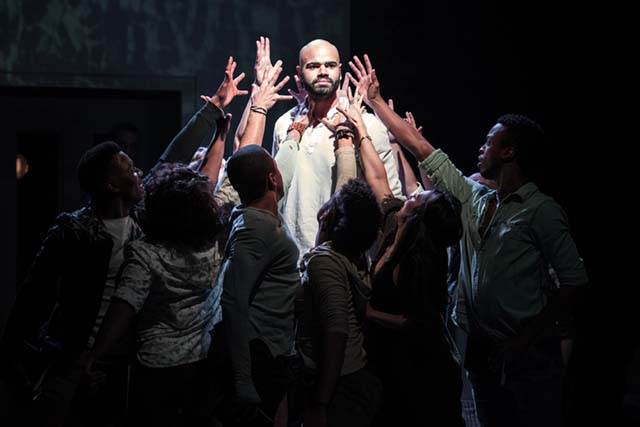
 Nicholas Edwards (Jesus) with the cast of Jesus Christ Superstar at Signature Theatre through July 2, 2017. Photo by Margot Schulman.
He’s ego-driven, easily swept up in his own cult of personality. He’s tired. He’s needy. He occasionally resorts to violence.
He’s Jesus.
Jesus Christ Superstar was controversial when it premiered in London way back in 1972 for many reasons, not the least of which because it portrayed a Jesus much more man than God. Signature Theater’s production of the beloved Tim Rice/Andrew Lloyd Webber rock opera leans even more heavily on this idea, and to great effect.
Nicholas Edwards’ Jesus is short-tempered and easily distracted by his holy mission, especially when the cry of his adoring followers reaches fever pitch. It takes the watchful, observing eye of Judas (Ari McKay Wilford) to keep him on mission (an idea particularly well-communicated in the rousing gospel-tinged “Simon Zealotes/Poor Jerusalem”).
By the time Judas is ready to inevitably betray him, Jesus already seems defeated, resigned. Subsequent blows from a jeering King Herod (Sherri L. Edelen, brilliantly cast against type) and a haunted Pontious Pilate (the always pitch-perfect Bobby Smith) do little to taunt an already broken man.
Nothing happens by chance in Joe Calarco’s brilliantly realized adaptation, in which each vocal performance is more impressive than the last. The director finds new layers and subtleties in a musical that has an uncanny power. The show has always portrayed Judas as a man deserving of pity for getting a raw deal from history, but Calarco goes further, emphasizing that the vigilant Judas is the one who really gets what’s going on, and the one most loyal to Jesus’s holy mission.
Wilford, appearing like a singer-songwriter balladeer with a guitar constantly strapped to his side, constantly questions and challenges a man he obviously loves and admires to the end, making his ultimate fate feel even more tragic. After death, Judas is rewarded with his own personal second act — the show’s rousing title number, which Wilford delivers with the appropriate rock-star magnetism and knowing skepticism. “Why’d you let the things you do get so out of hand?” he asks as images representing the cult of Jesus, from T-shirts to billboards, grace the set.
Calarco also emphasizes the importance of Mary Magdalene, thanks in no small part to the spellbinding performance of Nataschia Diaz. Mary has real power here — to capture the attention of a crowd, to unite Jesus’s followers even after his death. Her soothing “Everything’s Alright” brings comfort not just to Jesus, but to everyone surrounding him, as she addresses her words to Jesus’ entire camp of followers. Her performance of the iconic ballad “I Don’t Know How to Love Him” feels fresh and new, slowly building and gently questioning.
The show is full of staging surprises, largely thanks to Karma Camp’s choreography. One scene evokes a creepy mob of lepers and unfortunates; another captures the excitement and frenzy of his followers by showing them consumed by rave-like dancing.
This production takes risks, and can be heavy-handed: Jesus’s final moments on the cross are punctuated by hateful imagery ranging from the Klu Klux Klan to an angry, abortion-protesting mob. But even that moment is undeniably powerful. In “Superstar”, Judas chides Jesus that “Israel in 4 B.C. had no mass communication,” but we see a world still rocked today by one man’s death and life. Nearly half a century later, Jesus Christ Superstar still has the ability to make us think — and to make us uncomfortable.
Jesus Christ Superstar runs through July 2 at Signature Theater. $40-$114. Buy tickets here.