 Rachel Sadon
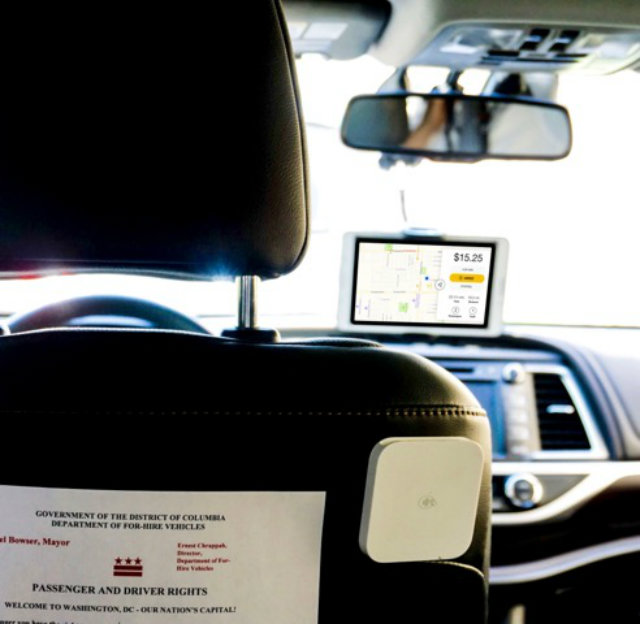 Tablets and Square readers will soon replace many of the city’s traditional meters. (Photo courtesy of the Department of For Hire Vehicles)
The most familiar hallmarks of D.C. taxi interiors are on their way out.
By the end of August, fares will no longer tick upward in glowing red digits. The perilously attached screens that blare local news segments and messages from the mayor will be gone, too. Tiny paper receipts and manual logs will be a thing of the past. They’ll all be replaced by the Square reader and other sleek digital payment options meant to bring cabs into the 21st century, along with a host of features that can best be described as Uber-like.
“I would characterize the [current] technology as pretty archaic,” says Neville Waters, a spokesperson for the Department of For-Hire Vehicles (previously known as the D.C. Taxicab Commission). “The intent is to try to level the competitive playing field and modernize the industry and improve the customer experience.”
Last fall, DFHV announced that all D.C. cabs would be required to fully transition to digital meters and payment systems by August 31, 2017. Paying via Square, a small device for mobile credit card processing, is the first piece of that puzzle.
Instead of the boxy meters and credit card machines, which currently take as much as 5 percent of fares in processing fees, drivers can have a tablet up front and a Square reader in the back. DCHV has negotiated a much lower rate—2.65 percent—which regulators say will help taxis remain competitive.
There won’t be a single app, though, to replace the meter, and alternatives to Square payments may emerge.
An in-house development team at DFHV created an API that essentially works as the digital meter. Then, they put out calls to private developers to create taxi apps that integrate that information. Particular apps might prioritize different features or offer better interfaces or charge less; drivers will then be able to choose which they want to offer. Officials say they have received seven applications and are working on testing and certifying them. All must be capable of handling street hailing.
“We, as a regulator, have said we want to see an open platform that forces innovation, competition, and equitable rates for drivers,” says DFHV Director Ernest Chrappah. “This is really about giving taxi drivers an opportunity to compete in a quickly evolving marketplace.”
In addition to allowing for digital payments, the new apps will be capable of doing a whole host of things that Uber and Lyft currently offer customers: digital receipts, route tracking, carpooling, driver ratings, and dynamic pricing.
“The competition is really single occupancy vehicles—people who choose to drive. We rather see people choosing to take for-hire vehicles,” Chrappah tells DCist in a phone interview from the back of a cab. He argues that DFHV has “no dog in the fight” between traditional taxis and ride-hailing services, though he admits that it’s important to him that taxis are able to survive.
Officials at DFHV believe that moving to a digital platform will help. The cost of adding the new apps and Square readers is marginal, they say, significantly reducing the barrier to entry for becoming a taxi driver (which currently entails a costly investment in the analog system).
More importantly, it will allow taxis to be competitive, offering the kinds of discounts, digital receipts, ride tracking, and carpooling trips that customers have come to expect from ride-hailing apps, but the current meter system isn’t equipped for. And while you can e-hail a cab through the one-year-old DC Taxi app, riders must currently go through the regular payment system. It’s a clunky experience to say the least, one that will be eliminated by apps that allow for e-hailing and payment in one product. DC Taxi, which is managed by an industry group, can also choose to integrate with the new system.
“This is a big deal,” Chrappah says of the new offerings. “We are unlocking value from taxis.”
It could very well also make it much cheaper to take a cab. Under the new system, taxi companies will be allowed to set “dynamic prices,” which can never go above the standard fare rates. Chrappah describes it as “the reverse of surge pricing.”
The idea is that if a taxicab company knows that business is slow on Tuesday afternoons or on a holiday weekend, it can choose to offer, say, 20 percent off. They simply have to file rate change notices with DCHV with 24-hours notice, and the discounts will be applied automatically for all drivers in that fleet.
Whether or not companies would choose to do this, how they might advertise the lower fares to differentiate themselves, and if it would actually lure ride-hailing users back to the taxi fold (not to mention how well this technology will actually work) all remain up in the air. But Chrappah has a lot of faith in loosening the physical restrictions and letting the free market do the work.
“This is purely marketplace dynamics and competition,” he says. “We trust entrepreneurs to come up with solutions” like how to make the public aware of special fares. And by opening up the digital meter app to any developer who wants to create one, rather than just choosing one company and offering the contract, the marketplace (i.e. the taxicab drivers) will settle which apps are best. Meanwhile, Square will be taking a lower cut of the fare than typical credit card processors.
“The key message is, for years, taxis have been a closed system,” Chrappah argues, noting that D.C. would be the first city in the country to adopt an entirely digital platform for taxis. “Now it is the hotbed for innovation.”