 Rachel Sadon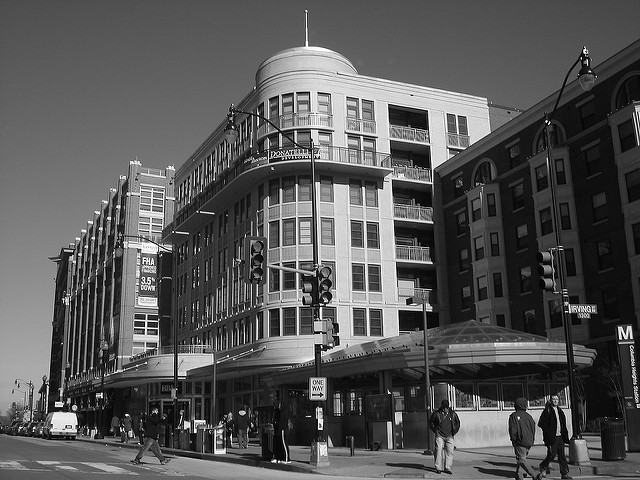
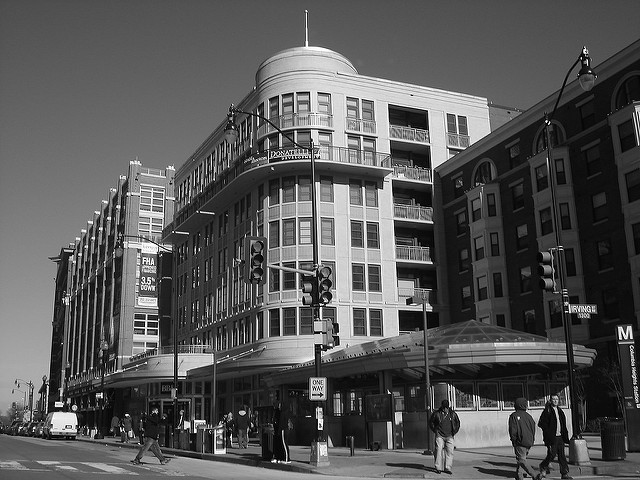 A man died of hypothermia a few blocks north of the Columbia Heights Metro station. (Photo by jng03)
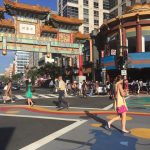
Seven years after D.C. implemented all-way crossing at an intersection in Chinatown, the city is finally getting it’s second such crosswalk, known as a Barnes Dance or pedestrian scramble.
The new traffic signal will be installed at the intersection of 14th and Irving Streets NW, where the Columbia Heights Metro station is located, starting in early June. Once complete, pedestrians will cross at any of the four crosswalks and diagonally at the same time.
“It’ll be easier and more predictable,” says Katherine Youngbluth, a strategic planner in DDOT’s planning and sustainability division. “Once people get used to it, I think they’ll find they like it and their commute is easier—and they’re less likely to get hit.”
In addition to cars and the Metro station, there are also a number of bus lines that run through the area and a dense residential population. “There’s a high density of everybody there,” she adds.
At its peak, during the p.m. rush hour, around 3,500 pedestrians and 1,500 vehicles use that intersection. It is notoriously chaotic, and often confusing and dangerous, too. The data bears that out.
Over the past seven years, Columbia Heights (as a whole, including Park View and Mt. Pleasant) was the neighborhood with the third-highest number of pedestrians hit by vehicles.
In 2016, that particular block (3000 14th Street NW) saw eight crashes involving pedestrians, resulting in four major and three minor injuries. The next block up didn’t fare much better, registering seven crashes last year. They were respectively ranked the 11th and 17th most dangerous intersections for pedestrians citywide, according to data recently compiled by an area law firm.
One block that didn’t make it on the list: 7th and H Street NW, where pedestrians have been crossing simultaneously and diagonally since DDOT installed a slightly modified Barnes Dance crosswalk there in 2010.
Similar traffic patterns were extremely common in D.C. and other cities during the 1960s and 1970s, but had fallen out of favor as planners started prioritizing cars.
“They were eliminated primarily because they don’t move as many vehicles as a two phase signal,” says George Branyan, a pedestrian coordinator with DDOT’s planning and sustainability division, noting that Barnes Dances have three phases (where one direction of traffic goes, then the other, then pedestrians).
The District Department of Transportation revived it in the hopes of solving chronic gridlock and improving pedestrian safety at the Chinatown intersection.
“We’re kind of coming back to the future, or forward to the past, and saying we’re going to prioritize pedestrian traffic in some of these areas,” Branyan says.
Planners say that intersections with higher numbers of pedestrians than vehicles, like at 14th and Irving, are particularly good candidates for this type of crossing.
Provided that everyone obeys the traffic signals, it allows people on foot to cross without having to worry about moving cars, and vehicles to make turns without having to wait for pedestrians to cross. Because foot traffic is so heavy, it may even speed up vehicular traffic in the end by clearing the congestion caused by cars and buses waiting to make a turn (DDOT and WMATA plan to study the new crosswalk’s effect on transit times). It also lessens what planners dryly call “turning vehicle conflicts,” when cars turn into a crosswalk and strike a pedestrian that has the right of way; they are the single biggest type of crash type in D.C., according to Branyan.
While DDOT has considered implementing Barnes Dance crosswalks at other highly trafficked intersections, none are in the immediate works. Most have diagonal crossings that are too long to make it feasible (because of ADA requirements about the length of time to cross).
The recommendation for the Barnes Dance in Columbia Height’s relatively smaller intersection comes out of a multi-modal transportation study aimed at improving east-west transit connections (it calls for new bike lanes and dedicated bus lanes between Columbia Heights and Brookland, among other changes that will be implemented in the coming years). The project also falls in line with Vision Zero, Mayor Muriel Bowser’s plan to eliminate all traffic-related fatalities and injuries by 2024.
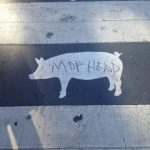
Unlike the ornate Chinese New Year-themed designs painted last year by artist Charles Bergen on the Chinatown Barnes Dance (which you might also remember as the site of anti-Semitic and Islamophobic graffiti), the Columbia Heights intersection will feature simple, clearly demarcated crosswalks.
DDOT plans to do extensive outreach to educate people about how the new crossing system works, and traffic control officers will be stationed in the intersection for at least one week after it goes live.
“The trade-off will be that pedestrians can’t go when [vehicular traffic on] Irving goes,” Branyan says. “There’s a behavior change that needs to happen, but there’s a great payoff if you wait,” namely the ability to get directly where one needs to go.
Bicyclists, who are allowed to follow signals for pedestrian crosswalks, will be also able to ride through, but they’ll have to learn to pay attention to people crossing diagonally.
Construction on the new intersection is slated to begin in June, and it is expected to last three weeks in order to add new pedestrian singles, paint the diagonal lines, and re-cut the curbs to include three ramps instead of two.