 Rachel Sadon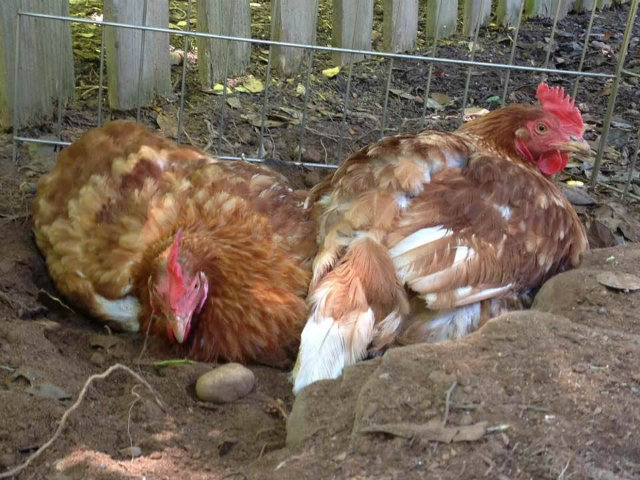
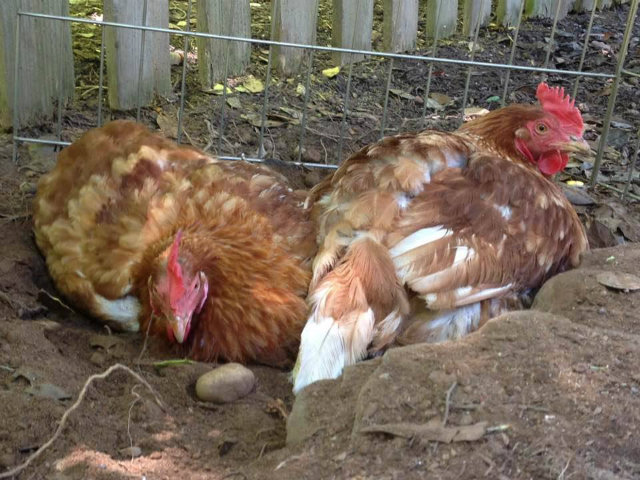 Greta and Tilly are two of the backyard chickens residing in the District despite ambiguity over the law. (Photo courtesy of Stephen Boone)
After Mayor Muriel Bowser moved to unquestionably ban backyard chickens last month, the administration now appears to be tentatively flying in the other direction, tasking Department of Energy and Environment Director Tommy Wells with issuing a set of recommendations for how to move forward on the issue.
He’s starting off by meeting next week with D.C. homeowners that are currently raising chickens in their backyards to ask about their experiences. “I want to understand: What are the risks? What’s the impact on the surrounding neighbors and the environment? And can it be managed and maintained safely?” Wells tells DCist. “Then I’ll make my recommendations [to Bowser] and depending on that, the mayor may or may not task me with moving forward on additional steps.”
The plan is to hold the discussions over the next month or so and issue his recommendations within 45 days. “I think the mayor is very open to hearing what reasonable regulations would look like,” Wells says.
It’s a somewhat surprising turn of events in the latest battle over backyard chickens, which began about a year ago.
A Chevy Chase family had been raising hens in their backyard for three years when the Department of Health came knocking with a notice that they’d have to get rid of the birds within 48 hours or they’d be impounded. D.C. officials maintained that keeping poultry in the yard is illegal under city law, which prohibits exotic animals but does allow for racing pigeons, parrots, and other “captive-bred species of common cage birds.”
Allison Sheedy and Daniel McInnis, both lawyers, weren’t buying the city’s argument. They filed a temporary restraining order to stop the city from confiscating the birds, and argued in a lawsuit that the chickens fall under the category of “captive-bred species of common cage birds.”
Rather than fighting the suit, DOH eventually granted the family a one-year permit to keep their four chickens, which can be renewed annually under the same conditions set forth in the D.C. code—unless the code is subsequently revised.
Another family in the neighborhood went through the same rigmarole of getting an animal control violation notice, then a restraining order, and finally a one-year permit.
When Bowser administration announced her 2018 budget, though, it came with a surprising raft of animal control measures like making it legal to own ferrets, requiring registration for cats, and mandating that dog poop to be cleaned from yards within 24 hours. It also sought to close the loophole that Sheedy, McInnis, and other chicken owners were using to argue their birds are legal.
The move not only to ban backyard chickens, but to do so through the budgetary process, rather than typical legislation, ruffled feathers to say the least.
“If they want to ban our chickens, fine. But put it through the normal legislative process. It’s a representative democracy; the city council will vote on it,” says Stephen Boone, an IT worker who has been raising chickens for three years in Cleveland Park. “They were thinking it would never come up and slip right through everyone’s attention … It should be disconcerting to everyone how the process was pursued by the Bowser administration.”
Sheedy, McInnis, Boone, and around two dozen others came together as a group to fight back. One member “did a legal and historical analysis [of the law] that goes back to 1800s,” Boone says. “Our belief is that they are absolutely legal in D.C.”
The chicken owners flocked to testify at a D.C. Council health committee meeting that lasted for hours, and included open derision from Bowser sparring partner and Ward 7 Councilmember Vincent Gray (he was overheard after one panel saying “well, they certainly made the mayor look like a damn idiot,” WAMU reported). Members of the committee expressed surprise at how much of Bowser’s attention in the budget bill was devoted to the animal regulations (that subject was also mercilessly spoofed in a Post opinion piece). The whole thing was an incredible local government spectacle. Let’s just say, it isn’t every day that oversight hearings make it into an Overheard in D.C. column.
The move to ban chickens also raised the hackles of more than 800 other people who signed a petition calling on the D.C. Council to strike the language from the budget act, which the health committee seemed very prepared to do.
In the end, Bowser pulled all of the animal regulations herself, announcing the decision at a somewhat surreal press conference about the largely routine changes to the budget she initially proposed. “We’re talking about chickens,” the mayor said at one point with a disbelieving laugh.
City Administrator Rashad Young told reporters: “The [budget] timing just fit with what we were doing. This is not a war on pets.”
When reached for comment about next steps, Bowser spokesman Kevin Harris told us in a statement last week that “we are in the process of developing an outreach approach that will include opportunities for robust discussions with the community and residents who currently raise chickens.”
The choice of Wells to lead the administration’s preliminary inquiry is a telling one.
“He’s the father of backyard chickens,” Boone told me before the DOEE director even got involved.
That’s because in 2009, when he was serving as the Ward 6 Councilmember, Wells proposed legislation to create a regulatory framework for backyard chickens.
Wells admits, though, that he wasn’t always quite so enlightened about the merits of backyard chickens or their feasibility in an urban environment.
“In all honesty, when it was first brought to me, I thought it sounded to me, how should I say, um, that it was not a reasonable request,” Wells recalls about the plea from Ward 6 parents to keep chicks that their kids had brought home from school.
But Wells promised to do some research and what he learned surprised him. “After initially thinking it sounded kind of ridiculous, I found out it wasn’t.”
Although his legislation didn’t get a hearing at the D.C. Council’s health committee and never went any further, it still managed to spark vehement debate.
“It was incredibly controversial on the listservs, especially on the Hill East area,” Wells recalls. “There was anger on both sides of the issue. People being anti-backyard chickens or pro-backyard chickens had people leaving the listserv for good. It was quite vitriolic.”
So when the topic resurfaced eight years later, he knew the Bowser administration would be in for another round of heated controversy.
“She asked,” Wells says, of the mayor’s request that he get involved in the issue. “But I also offered.”
While the regulations fall under the health department, there are also issues of concern that fall under Wells’ environmental purview, such as stormwater runoff. Plus, he sounds excited to dig in.
“I want to talk to people who have backyard chickens and ask them how manage waste? How much room do they think is the right amount? Do [chickens] encourage rats or mice or any other things? I’d like to get an understanding of their experiences and their techniques for mitigating impact on the neighbors, ” Wells says, with genuine-seeming curiosity.
In Stephen Boone, Alison Sheedy, and their comrades in chicken arms, he’ll find plenty of experience and enthusiasm.
“I think that there are a lot of regulations we can look at from around the country and have a discussion about the rationale for the different pieces that you might include in a regulation,” Sheedy says, pointing specifically to New York’s law as a possible model. “We feel really optimistic.”
Locally, Rockville has allowed backyard hens since 2015. Over in the other Washington, Seattle denizens have been able to keep as many as eight hens since 2010, and chicken coops have now risen to the level of a luxury apartment amenity.
“I do believe that chickens can be responsibly managed and maintained in an urban area,” Wells says. “But I think that safeguards have to be taken.”