 Rachel Sadon
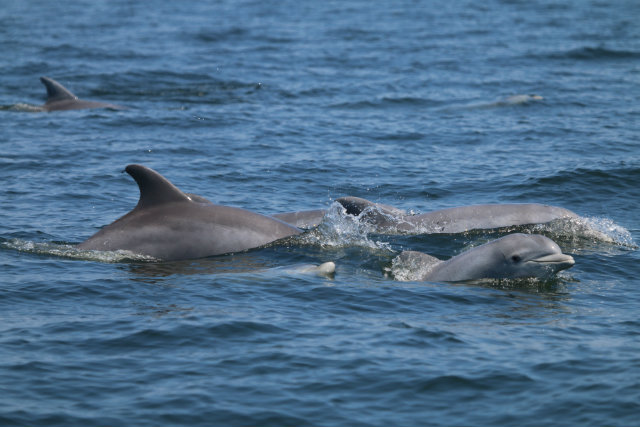 A group of dolphins spotted by the researchers with the Potomac-Chesapeake Dolphin Project. “NMFS Permit No. 19403.” (Photo by Megan Wallen, PCDP)
Barack Obama could be hanging out in the Chesapeake Bay. Dick Cheney and Jimmy Carter may be frolicking in the same Potomac River waters. Lyndon Johnson could conceivably be playing with Dolly Madison nearby. Did I mention these are all dolphins?
From a base near Ophelia, Virginia, Georgetown professor Janet Mann has been naming and getting to know the hundreds of bottlenose dolphins who call the Chesapeake Bay and Potomac River home for part of the year.
“There are a lot of questions. Are the same animals coming back? Where do they go? How stable are the groups? Who are they with? What are they feeding on?” Mann says.
Almost nothing is definitively known about the population. But she is working on changing that, conducting the first major research project on the dolphins of the Chesapeake Bay and the Potomac River.
“Other than a couple of newspaper articles, we have no literature to go on,” says Mann, who has been studying bottlenose dolphins in Australia’s Shark Bay for more than 30 years.
Although she’s been flying halfway around the world each year for decades to study the marine mammals, it was still a surprise to learn that there are dolphins frolicking downstream from Georgetown.
“I’ve not met anyone who actually knew there were dolphins in the Potomac except for people who live right on the water,” says Mann, herself included. It was only once she bought a house on the water that she came to learn about their existence.
“I’m a workaholic and my husband was trying to get me away from my work,” explains Mann, a vice provost for research and a professor in the biology and psychology departments. She was originally resistant to the idea of getting a vacation home, but he persisted, believing they needed a place where she could take a break from her research. They eventually settled on a cottage in the lower Potomac region in 2012.
“The day we closed, we went to the house and I looked in the backyard and I said ‘Oh look, dolphins literally in the backyard,'” Mann recalls. “My husband, in his mind, was like ‘Oh crap.'”
Initially she thought the sighting might have been a one-time thing, but neighbors told her that they regularly saw the marine animals cruising by.
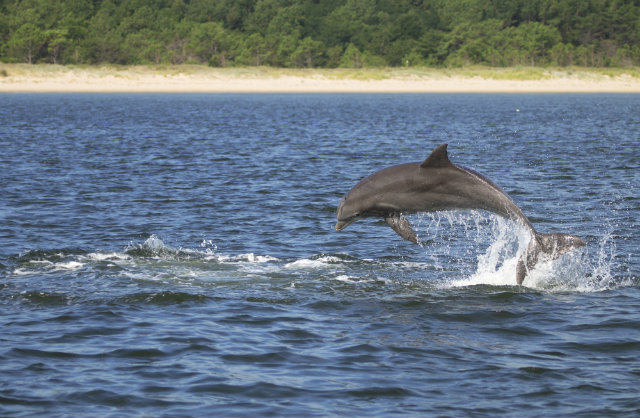 A dolphins spotted by the researchers with the Potomac-Chesapeake Dolphin Project. “NMFS Permit No. 19403.” (Photo by Ann-Marie Jacoby)
In the following two years, there was a major outbreak of the morbillivirus, killing more than 1,000 bottlenose dolphins along the East Coast, which is home to a number of recognized migratory bottlenose dolphin populations, known as stocks. Mann got to thinking that if she’d been collecting data on groups that hang out in the Chesapeake and Potomac, it might have helped understand the situation better.
Thus the Potomac-Chesapeake Dolphin Project was born, and Mann’s place of respite became her new field of research.
Over the course of the first two years of collecting data, the team has identified more than 500 individual dolphins. Given that they’re only sampling once a month in a relatively small area, the researchers believe that only represents a fraction of the total population.
Still, about a third of the animals they spotted in 2016 were repeats from the year before, meaning that some or even all of the dolphins are returning year after year. It’s also becoming clear that this is a vital area for birthing and breeding.
“We know they’re giving birth in the Potomac and the Chesapeake; we see tiny babies just a week old or less,” Mann says, noting that she sees far more newborns in these waters than in Shark Bay. Dolphins have a 12 month pregnancy (very convenient for research), and the researchers also see a lot of sexual activity.
“It seems from our preliminary data that a lot of dolphin populations [congregate in the area]. It may be critically important to several during the birthing and breeding season,” says Ann-Marie Jacoby, a research associate on the project.
Which specific stocks come to the Chesapeake and other big questions, like what the dolphins eat while they’re there and where exactly they go during the winter months, are still awaiting answers.
To keep track of all the individual dolphins throughout the study, the researchers have given them names. This being the D.C. area, they started with the presidents, vice presidents, and their families. Having exhausted that list (“with 500 dolphins, you run out of names quickly,” Mann notes), they’re turning next to Supreme Court justices and then speakers of the House.
“I‘m hoping that we’ll get to know the individuals well enough to recognize them [on first sight]. Like ‘oh look, there’s Hillary Clinton and oh my god, Laura Bush and Hillary are are hanging out together,” Mann says. “We could have Democrats and Republicans working together, in name only amongst the dolphins.” It’s all the more likely that they’ll stumble on odd political pairings because the researchers didn’t take real-life allegiances into account when bestowing the names.
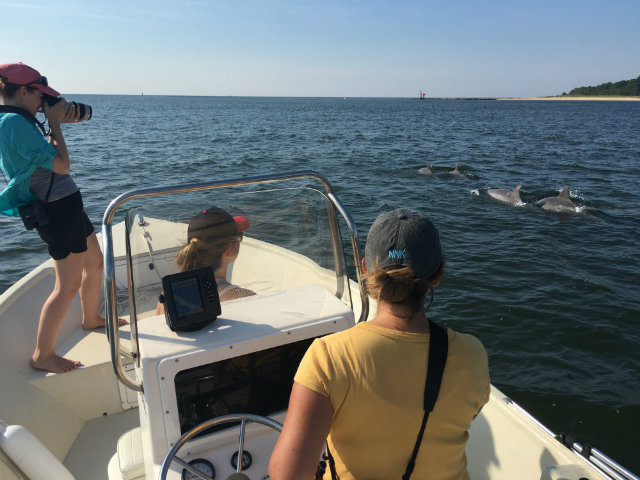 Research associate Ann-Marie Jacoby photographs a group of dolphins, while Professor Janet Mann drives the boat. “NMFS Permit No. 19403.” (Photo Madison Miketa)
It isn’t clear why no one has undertaken this work before, but both Mann and Jacoby say they are amazed that there haven’t been any significant studies of the area’s dolphin population.
“The Chesapeake is one of the most iconic and important estuaries in North America, and even the world,” Mann says, pointing out its relevance for recreation, commercial fisheries, shipping traffic, and sailing. Dolphins are considered an indicator species, meaning that the health of their population can reflect the overall health of the ecosystem or act as a warning for looming ecological threats.
They’re also a flagship species, with the charisma to get people to pay attention to environmental issues and species that don’t have the same cuteness factor.
“If you can use the dolphins to help protect the broader ecosystem so the Chesapeake Bay or the Potomac River, that’s really something,” Mann says. “Wouldn’t it be great if we had not just a livable, swimmable, fishable Potomac all the way up and down but that it was livable, fishable, and swimmable for dolphins further up the Potomac?”
According to historical records, they’ve come as far up as D.C. in the 1800s. The response at the time: to chase and try to kill them.
More recently, sightings have been reported as far north as the 301 bridge, about an hour south of the District (the population seems to be at its peak in July, August, and September).
Because there haven’t been any sustained studies before, it’s hard to say for certain, but the anecdotal evidence from reported sightings seems to indicate that there have been more dolphins in the Potomac in recent years. That also corresponds to improving conditions of the river’s health overall.
“I hope that people look at the Potomac differently,” Mann says. “If it’s clean enough for dolphins in the lower Potomac, and maybe the rest of it if it can keep getting cleaner, there’s no reason why we can’t find a way to make the city river a place that is home to healthy wildlife.”