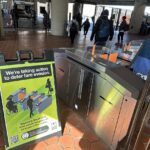
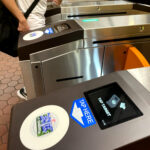
Passengers who try to exit stations without paying may soon be met with sirens at more than 20 Metro stations as the transit system expands a pilot program this summer and fall.
“Fair Share” was set up to deter people from walking through the swing gates at stations without paying, which is the most common form of “fare evasion.”
Metro launched the program on May 1 at Fort Totten and Gallery Place stations to figure out if strategies like adding alarms, securing the gates, putting up new signage, educating employees, and getting extra support from Metro Transit police officers would help reduce fare evasion. Between bus and rail, fare evasion costs Metro about $20 million a year—and the transit agency really cannot afford it.
Metro’s swing gates are located next to the fare gates where people tap their SmarTrip cards to enter and exit stations. They should largely be used by riders in case of emergencies.
The results of the pilot, which were presented to the Metro board on Thursday, show a 91 percent reduction in people getting through the swing gates at Fort Totten after the pilot program compared to a day when the mechanisms weren’t in place.
For the pilot at Fort Totten, all of the swing gates were magnetically secured and had alarms, which has proven to be the most effective deterrent.
At Gallery Place, some of the swing gates were magnetically secured. But because of ADA spacing requirements, others couldn’t be magnetically secured. Instead, Metro officials put large cardboard boxes that read “stop” and “this gate is now secured” in front of the gates. But after about a week, passengers realized that the boxes were actually the only thing stopping them, and they proceeded to go through the gates, according to Metro’s report.
Most station managers surveyed during the pilot told Metro officials that they were “generally supportive” of the fare evasion efforts, according to the report. But most of them also told officials that the tactics are most effective when combined with extra transit police. (Because of the risk of assault, Metro directs station managers not to confront passengers who don’t pay.)
Station managers also pointed out that some people were still finding ways to exit without paying such as jumping over gates and following closely behind paying customers.
Metro is continuing to evaluate the program and has plans this summer and fall to expand to 20 stations with high rates of fare evasion.
Fair Share Pilot Presentation by Christina Sturdivant on Scribd