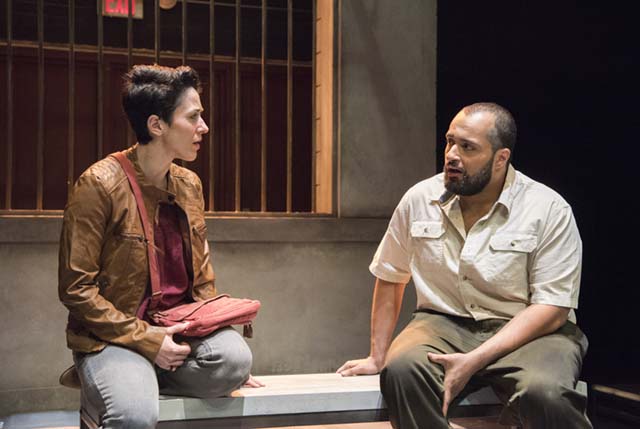
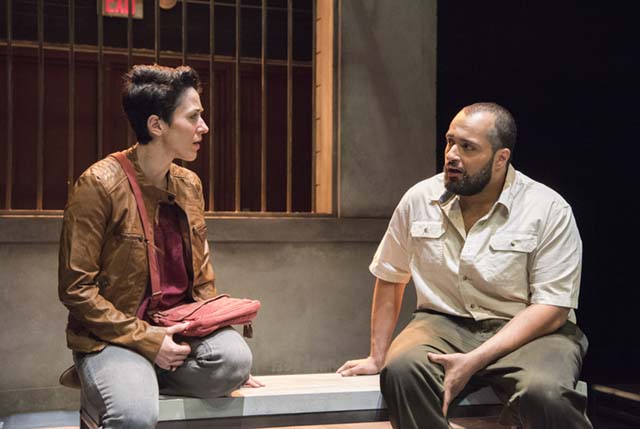
 Alyssa Wilmoth Keegan as Talia and Ahmad Kamal as Samer (Stan Barouh)
By DCist contributor Allie Goldstein
The Return opens on the stark set of an auto shop as the audience sits on opposite sides of the theater to complete the four walls of this jail.
As the sirens of Herzliya wail outside, Talia (Alyssa Wilmoth Keegan) enters, searching for Samer (Ahmad Kamal), an ex-lover who she turned over the authorities after discovering he had lied to her about being Jewish. When she finds him, the two perform an autopsy of their forbidden relationship over four intense acts.
The play first premiered in Hebrew to a Haifa audience, and its debut at Atlas Performance Arts Center brings the human story of the Israeli-Palestinian conflict to an American stage. With it comes timely parallels to the uncomfortable history of citizen surveillance and racist policing in the U.S.
Part of Mosaic Theater Company’s Voices from A Changing Middle East festival, The Return portrays Israel as a police state that micromanages the lives of even the most compliant Palestinians. After the “crime” of sleeping with a Jew, Samer was sent to prison where he was forced to burn the tattooed name of his grandmother’s village off his arm. Even once he’s “free,” he’s not allowed to leave the country and must check in regularly with the police—a life-on-a-leash theatrically highlighted by the fact that Samer is always in the shop when the lights go up, while Talia comes and goes.
Based on the real case of a man sentenced to 18 months in prison for “rape by deception,” Samer is a Palestinian “who not only surrenders but is willing to erase himself,” said Edward Mast (who co-wrote the play with Hanna Eady) in a June 8 talk-back. The Return conveys the idea that “your compliance [as an Arab] doesn’t matter. It’s your existence that’s in the way of the State of Israel.”
The play certainly makes this point, but could have done so with more showing and less telling. Keegan and Kamal give convincing and at times moving performances, but are unable to overcome the script’s expository dialogue. While at first it seems like this exposition may be for the benefit of surveillance cameras, this potentially interesting thread (are they watching? are they not?) is left dangling and forgotten by the third act.
John Vreeke’s direction produces explosive, taut moments, but also misses opportunities to explore Talia and Samer’s chemistry. The characters rarely touch over the play’s duration. During one especially nostalgic scene, the two sit apart from each other on a bench, staring straight ahead almost as if watching their memories on TV. Then again, their romantic backstory also leaves something to be desired: the playwrights give us little more than a clichéd image of a passionate evening on a rooftop to convey their protagonists’ supposedly profound connection.
No wonder Samer spends nearly half of the play’s 70-minute runtime trying to get Talia to leave the auto shop. When he finally does let her in emotionally, it’s unclear whether his change of heart is genuine or yet another act of acquiescence to power—in this case, to the woman who caused his predicament and is now insistent on “saving” him. If only Talia knew what Mast came to understand: that “solving racism and persecution is not something we solve one-on-one.” That would have saved Samer a lot of trouble.
The Return is at Atlas Performing Arts Center through July 2. $40. Buy tickets here.