Rachel Kurzius
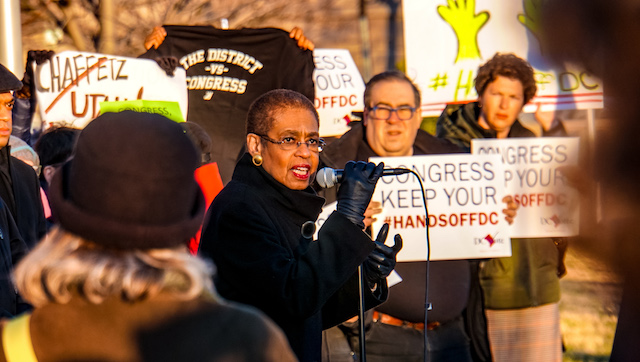 D.C. Delegate Eleanor Holmes Norton speaks at the Hands Off D.C. rally. (Photo by Ted Eytan)
Federal law has residency requirements for people appointed as federal district court judges, U.S. attorneys, or U.S. marshals. The idea is that if you’re going to serve a jurisdiction, you ought to live there.
But there’s one major exception—those appointed to serve in the District of Columbia.
Now D.C. Delegate Eleanor Holmes Norton is calling on colleagues in the Senate to ensure that the people nominated for the federal district court in D.C. pledge to live here, after President Donald Trump did not consult her about his nominees.
“We are frankly offended that, alone in the U.S., our District is a district where you can live anywhere and still get a federal position serving the District of Columbia and its residents,” Norton says. “They have a deeper familiarity with residents when they don’t cross state lines to go home every night.”
Trump has sent to the Senate three nominations for federal judgeships in D.C., and only one of them—Timothy Kelly—lives in D.C. Dabney Friedrich is from California and Trevor McFadden lives in Virginia, according to the White House.
Trump is also nominating Jessie K. Liu, a former assistant U.S. attorney in D.C. and current deputy counsel for the Treasury Department, as the U.S. attorney for D.C., replacing Channing Phillips. Liu resides in Virginia, and was on Trump’s Department of Justice transition team.
The U.S. Attorney’s Office for D.C. is the largest in the country, with more than 300 prosecutors. It is also unique because, alone among U.S. Attorney’s Offices, it prosecutes local crimes in addition to federal crimes.
“You could be U.S. Attorney for the District of Columbia, where almost all of your jurisdiction are local crimes, and not live here,” says Norton. “But if you were U.S. Attorney for the Eastern District of Virginia, even though you didn’t have control over local cases, you’d have to live there … I’m interested in equality with other jurisdictions.”
As an example of the impact of having residency requirements, she gives former Attorney General Eric Holder, who served as the U.S. Attorney for D.C. from 1993-1997 after being recommended by Norton. He was the first African American in the role, which oversaw crimes in a city with a majority black population.
“He had initiated what no U.S. attorney had ever done before,” says Norton. “He put U.S. attorneys in the neighborhoods—they’re still there.”
A Senate tradition known as the “blue slip” gives senators a chance to weigh in on federal judgeships in their state. D.C does not have a senator, though.
Under the Democratic presidencies of Bill Clinton and Barack Obama, Norton recommended officials for nomination, using a commission to screen potential candidates, as in the case of Holder. She says that one requirement during her process was that nominees either live in D.C., as most did, or commit to moving here.
Norton requested that Trump consult her about D.C. appointments, as President George W. Bush had, but he has put forth nominations without her input. Trump did not respond to her letter, but she did send along a list of preferred nominees.
Have any of her picks been nominated by Trump? “If they were, I certainly would have told you about it,” says Norton.
She says that she knows nothing about the nominees beyond what anyone could read in press reports, and has not met with them. “They have not asked to see me,” she adds. “Perhaps they will—I hope they will.”
Norton introduced a bill in April that would require that federal district court judges, U.S. Attorneys, and U.S. Marshals serving D.C. to live here, though it has not gotten any traction on Capitol Hill yet.
Congress did once see the wisdom in having residency requirements for D.C. Court judges, however. Under D.C. Code established by Capitol Hill, no one can be nominated to a D.C. Court judgeship unless he or she “is a bona fide resident of the District of Columbia and has maintained an actual place of abode in the District for at least 90 days immediately prior to the nomination, and shall retain such residency while serving as such judge.”
Updated with information about residency requirements for D.C. Court judges.