Brookland is exploding in popularity and population density. That’s not terribly unusual for D.C. these days, but as the home of the Catholic University of America, there are some some special characteristics and dynamics involved. It’s also relatively far away from downtown corridors, giving it the feel of a small town enclaved in the big city—a feeling residents are trying strenuously to preserve. Not all (or maybe any) of its residents would call this a disadvantage, but Brookland is not an overly well-known neighborhood outside its function as the cradle of Catholic U. So let’s shine some light on these city blocks, with 10 things you may not know about Brookland.
 (Photo by kellybdc)
1. There’s A Big Monastery Here
Brookland’s Catholic roots go deeper than the college. Some even know the neighborhood as “Little Rome.”
Different Catholic orders own various tracts of property in Brookland and surrounding neighborhoods. The Paulists, for example, sold a large portion of its property in the nearby Edgewood neighborhood to a developer for a 237-unit townhouse development. Catholic University used its own land to develop the $200 million Monroe Street Market project, five sparkling blocks of housing and retail space near campus.
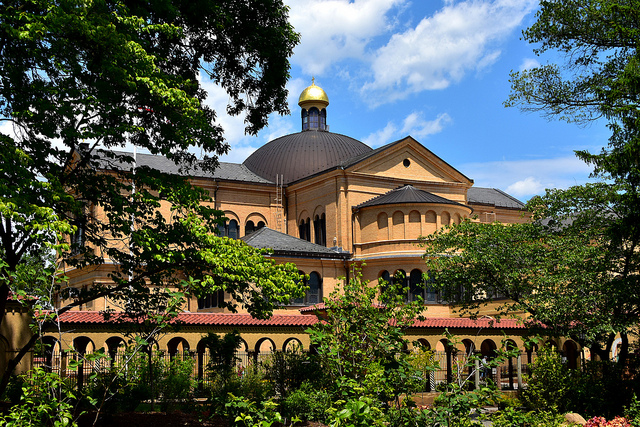
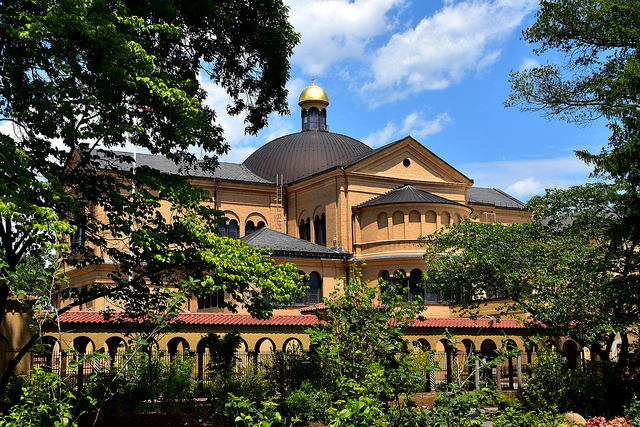
But perhaps the most well-known as a destination, though, outside of the university, is the fully functioning Franciscan Monastery. It’s pretty huge and impressive.
Even its name—the Franciscan Monastery of the Holy Land in America—evokes elegance. The place only gets more so as you walk through the gorgeous church, gardens, and catacombs, all replicas of originals found in Israel and Rome.
It’s all free to visit, by the way, and you can wander on your own or take a guided tour.
In related news, you can also check out the Basilica of the National Shrine of the Immaculate Conception, home to over a century of historic records, the world’s largest collection of contemporary ecclesiastical art, and the papal tiara given up by Paul VI.
The Franciscan Monastery of the Holy Land in America is located at 400 Quincy Street NE.
 (Photo by Nathan Jones)
2. There Are Lots Of Gardens
It’s not just a monastery thing. It’s a thing thing.
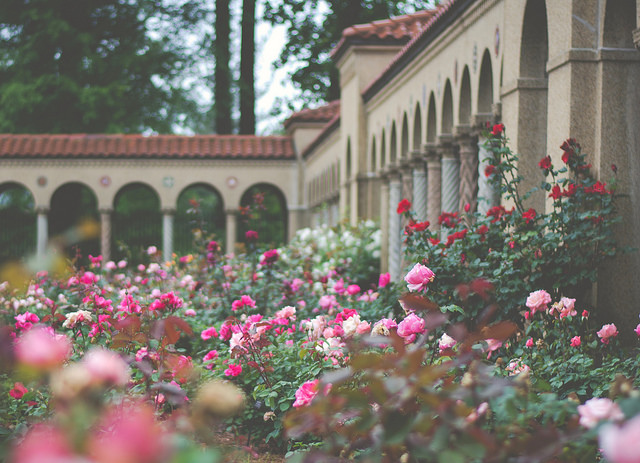
“Gardening is a tried and true Brookland pastime,” writes one of the authors of The Brookland Bridge, a very good neighborhood blog. “One of the things that separates Brookland from other D.C. neighborhoods is the sheer amount of space surrounding the many lovely homes here. Many lots average around 1/5 acre or more, providing lots of space for kids of all ages to run free and enjoy being closer to nature. All that space lends itself to another purpose as well: there are many artists who live around here, using the land as their preferred palette to create amazing gardens full of flowering plants, lush shrubs, and shady trees.”
A good part of the credit for said garden scene goes to the Greater Brookland Garden Club, which was founded in 1998 and remains active to this day. They’re behind the neighborhood’s annual home and garden tour, which raises funds to maintain several area gardens and community projects.
Outside the university and monastery, there aren’t any specific public destinations where one can view specific landscapes, but as one traverses the streets here, the culture of horticulture becomes evident. Maybe it’s not the Garden District of New Orleans just yet, but it’s a pretty decent equivalent for stone-and-glass D.C.
And hey, if you want another true destination, the U.S. National Arboretum is just a few miles away.
 (Photo by Jill Slater)
3. There Is A Serious Arts Community Here
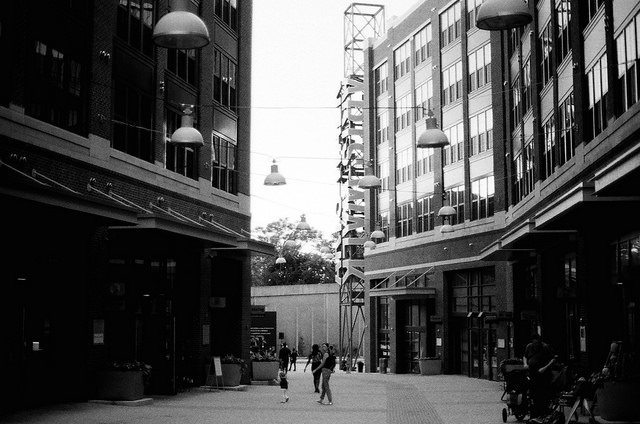
Remember the aforementioned Monroe Street Market? It’s home to no less than 27 artist studios, which together comprise the Arts Walk at Monroe Street Market.
Overseen by CulturalDC, a local nonprofit organization, the arts walk is a pedestrian-oriented area near the local Metro stop. All told, about 40 artists are here at any given time. There is art on display ranging from paintings to leather goods and performances in areas ranging from drama to poetry. Although different artists and performances are available at different times (each studio makes its own hours), there are recurring weekly and monthly events—the Saturday farmer’s market is one notable example—plus special occasions like beer gardens and film screenings.
But the neighborhood’s arts scene long predates the walk; Dance Place has operated there for more than three decades.
 This could’ve been yours Brookland. (Photo by Mike Maguire)
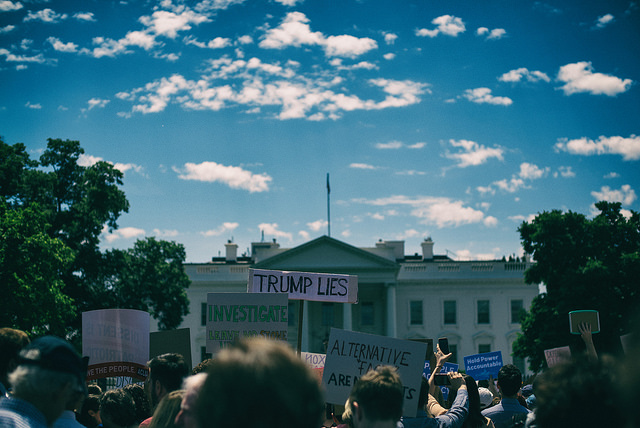
4. It Was Almost The Home Of A New White House
There’s no guarantee it would have been white. But if I’d said “Executive Mansion” it wouldn’t have been nearly as eye-popping.
In any case, in 1865, according to research from Bygone Brookland (this neighborhood has some good blogs!) a large parcel of land (more or less where Catholic University now resides) was put up for sale—at the same time that “the government was giving serious consideration to finding a new location for the Executive Mansion.
According to Bygone Brookland, “the established White House site was considered unhealthy in the summer, thanks to the putrid Washington City Canal (Tiber Creek) that ran through downtown and spilled into the Potomac in the swampy area just south of the mansion.”
Officials were zeroing in on Brookland, even appearing to begin considering an offer for the land. But then Ulysses S. Grant was elected president and the whole idea disappeared. Go figure.
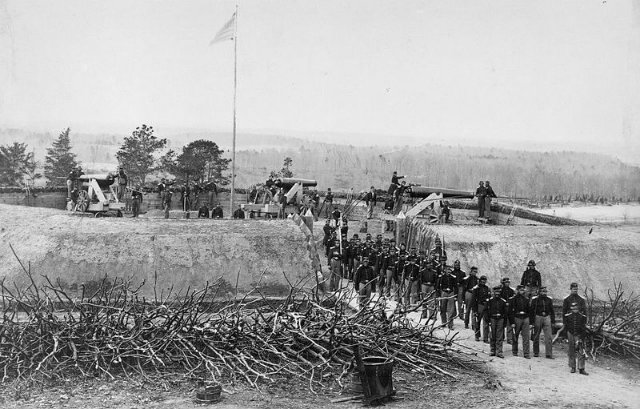 Fort Slemmer was located on what is now the far north end of Catholic University’s campus during the Civil War. (Photo courtesy of the United States Library of Congress)
5. During The Civil War, Brookland Residents Took Serious Damage—From Union Soldiers
Though they didn’t own slaves for much of the war because of the District of Columbia Compensated Emancipation Act of 1862, many D.C. families— particularly those in relatively bucolic Brookland—had at one time been slaveowners.
As a result, according to the historical blog Bygone Brookland, many of the area’s wealthy landowners had their homes badly damaged by Union soldiers during the war. Property was destroyed, and sometimes even worse. Apparently it got pretty macabre.
Thomas Berry, one of the estate owners of the time, related his own story (per Bygone Brookland): “A party of them even went so far with their vandalism, as to break into the family vault, and desecrate the remains of the dead, tearing the silver-plated handles and screws from the coffin which contained the ashes of his father; while the coffins of his infant brother and sister were broken open at the same time and their bones left lying on the floor of the vault; that when John Maguire, an honest Irishman, went to them, and with tears in his eyes entreated them to desist and respect the dead, and not to desecrate the remains of the family, as they had been good to him, he was met by these unfeeling men with jeers and laughter, and the remark that they were all rebels, and that they had heard there was jewelry buried with the dead.”
What?
Ladies and gentlemen, the most fabulously named band in the history of Western civilization: it’s Force of Habit!
Is that the best or what? Oh, you don’t even need to answer.
According to a recent Washington Post write-up, the band is actually four nuns and two monks, but it all adds up to one smokin’ sextet, laying down rock and jazz covers until the break of fast.
The group comprises Sister Miriam Holzman on piano, Sister Peter Grace Weber on bass, Sister Louis Marie Zogg playing saxophone, Sister Mary André Thelen on trumpet, Brother Brad Elliott on the drums, and Father Father Jude DeAngelo, the university chaplain and director of campus ministry, as lead vocalist.
Previously known in a similar incarnation as Nun of the Above (I love these people!), don’t yet have a public website or a Twitter or a performance schedule or anything like that, but you have to imagine the spirit will move them in that direction sooner or later. At least if there is a, well, you know.
 (Photo by Ted Eytan)
7. A Pioneer Of Medicine Is Commemorated Here
Charles Drew grew up in D.C. before heading off to school. He eventually earned a doctor of medical science degree from Columbia University in the 1930s.
He was the first black student to do so at Columbia.
Dr. Drew went on to become a celebrated surgeon, educator, and researcher, specializing in blood transfusion and storage. Have you seen or donated blood in a bloodmobile? Charles Drew invented that.
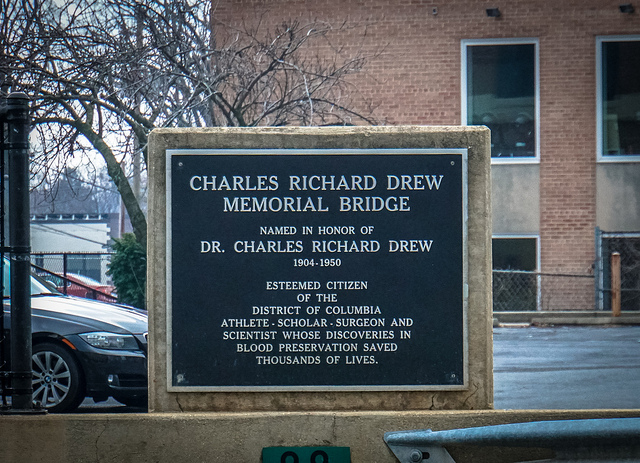
Although he doesn’t appear to have ever actually lived in Brookland (he grew up in Foggy Bottom), the bridge portion of Michigan Avenue that most people simply call “the Michigan Avenue Bridge” is actually the Charles Richard Drew Memorial Bridge. It’s a deserved, if slightly under-the-radar, celebration of a real, honest-to-goodness trailblazer.
 (Photo by comunicom.es)
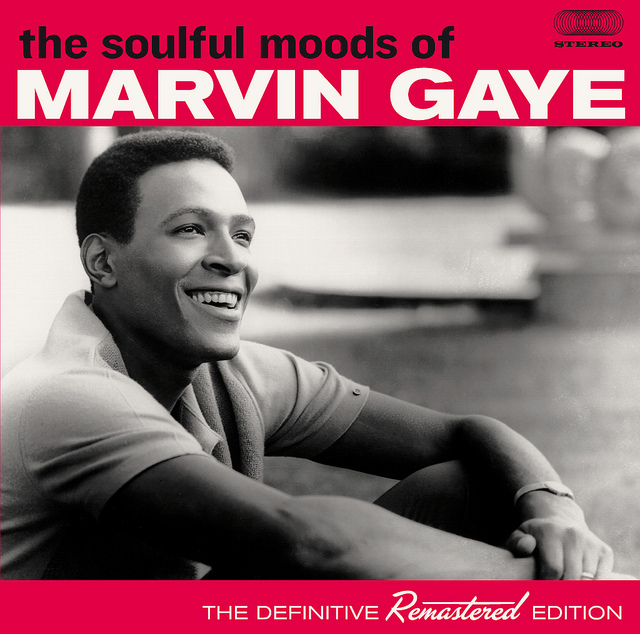
8. Marvin Gaye Recorded Music Here
In the late 1950s and early 1960s, soul legend Marvin Gaye found himself spending time in Brookland.
Gaye lived and worked all over the city for much of his life, and that includes at 2614 Rhode Island Avenue, according to Washingtonian. Gaye worked with his group and even recorded music in this basement.
Oh, and the homeowner at the time? One Bo Diddley. Ever listened to Bo Diddley Is a Gunslinger? He recorded it here.
 (Photo by inkandserif)
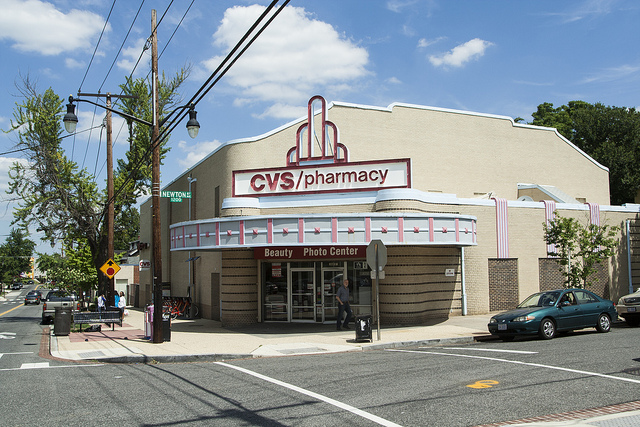
9. Their CVS Pharmacy Is On The National Register Of Historic Places
The Newton Theater is a classic example of the art deco style of architecture. It was designed in 1937, and 70 years later, it was on the National Register of Historic Places.
But along the way, times got tough, as they do, and the theater closed in 1979. It re-opened in the 1980s as a live music venue, but never quite made it and closed again.
Then, in one of the more glaring examples of architectural hermit-crabbing, CVS crawled into the theater’s shell, but did so while preserving the building’s character and signage.
The CVS Pharmacy, formerly the Newton Theater, is located at 3601 12th Street NE.
 (Photo by nospmas311)
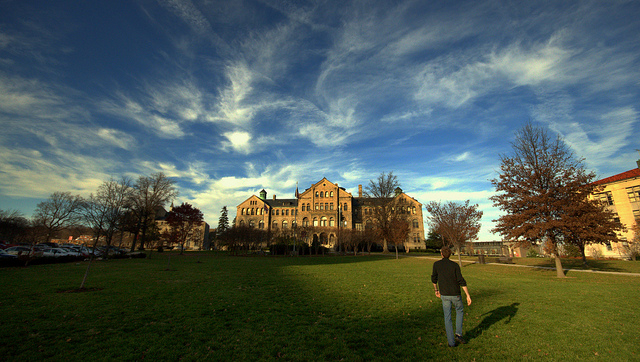
10. A Bunch Of Really Famous People Went To Catholic University
Peruse what appears to be an accurate and thorough list from Ranker, or, if you don’t feel so inclined, take my cliffs notes version: It’s a pretty long list!
Many of them appear to be from the arts and humanities end of the spectrum, as you might expect, given the robust range of offerings (including all religious studies) that it offers in these areas.
An A-list sample, with names in alphabetical order: Maureen Dowd, Ed McMahon, Susan Sarandon, Jon Voight, Brian Williams. That is a formidable list, no matter the alma mater.
Previously:
Ten Facts You May Not Know About Anacostia
Ten Facts You May Not Know About Dupont Circle
Nine Facts You May Not Know About The Southwest Waterfront
This post has been updated with information about the Greater Brookland Garden Club.