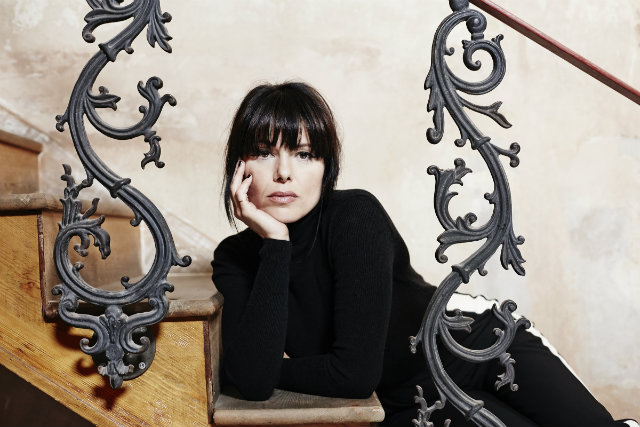
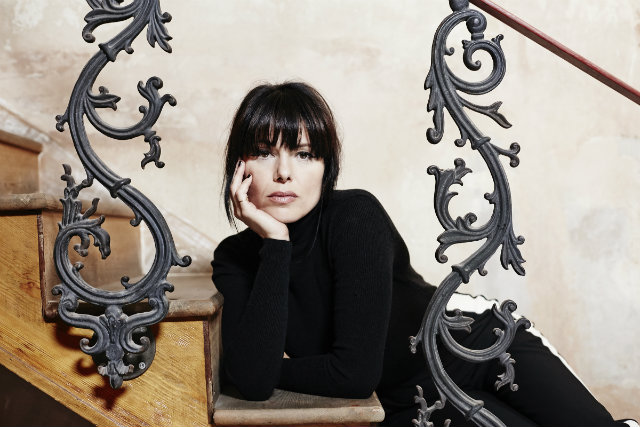
 Imelda May opens for Elvis Costello tonight at Wolf Trap (Photo by Roger Deckker).
By DCist Contributor Chris Klimek
The Irish singer-songwriter Imelda May may be a little more anonymous on the sidewalk than she was a few years ago, having traded in the conspicuous architectural blonde curl she sported as a rockabilly diva for a quieter coif with brunette bangs. But on her fifth album, Life Love Flesh Blood, her first collaboration with Americana legend T-Bone Burnett, she sounds more assured and distinct than ever. Once a reliable purveyor of sweaty-rave ups like “It’s Good to Be Alive” (which she performed on The Tonight Show with Jay Leno in 2013, during that show’s bizarre post-Conan O’Brien, pre-Jimmy Fallon idyll), she’s now written a set of torch songs, ballads, and country & blues numbers that chart her journey through the world as a newly single (and then newly coupled) woman over 40.
DCist reached her by phone—and struggled to hear her over Elvis Costello’s soundcheck—in Richmond, Virgina. She performs with Costello at Wolf Trap’s Filene Center tonight.
This interview has been lightly edited for clarity.
DCist: You’re playing a mix of a big outdoor sheds as an opener and smaller indoor venues as a headliner this month. Is it difficult to scale your show appropriately when you’re playing such a mishmash of venues?
I have to get my time right, obviously, because I’m doing a 40-minute set opening for Elvis. But I don’t change too much for other people. I tend to do what I want. I learned that early on in my career: If you changing for everybody, then no one knows who you are or what you do. If you try to please everybody, you end up pleasing nobody. So I just do my own thing and hope that people like it.
What about balancing material from your new album with your expanding catalog? Do you have any particular philosophy about constructing a setlist?
I’m adding a few old songs, but I’m doing mostly the new album. I’m just so excited about this album, I’ve been dying to play it.
The album is very direct and—I’m trying not to say confessional here. But a lot of the lyrics are less oblique than you’ve been in the past, and you always have a few co-songwriters credited for the first time. I wonder if that’s a contradiction: An album that feels like your most personal one is the first to feature other songwriters.
No, no. I’ve always written alone. I wrote 38 songs for this album, five of which had cowriters. [Life Love Flesh Blood features two songs co-written with Patrick Davies, two written with Paul Moak, and one with Angelo Petraglia.]
Sorry, did you say your wrote thirty-eight songs for this record? [The standard version of Life Love Flesh Blood features 11 songs, though the iTunes Deluxe edition has fifteen.]
Yeah, I wrote 38 songs. I’d never co-written before, and I wanted to see how other people write songs. So I wrote with four writers. Five songs on the album [have a co-writer]. And those were me and one other person sitting in a room until we finished the song. I like to write. I don’t want someone else writing my songs. It’s quite a personal thing, to get in a room with somebody and write. So we used five of those, and the rest are my own.
I didn’t hold back with any of them. They were open-minded, nice, talented individuals. Otherwise I wouldn’t have been writing with them. Mostly I write the lyrics anyway. I was just wanting them to hear my musically, more than anything. I just get on with the lyrics myself.
Is that typical for you, to write two or three times as many songs as you can use on one record? Do you keep your outtakes in a drawer for the next project?
No, I never use old songs. On my other albums I had a lot of [extra] songs, too, but I never keep them and use them because by that point I’m in another place in my life. It doesn’t fit well. I like to keep what I’m writing and performing current. And if they’re not good enough to go on this album, they’re not good enough to go on another album. I’m quite critical of my own songs.
I read that you sent your demos to T-Bone Burnett, who produced the album and he encouraged you to keep them as unadorned as possible.
T-Bone is amazing. When I make a demo, I make it close to a finished product. He said, “No, I want to hear the raw stuff. I want to hear where this came from.” I was mortified for him to hear my awful demos of me playing bad guitar, but that’s what he wanted.
We had a lot of meetings before [we went into the studio]. For each song, he wanted lots of references: movies, moods, visual references. He would write all that down as I was talking to him about it. We did a lot of prep before we recorded. But I didn’t meet the band until the day before, because he likes to keep things fresh.
You’ve also mentioned Bono, with whom you’ve performed at U2 concerts, as someone with whom you consulted on this album. What sort of advice does one get from Bono?
He’s just really kind. He said, “If you get stuck, just give me a call.” We all need someone who’s not involved with them to listen to our songs. And I had too many songs. I couldn’t decide which ones to keep and which ones to lose. He’d help me with things like that.
He also hounded T-Bone to get it right. T-Bone asked me, “Could you please get this small Irishman to stop calling me?”
That’s funny. Like him, you’ve been performing since you were a teenager. Do you remember a moment when you realized that you had this voice that can quiet a room, and that people should hear it?
Oh God, I never had a moment like that. I just loved doing it. I started in a pub in Dublin in a jam session when I was 16 and I never stopped. I couldn’t not do it, if that makes sense.
You played Manchester just a couple of nights before the terror attack at the Arianna Grande concert, and you spoke about that a few nights afterward, at a gig in Dublin. Has that event changed what it feels like to be out on tour in front of people every night?
No. It makes it even more important to keep going. It makes me more determined. You do keep your eye on things more: If you see someone coming towards the stage, you’re a bit more aware. But I’m just grateful people are still coming to gigs. That’s what we all have to do.
Imelda May opens Elvis Costello & The Imposters at Wolf Trap’s Filene Center on Thursday. Tickets are $35-$85.