Rachel Kurzius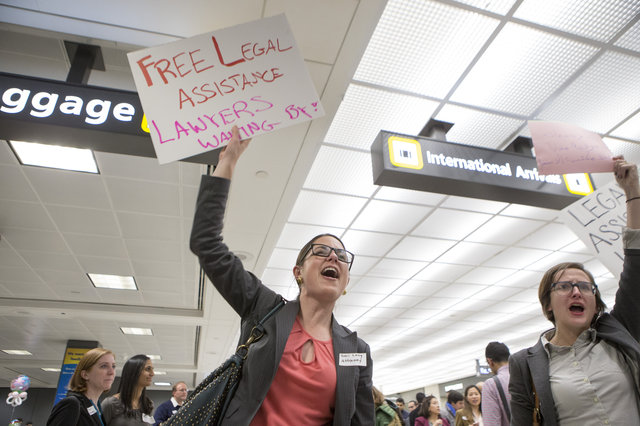
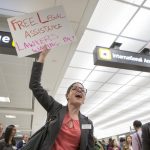
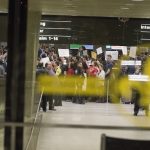
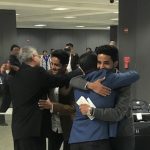
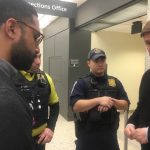
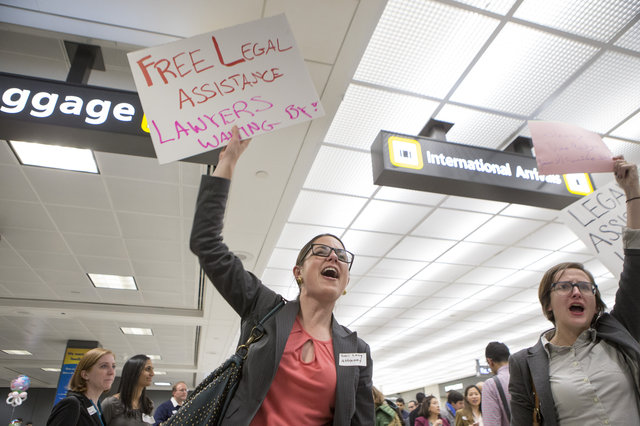 Lawyers and advocates posted up at Dulles International Airport in late January, when President Donald Trump signed the first travel ban. (Photo by Alex Edelman)
A group of lawyers and advocates are returning to Dulles International Airport on Thursday evening as parts of President Donald Trump’s travel ban take effect at 8 p.m.
“We going to be here to support any family members who are waiting, and monitor the situation to make sure no one’s rights are being violated,” says Sirine Shebaya, a senior staff attorney with Muslim Advocates and a volunteer with Dulles Justice, which is what the coalition of volunteers has christened itself.
Dulles Justice initially formed when Trump signed an executive order in late January that barred people from seven majority-Muslim countries from entering the U.S. for 90 days and suspended the refugee admissions program for 120 days. It led to confusion and chaotic scenes at airports across the globe, including Dulles. That administration quickly suffered a series of losses in court against the American Civil Liberties Union and a number of state attorneys general. It is currently blocked from implementation.
So Trump tried again, with Travel Ban 2.0, signed in March, which prevented travelers from six majority-Muslim countries from entrance.
Dulles Justice was still a constant presence at the airport, and was ready for the ban’s implementation when a federal judge in Hawaii blocked it from taking effect, a ruling upheld in a series of appeals court decisions. (Dulles Justice filed an amicus brief in opposition to the executive order.)
Members of Dulles Justice decided to stop staffing around-the-clock volunteers at the airport’s international terminal in early April, but now they’re headed back.
This week, the Supreme Court said it would weigh the ban’s constitutionality the fall. In the meantime, though, the high court reinstated part of the ban that stops the U.S. from issuing new visas to people from Iran, Libya, Somalia, Syria, Sudan, and Yemen, though the it can’t be enforced against “foreign nationals who have a credible claim of a bona fide relationship with a person or entity in the United States.”
So parts of the travel ban will take effect at 8 p.m. on Thursday, even as uncertainly about how, exactly, it will be implemented continue to swirl.
“I don’t think there’s going to be the chaos at the airports that we saw the first time around,” says Shebaya. “Most of the problems are not going to happen in the U.S.—they’re going to happen abroad.”
Still, though, a skeleton crew of between five and ten Dulles Justice lawyers will be on the scene. “It remains to be seen how this will be implemented,” says Shebaya. “We’re retaining a presence on the ground to make sure implementation happens as it should.”