By DCist contributor Marsha Dubrow
Author Sylvia Plath committed suicide in 1963 at the age of 30, an act that has overshadowed her brilliance while perhaps enhancing her fame. Through photos, archival material, and Plath’s visual art, a poignant, well-rounded exhibit at the National Portrait Gallery reveals an unexpected whimsy and even joy to a writer best known for a stark bleakness.
In her autobiographical novel The Bell Jar, Plath fictionalized her first suicide attempt, which nearly killed her at age 19 in 1953. The book describes a nervous breakdown, treatment with overly-high-voltage electroconvulsive therapy, and recovery under the care of a female psychiatrist.
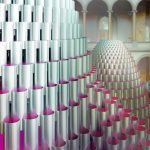
The novel inspires Jenny Olivia Johnson’s interactive installation Glass Heart (Bells for Sylvia Plath), which consists of eight glass bell jars that, when tapped, turn on LED lights and make delicate sounds—ethereal music as well as snippets of Plath reading poems such as “I Thought I Could Not Be Hurt,” written when she was 14 years old.
Glass Heart “creates a community in the gallery. People come together to ‘play’ the bell jars, and they connect with each other and with (Plath), and feel less alone,” says Dorothy Moss, a National Portrait Gallery curator, who co-curated the exhibit with Karen Kukil of Smith College, Plath’s alma mater.
Artifacts include Plath’s Girl Scout uniform, with 20 badges; her long caramel-colored pony tail with her mother’s inscription; the writer’s two-tone green Royal manual typewriter; photographs; manuscripts showing her many edits; and self-illustrated journals and letters. She had intended to major in studio art at Smith College in 1950, where she eventually returned after her breakdown and graduated summa cum laude.
One of many items that have never been displayed in public is Plath’s Triple-face Portrait, a vividly colorful abstract self-portrait that illustrates her intellectual, creative, and sensual sides—painted when she was only a high school senior.
“Plath relished manipulating her image,” especially in her self-portraits and photographs, says Moss. One of the most striking is a Marilyn Monroe-inspired snapshot of Sylvia as a smiling bleached blonde in a white bikini, lying on a beach. It’s an image at odds with the perception of Plath’s depressive personality (more in line with that is a photograph of herself she pasted into a 1953 journal, where she wrote, “Look at that ugly dead mask…like the death angel.”)
A slab of Plath’s elm wood writing desk, another item never previously displayed, was originally cut for a coffin lid. The piece was sanded by Plath’s husband, British poet Ted Hughes, who wrote the poem “The Table” about it.
The shadow of Hughes, who met Plath at a Cambridge party when she was in England on a Fulbright scholarship, sometimes hangs over her legacy. But for once, he takes a back seat in this exhibit.
“Plath had many many boyfriends before she met Ted Hughes,” says co-curator Kukil. But it was a fateful junction. “Here was a man as huge as his poetry, and she went up to him and recited one of his poems.” The next day Plath wrote “Pursuit,” which she described in her journal as “a full-page poem about the dark forces of lust … dedicated to Ted Hughes.” The poem’s second line foreshadows his fatal effect, “One day I’ll have my death of him.”
They married less than four months after they met. Six years and two young children later, Hughes left Plath for another woman, a betrayal that contributed to the despair that led to Plath’s suicide.
Nineteen years after Plath died, she won the 1982 Pulitzer Prize in Poetry for The Collected Poems, published the year before. Kukil told DCist, “If she had survived, I think she could have written for Monty Python.” The co-curator wants to dispel the morose “stereotype of her … she was an incredibly brave, fearless, and intensely intelligent woman.”
One Life: Sylvia Plath is on view through May 20, 2018 at the National Portrait Gallery, 8th and F Sts NW. FREE. Gallery hours are 11:30 a.m. to 7 p.m. every day except Christmas Day. Check out the Marlene Dietrich exhibit while you’re there.