 Rachel Sadon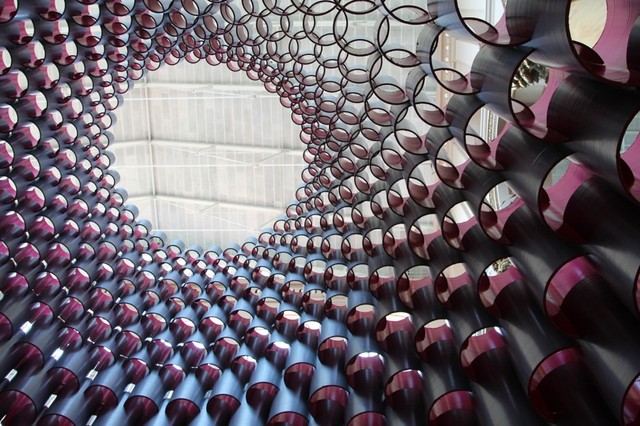
Trying to yell at your family member across the Great Hall of the National Building Museum is a little like trying to scream across a football field.
“It feels like you’re outside in the middle of a big field, an expansive space, because there’s nothing for the sound to reflect off of. If you say something standing about 10 feet away from someone you almost can’t hear it,” says Jeanne Gang, the founder of Studio Gang, which designed the latest summer exhibit to fill the center of the museum. “We wanted to create spaces that would encourage people to gather and interact within the atrium, where the acoustic properties would be noticeably different.”
Enter Hive, a set of three domed chambers constructed out of more than 2,551 wound paper tubes of various sizes. Museum-goers can wander in and out of the exhibit—the tallest structure ever built in the atrium—and notice the difference in sound for themselves, testing the musical waters with instruments built out of common building materials (like a tubulum made out of PVC pipes).
“The whole structure acts like a clearing in the forest rather than a field,” says Gang, whose innovative work won her a MacArthur “genius grant” in 2011. “The tubes in a way are like the trunks of trees where you get the bouncing of sound around you.”
Opening on July 4, Hive is the latest iteration of the National Building Museum’s hugely popular summer party exhibitions, following last year’s angular Icebergs, the playful Beach, and the labyrinth Maze.
“We are more excited than ever to celebrate the opening of this year’s rather buzzworthy installation … I did not write that,” said National Building Museum director Chase Rynd in remarks to journalists today. “Hive takes us to dazzling heights this summer.”
While the enormous scale of the Great Hall created a logistical nightmare for each of the previous summer exhibitions, Hive’s design added the challenge of a huge, weight-bearing structure.
They chose to build it out of 90 different size of paper tubes, a commonly used building material (the magenta enlivening the interior was inspired by all the pink that descended on D.C. for the Women’s March.)
But it was a totally new application for the material; both structurally and in how they are connected, using slots. Engineers conducted crushing tests to ensure that the whole thing doesn’t come tumbling in on itself.
“It has to span over the top of our heads without falling down and be safe and be constructible,” Gang says. “This has all the constraints of any real building. It doesn’t have wind, but it does have gravity.”
Hive will be open to the public from July 4 through September 4. Admission to the installation costs $16 for adults, $13 for youths/students/seniors, and $10 for Blue Star Military Adults. Tickets are free, though still necessary, for National Building Museum members.