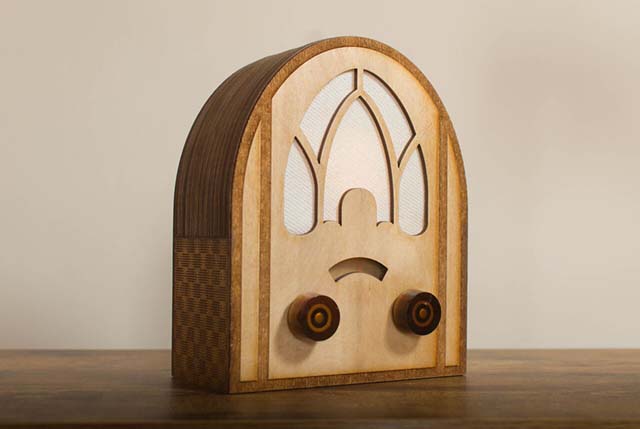
 Chris Combs, Markov Radio: Dispatches from the Uncanny Valley (Hirshhorn)
Open your ears this weekend as the 10th annual Sound Scene festival brings live music, interactive exhibits, and DIY workshops back to the Hirshhorn— and in a first for the program, its sound art will be more accessible to the deaf community.
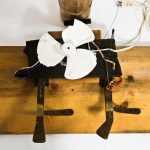
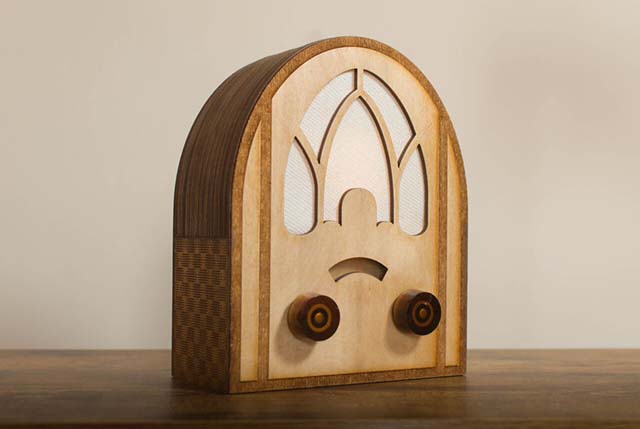
This year’s theme is dissonance, and some of the most inventive pieces in the festival are indeed a bit unsettling. D.C. artist Chris Combs contributes “Markov Radio,” an faux old-time radio with a dial that tunes in eight stations of computer-generated speech assembled on the principle of the Markov Chain. Source texts include Alice in Wonderland, the U.S. Constitution, and the tweet history of Donald Trump. Elevator music is reimagined in “Going Up,” by artists Jax Deluca, Josh Lefkowitz, and Nate Scheible. Installed in a museum elevator, this piece features a male and female voice reciting poetry over a dreamy electronic soundscape.
Curated by the DC Listening Lounge, the festival has grown from intimate alternative art spaces like La Casa, The Warehouse, and The Goethe Institut that drew at most 150-200 attendees, to the Hirshhorn, where 1100 people RSVPed for the event last year. Sound Scene IX even helped break the daily attendance record for the museum, which had over 6000 visitors that day.
Developer Bobak Shafiei, who contributed to last year’s installations, explains that while attendees signed up at a record rate, the festival was an even bigger hit thanks to its ability to draw in the casual museum goer, “passing off the streets looking for air conditioning or water and stumbling into the event.”
Shafiei is particularly excited about the increased presence of live music at this year’s event—including members of the National Symphony Orchestra as well as returning musician Layne Garrett—and interactive workshops where you can build your own wind chimes (a favorite last year) and a new workshop where you can create sounds to make an audio postcard that can be shared on social media.
DC Listening Lounge’s Jocelyn Frank explains that the expanded festival fulfills part of the group’s core mission:”we always felt a responsibility to represent the creative community of D.C., and to represent them more widely,” she says. To that end, “this year we tried to make audio more accessible and engaging to everyone.”
That includes the deaf.
This came about in part after discussion with Gallaudet University and their well-respected dance department, and with the Kennedy Center’s VSA program, which provides opportunities for youth with disabilities to pursue their aspirations in the performing arts.
At this year’s Sound Scene, American Sign Language interpreters and visual guides will be available, and balloons will be distributed as members of the NSO perform to enable audience members to feel the vibrations of the music.
In addition to these more traditional means of accessibility, new technologies will be available.
“Vibrotactile” compositions will be created during a workshop led by the Music: Not Impossible project; these works are made for “wearable technology” that can be fitted to ankles, wrists, and torsos, which vibrate, enabling people to hear beyond their ears. Frank explains that this technology also “bridges auditory segregation”—what happens when you attend a concert where the bass is turned way up and the resulting vibration dominates the experience. This technology “allows you to feel distinct instruments and voicings in different parts of your body. Obviously this is cool for deaf listeners,” Frank adds,” but it’s also super-cool for non-deaf listeners.”
Other unusual uses of sound include furniture made by artist Hugh Livingston; his Conversation Pieces are chairs that emit sounds and vibrations.
You’ll also be able to see sound waves with an acoustic autograph: sing into a tube that connects to a membrane that vibrates and creates sand waves.
Finally, for those interested in the DC Listening Lounge’s year-round activities, a number of mini-lounges will be set up where attendees can simply sit and listen to audio pieces, much as the group does during its monthly meetings. For the culturally savvy who want to hear how artists are pushing the boundaries of sound, Sound Scene is an essential annual event. But it’s just the tip of the audio iceberg.
Saturday, July 8 from 10 a.m. to 5 p.m. at the Smithsonian Hirshhorn Museum and Sculpture Garden. Free. Register here.
Listen to audio excerpts from Sound Scene X