 Rachel Sadon
 (Photo via Facebook)
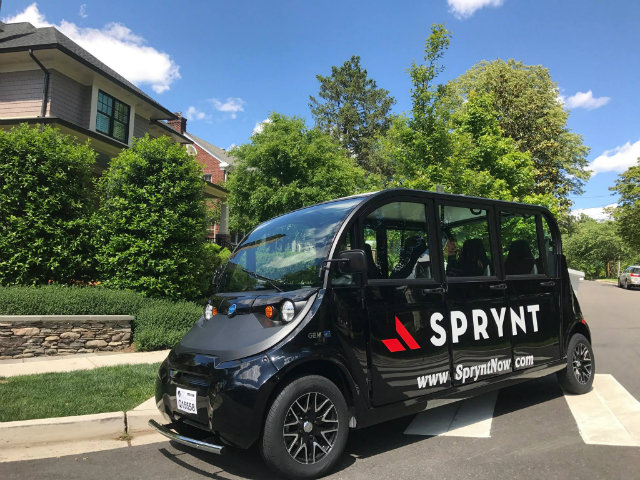
What appears to be a souped-up golf cart has been plying Arlington’s roads for the past few weeks, carting people around at a stately 25 miles per hour and eliciting stares from onlookers. Actually, it is a fleet of four (soon to be five) electric vehicles that make up the newest way to get around the Ballston, Virginia Square, Court House, and Clarendon corridors. And it doesn’t cost riders a cent.
“People are skeptical about trying out a free ride—I would be. But once they find out it truly is free and there’s no strings attached they come back,” says Alex Villanueva, the founder of new ridehailing service Sprynt.
Riders can summon one of the unorthodox vehicles from an iPhone app (Android is on the way) and go anywhere within the service area, essentially from a few blocks west of the the Ballston Metro station to a few blocks west of the Rosslyn stop.
“This entire corridor is very walkable, there’s no doubt. But there’s a lot of times where you have to go two miles from one end to the other,” Villanueva says. Sprynt solves “the dilemma of too far to walk, but too close to drive.”
Advertisers, meanwhile, bear the cost of the ride, paying to have deals available on the app, ads on the iPads installed in each vehicle, or their logos emblazoned on the cars themselves.
Essentially, he explains, it is two businesses. There’s the ride-hailing half—developing the right software, hiring drivers, actually transporting people—and the advertising operation—selling ads, developing products for businesses—that allows the service to be free for riders.
Arlington is a good fit in a lot of ways—with plenty of pockets of annoying-to-reach places and a large population of millennials, traditionally one of the most coveted demographics for advertisers.
The idea is that a large company (or several) would pay to have its logo blaring from the sides of an unusual set of vehicles bouncing around Arlington, and riders come to associate the brand with the positive experience of getting something for free. Inside, they’re each seated in front of an iPad, where local businesses can advertise, say, 10 percent off a meal or a free month of gym memberships.
“Once a rider is in the vehicle, they are engaged, excited, happy. No one gets in there angry or upset—it’s a free ride!” says Villanueva, a 26-year-old who previously worked in corporate finance. “They’re already in there. You put a 13-inch iPad in front of millennials and they’re going to start clicking. It’s a unique way of reaching that demographic.”
Since launching on June 21, the electric vehicles have already taken more than 3,000 trips and covered more than 4,000 miles—all the more impressive when you consider they only go 25 miles per hour.
Made by Polaris, they are branded as “electric shuttles” (categorized as a low speed vehicle/neighborhood electric vehicle), with a base cost around $16,000. Though street legal on roads with a speed limit of up to 35 mph, Villanueva says they are largely sticking to areas that are restricted to 25 mph, with a few that go up to 30 mph, to make sure they aren’t a nuisance to drivers or offering a frightening experience to riders.
The most popular route, by a long shot, is between Ballston and Courthouse—a mile to mile-and-a-half walk that is feasible, but somewhat time consuming. “You have businesses in Courthouse that are now getting a lunchtime crowd because I’m bringing people all the way from Ballston,” Villanueva says.
Before moving to the area in March specifically to start this business, he was living in Florida, where free shuttles supported by advertising or paid by the municipalities themselves are a fairly common occurrence in beach towns. The idea is that it’s a win all around—people get a free ride, advertisers have a new method of reaching consumers, and restaurants and shops see an uptick in traffic from people able to more easily traverse longer distances.
His aim is for Sprynt be a reliable transportation option as opposed to a leisurely vacation shuttle, though. While the vehicles are open air in the summer, the vehicles have windows for inclement weather. The app makes it conveniently on-demand (though wait times have crept up to 10 minutes as word has gotten out) as opposed to something more akin to a free, low-speed bus.
Originally the goal was to operate more like Lyft Line or Uber pool, where people share rides going in the same general direction. That’s even why Villanueva chose this particular model of vehicle, which has no middle seats, so that each person could get in and out easily. But it’s a much more difficult algorithm to program, so they’re sticking with one ride request at at time, at least for now.
The plan is also to expand into parts of D.C. and other corridors where such short hops make sense. “It takes a very special service area for this to work,” he says. But “there’s a growing demand for looking at your phone in your living room and then you go downstairs and your ride is waiting.” Turns out there is such a thing as a free ride.
Sprynt currently operates Monday through Thursday from 11 a.m. – 9:30 p.m.; Friday from 11 a.m. to midnight; Saturday from 10 a.m. to midnight; and Sunday from noon to 8 p.m. It’s free to ride.