 Julie Strupp
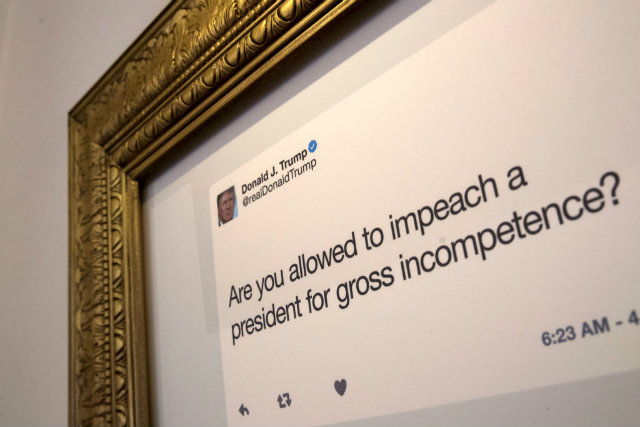 A tweet is displayed at The Daily Show-produced ‘Donald J. Trump Presidential Twitter Library,’ June 16, 2017 in New York City. (Photo by Drew Angerer/Getty Images)
On Tuesday, a group of seven Twitter users blocked by President Donald Trump filed a lawsuit against him and two of his top aides. They maintain that the president’s account amounts to a public forum and Trump and his aides, as government officials, are violating the First Amendment by blocking individuals from being able to see and interact with official correspondences.
The lawsuit argues that by blocking people from reading, viewing, or being able to reply to tweets, Trump is violating users’ rights simply because they expressed views he did not like. The suit also names White House press secretary Sean Spicer and Dan Scavino, Trump’s director of social media, as defendants.
“The @realDonaldTrump account is a kind of digital town hall in which the president and his aides use the tweet function to communicate news and information to the public, and members of the public use the reply function to respond to the president and his aides and exchange views with one another,” the lawsuit reads.
Columbia University’s Knight First Amendment Institute, a nonprofit that defends free speech, filed the suit in the Southern District of New York. The Institute first sent a letter to the White House in June, demanding the president or his aides unblock people on Twitter, but they say they never got a response. In June the White House conceded that Trump’s tweets are official statements.
A D.C. woman is among the group of plaintiffs. She was blocked in early June, after tweeting “To be fair you didn’t win the WH: Russia won it for you” in response to one of Trump’s missives boasting about his win.
“It was surreal,” Rebecca Buckwalter-Poza told WJLA about being blocked by the sitting president of the United States. The lawsuit is “about preserving a constitutional right. It’s a principle. It’s something that is guaranteed to everyone in this country.”
Legal experts say the suit raises interesting constitutional questions, and the case makes a plausible claim. In June the Supreme Court unanimously ruled that a North Carolina law preventing convicted sex offenders from using Facebook or Twitter was unconstitutional because it violated the right to free speech.
The Institute discussed this North Carolina case and its implications for their lawsuit in a detailed blog post, saying, “By excluding those with opposing viewpoints, President Trump is manufacturing echo chambers in the discussions that surround his posts. Those in the echo chambers aren’t exposed to the views of those who disagree with the President, and they lose the opportunity to engage those people in debate.”
Trump Twitter lawsuit by Rachel Sadon on Scribd