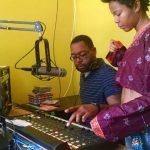
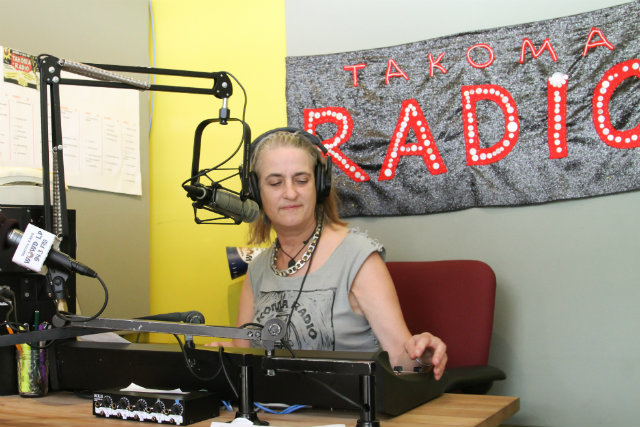
 Marika Partridge runs the sound board in the Takoma Radio studios on Sunday July 16, 2017. (Photo by Chris Cioffi)
By DCist contributor Chris Cioffi
In 2011, a small group of people showed up on Marika Partridge’s porch after she called a meeting to gauge interest in starting a new radio station.
On Sunday, Takoma Radio celebrated its one-year anniversary of being on-air, opening its doors for an all-day concert that was broadcast live. The birthday marks a nearly six-year journey through a fierce Federal Communications Commission application process to create a radio station on a shoestring budget.
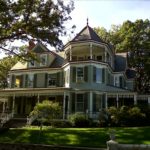
The colorful and eclectic mostly-volunteer staff of 94.3 FM broadcasts at least 18 music genres, news, talk, and other programming 24/7 from a closet-sized storefront studio in downtown Takoma. The non-commercial, low-power radio station’s transmitter — which Partridge can keep an eye on sitting in her front porch glider —reaches about 250,000 residents in a roughly 2- to 5-mile radius.
“It’s beautifully, overwhelmingly delicious,” Partridge said as she helped moderate Sunday’s festivities. “People are eager for this, they mean well and they want to do it right.”
The FCC opened up applications for new low-power FM radio stations in 2013. Patridge immediately applied with the support of the non-profit Historic Takoma, and the group was granted the license in early 2016. After crowdfunding and cultivating a slate of shows, they started transmitting at 9:43 a.m. on July 16, 2016.
Exactly one year later, community members balanced plates of cake on their knees in the recording studio adjacent to the broadcast booth, listening to a concert that included several renditions of “Happy Birthday” from volunteers, an original birthday song by roots band Ruthie and the Wranglers, and jazz from Juedienne Gordon. The station is still going strong.
Partridge, a former director of NPR’s All Things Considered, said the number of people who are interested in Takoma Radio has grown as more people find WOWD-LP on the dial.
The shows, which tend to have quirky names like “Hot Sauce Lounge” and “The Infinite Number of Monkeys Program,” play music that tends to be just as eclectic. Hosts spin tunes from Afro pop to Argentine Tango, and some shows feature conversations with people like community leaders and artists.
Volunteers come up with show ideas, and receive training on how to operate the equipment. The station is taking applications for people interested in starting their own shows, and it is always taking donations, Partridge said.
 Juedienne Gordon, and her band JuJu and the A Band, performs during the one-year anniversary of Takoma Radio on Sunday, July 16. (Photo by Chris Cioffi)
It cost about $120,000 to set up the station and get it operating, Partridge said. She projects the station’s annual operating budget will be about $100,000.
Fundraising sometimes proved difficult before Takoma Radio went live, but has become easier since the station began transmitting.
“We made enough to get it on the air,” Patridge said. “And the donations just keep coming in.”
Many listeners have made contributions and station leaders went door-to-door asking Takoma businesses to sponsor underwriting messages, according to Partridge.
“People believe in it, and it sounds good,” she said.
DJ James Clark, who goes on-air by the pseudonym “James C. Clark” plays underground, electronic-heavy ambient music on the Tuesday night show he co-hosts called Ad Infinitum.
He found out about the start-up station through friends, and was one of the first wave to get a show. With no previous radio experience, Clark said being on-air has made him more comfortable when he makes presentations at his job.
“I’ve had to have a lot of confidence in my voice,” he said. “And starting out with something I’m passionate about, it definitely translated to my work.”
Clark said he helped train several new volunteers over the past year as the station’s offerings has grown to about 75 hours of original programming.
In the next year, the station hopes to recruit volunteers to run shows in different languages, and several new programs aimed at youth, according to general manager Hugo Najera.
It also will add a community youth hour for young people to share music, poetry and stories, and Takoma Radio has plans to launch a program to teach teens radio production skills and responsibilities.
Najera said he hopes the new programming will help mirror Takoma’s diverse community on its airwaves.
“The radio is really cool and really personal and you hear people speak from their heart,” he said. “We want to use this as a tool to build a bridge among communities, even within our own neighborhood.”