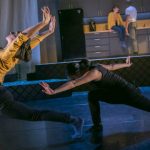
 Think Before You Holla is drawn from real-life testimonials. (Photo courtesy of Capital Fringe)
By DCist contributor Blake Richardson
Three years ago, theater director Taylor Reynolds noticed a pattern. During small talk with acquaintances, she or a friend would mention that Reynolds had just started planning a show about gender-based street harassment.
“Immediately, every woman who was in the room would gather in a circle,” Reynolds says. “And it just became this space of being like, ‘Oh my gosh. Let’s talk about this.’ That made me realize how rarely at that time that I was actually talking about this with people that I knew, even though it was happening every day.”
Since she started working on the piece, the reaction has been similar. Reynolds used that passion to spark discussions she eventually incorporated into her Capital Fringe show Think Before You Holla, which combines monologue and movement to tell the stories of women who have experienced street harassment. The Ally Theatre Company show premiered Saturday and has nine more shows coming up at Joe’s Movement Emporium between Thursday and Sunday.
Inspired by “Stop Telling Women To Smile,” a street art series by Tatyana Fazlalizadeh, Reynolds started reaching out to co-workers, relatives, friends from all over the country, and members of art groups on social media to gather stories about street harassment. She compiled the stories, themes from group discussions, and news articles on the issue into one thick binder. Every item in the binder ended up in the show, Reynolds says.
Reynolds then probed her actors to share their own experiences in an attempt to capture the psychological impact of incessant street harassment — from its effect on how someone walks down the street to how he or she gets dressed in the morning. Reynolds aligned movement with monologues to bring the piece to life, creating a show that exposes the angles and depths behind catcalling.
“As the women and my fellow collaborators were exchanging stories, it became this very therapeutic release,” says actress Jehan Young, who has been working on the piece with Reynolds for nine months. “And I think I realized that I had been sitting on resentment and anger and just feeling weak without even acknowledging it in my daily life. And just being able to give voice to that in a very safe space has been really healing.”
Reynolds wanted the show to be more than a cathartic release for her audience. She hopes to empower women and men to confront the problem head-on. The show encourages bystander intervention and even explores the harasser’s perspective in portions of the show like “a conversation with my harasser,” when a woman explains to a harasser how his telling her to smile made her feel. The harasser tries to respond, but the pair can only partially hear each other.
“Street harassers have to do something else at some point for at least 10 minutes,” Reynolds says. “They have a child, or a dog, or they have to brush their hair… just like everybody else.”
Ally Theatre Company is taking steps to make sure the show’s impact doesn’t stop at curtain call: Defend Yourself is partnering with the company to offer free self-defense and bystander workshops in conjunction with the show.
“We don’t want to just put a show up and have the audience go home,” says Ally’s founding artistic director Ty Hallmark, who helped organize the partnership. “We want the programming around our shows to be more active.”
The show will stay the same throughout Capital Fringe, but after the festival ends, Reynolds will focus on incorporating even more diverse stories and perspectives.
“I hope it empowers the audience to at least recognize that street harassment is not a given,” Young says. “It’s not something that women have to deal with just because we’re walking around in the world—that it is not something that we have to accept.”
Think Before You Holla is playing at Joe’s Movement Emporium on July 20 at 6:30 and 9 p.m., July 21 at 6:30 and 9 p.m., July 22 at 2:30, 6:30 and 9 p.m., and July 23 at 2:30 and 5 p.m. Buy tickets here.
See here for all of DCist’s 2017 Capital Fringe coverage. All shows are $17, with a button ($7) required for entry.