 Rachel Sadon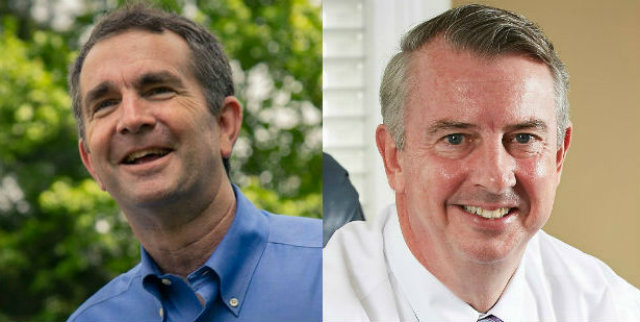
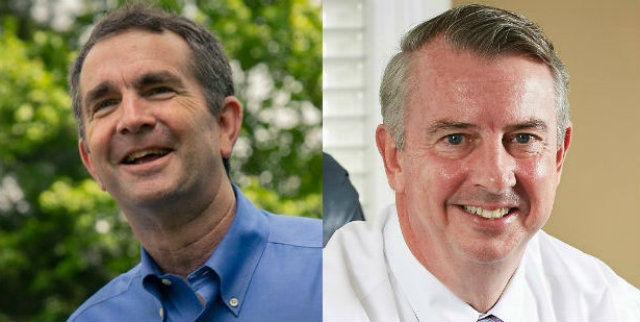 Ralph Northam and Ed Gillespie are tied at 44 percent of likely voters in a new Monmouth University poll.
For all the talk of Virginia’s purple-ness giving way to blue, a new poll has Democrat Lieutenant Governor Ralph Northam in a tie with Republican Ed Gillespie.
Each has a 44 percent share of likely voters, with 3 percent going to Cliff Hyra and 9 percent undecided, in a new Monmouth University poll.
Northam is a physician with a strong record on gun control and women’s reproductive rights who has served as the lieutenant governor to Terry McAuliffe. Ed Gillespie is a former chairman of the Republican National Committee and advisor to George W. Bush who has only recently begun to mention the president by name.
One place that Gillespie has a definitive edge is in cash. After a hotly contested Democratic primary (the Republican primary turned out to be very close too, but Gillespie underestimated his opponent), Northam has about half the amount in his coffers as his opponent.
The geographic breakdown between the candidates is what one might expect, with Northam leading by 13 points in the Northern Virginia suburbs and 9 points in the eastern parts of the state and Gillespie holding an 18-point advantage in the western half of the state.
White, non-Hispanic voters swing for Gillespie (54 percent to Northam’s 36 percent), with non-white voters coming in at 69 percent for Northam (to 18 percent for Gillespie). The gender breakdowns are mirrors of each other: 50 percent of likely female voters plan to cast a ballot for Northam, to 37 percent for Gillespie; meanwhile, 51 percent of men plan to vote for Gillespie, to 37 percent for Northam.
Before the results of the primary, Northam was polling nearly 10 points ahead of Gillespie in the hypothetical match-up. Once considered a bellwether for the rest of the country, Virginia has been looking more violet blue, with a Democrat in the governor’s office, both Senate seats, and serving as the attorney general. Clinton won the state by five percentage points.
More than half of respondents said they approve of the job that McAuliffe is doing and 51 percent say that the commonwealth is going in the right direction (only 31 percent say the country as a whole is heading the right way).
Four in ten of those surveyed said that President Donald Trump is either a major or minor factor in deciding who to vote for in the Virginia governor’s race. The pollsters determined that if Trump wasn’t in the equation, Gillespie would likely be leading by 5 percentage points.
“A small but crucial portion of Northam’s support is coming from voters who are primarily anti-Trump. Unless one of the candidates breaks out with a clear advantage on Virginia-centric issues, the president could wind up as a decisive factor in the outcome,” said Patrick Murray, director of the Monmouth University Polling Institute. “National pundits like to paint Virginia gubernatorial races as referenda on whichever president was just elected and they are almost always wrong. 2017 may turn out to be the first time you can credibly draw a direct link between the Oval Office and the race for governor.”
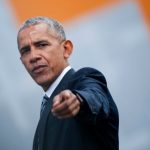
No less than President Barack Obama, who skipped out on several special congressional elections this spring, plans to campaign on Northam’s behalf.
It is not clear if Trump will stump for Gillespie. On a radio show, Gillespie answered a direct question that, yes, he would want the president to campaign with him—but qualified it with a long justification.