 Rachel Sadon
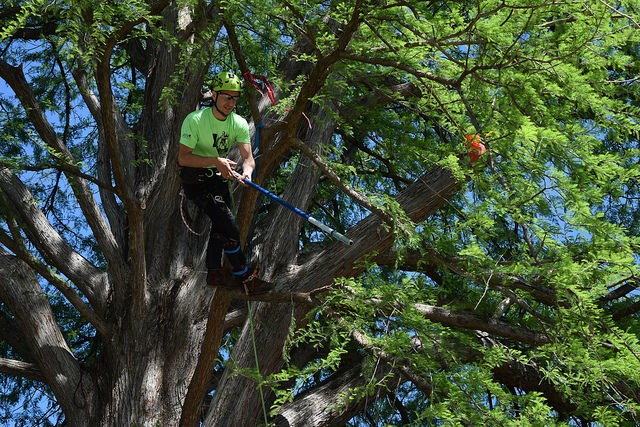 A competitor takes part in the 2016 International Tree Climbing Competition in San Antonio, Texas. (Photo courtesy of the International Society of Arboriculture)
The U.S. National Arboretum only lists eight rules for enjoying the 4012-acre oasis in Northeast. Number seven is “no climbing trees.”
(The author of this article may or may not have learned that lesson the hard way during her inconsiderate youth)
But the flurry of people carefully clambering through the foliage this weekend is sanctioned—and competitive. About 70 arborists from 18 different countries are in town to participate in the annual International Tree Climbing Championship.
“As a rule you don’t want people messing with trees,” says Sonia Garth, a spokesperson for the International Society of Arboriculture, which runs the competition. “But since we’re professional arborists, the techniques that they would use to get in the tree and care for them [are the same].”
There are five preliminary rounds that mimic the skills necessary to do tree work. The throw line, for example, involves setting climbing lines in predetermined places within the trees; competitors need to figure out the safest way to do so without breaking branches. In a belayed speed climb, they follow a set path up to the top. During the aerial rescue event, competitors must safely bring down a human-sized dummy.
“Some of them are little hard for somebody to understand [the scoring] that doesn’t already understand the rules of the events. There’s a lot of subtle things that will give you points or lose points,” says Jocelyn Lohs, a Richmond-based, ISA-certified arborist. “But you don’t really need to know all the ins and outs to enjoy the competition.”
It dates back to 1976 as a way to train climbers to in aerial rescues techniques. While most of the chapters are in North America, where the competition originated, Garth says it has grown in popularity in Europe and Asia, too. There are now regional competitions on each of those continents, with winners going on to the international championship.
After two days of preliminary events, the finalists will go on to the “master’s challenge championship,” which is made up of similar tasks as many of the qualifying rounds. Last year’s male and female returning champions, both of whom hail from New Zealand, will be among the competitors.
Like most people, Lohs had never heard of competitive tree climbing until she began working at a summer camp and doing tree work over the winter. Her employer, the outdoor recreation company Riverside Outfitters, encouraged her to sign up for a regional competition. She won, and went on to compete in the international event. That was eight years ago.
“It’s a really cool atmosphere at the competitions. Everyone is really supportive and super nice,” she says. “It’s really fun.”
The professionals don’t have a monopoly on the good time, though. In conjunction with the competition, the Arboretum is also playing host to bonsai workshops, walks, and an “Arbor Fair,” all of which are family friendly.
The best part, though, may be the opportunity for visitors to get in the normally off-limit trees themselves. Organizers will set up a “fun climb” for both kids and adults to try out their own Tarzan skills.
The competition takes place from July 28-30, with qualifying events on Friday and Saturday and the finals on Sunday.