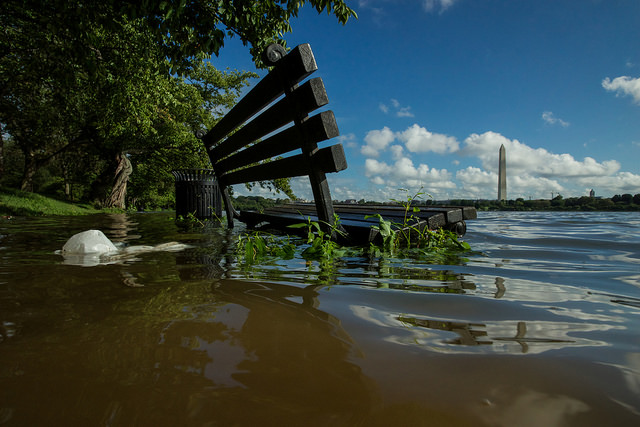
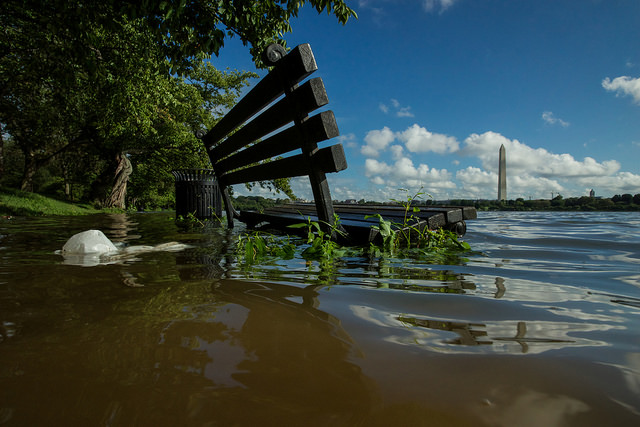
 Kevin Bush’s role is to find solutions for residents when “shocks” such as floods collide with “stresses” such as unemployment and inefficient public transportation systems. (Photo by wolfkann)
In 1995, a heat wave in Chicago led to hundreds of deaths across the city. Sociologist Eric Klinenberg later wrote about how neighborhoods where residents also faced social and economic challenges had incredibly higher mortality rates during that period.
Kevin Bush tells DCist that Klinenberg’s research is a perfect example of how natural disasters like heat waves have a greater impact on people who are already vulnerable, such as an elderly woman who couldn’t afford air conditioning in her home and didn’t know her neighbors because her community had changed over time.
Why does Bush care about this correlation? Because Mayor Muriel Bowser recently appointed him as D.C.’s first chief resilience officer.
 Kevin Bush (Photo via D.C. Administrator’s Office)
He’ll lead a team that’s part of the District’s participation in 100 Resilient Cities, a project pioneered by the Rockefeller Foundation, which is funding the chief resilience officer position and providing a bevy of resources from partnering organizations. The global project includes 24 cities in the United States.
Bush’s role is to find solutions for residents when “shocks” such as earthquakes, floods, and disease outbreaks collide with “stresses” such as unemployment, inefficient public transportation systems, and endemic violence.
He says that, to him, “resilience is really the immune system of a city—it’s the city’s ability to anticipate and recover from social, economic, or physical challenges.” In practical terms, he adds, it’s a process “that helps the city better understand and prioritize challenges and address them with interventions that pull in multiple departments at once.”
A former specialist at the U.S. Department of Housing and Urban Development, Bush led the agency’s first-ever team focused on resilience policy, risk reduction, community engagement, and infrastructure. He’s been lauded for his efforts after Hurricane Sandy, which wrought havoc in New Jersey and New York.
Over the next several months, he’ll work to develop a plan that caters to the District.
“Our charge is very broad—we need to make sure that D.C. thrives in the face of change,” he says. “Being the nation’s capitol, it’s also got some very real threats of terrorism and we also know that climate change is going to make us think about ways to protect those folks who are already vulnerable.”
He also says that his office will work to protect the city’s infrastructure and tackle issues such as affordable housing, among other things.
Reporting to the City Administrator’s Office, Bush will work with directors in 13 departments, including those overseeing health and human services, public safety, transportation, and the office of planning.
“I’m hoping to ask the tough questions to the various department heads about working closely enough together toward common goals, challenging the way the city plans and implements projects.”
He’s also learning from other cities who are further along in the 100 Resilient Cities program, which launched in 2013. New York is working on a project that combines flood prevention, retail, and recreation, he says. Boston just released a strategy that’s primarily focused on racism and inequality. And New Orleans is looking at increases in property values that are affecting affordability throughout the city.
“I started my career working in economically distressed cities so that’s a little different from D.C., but this taught me that existing economic, social, and other stressors make it so that folks can’t cope with major change,” Bush says. “It doesn’t matter what that change is, but it makes it a lot harder to cope with it.” And that’s where he comes in.