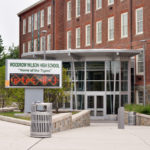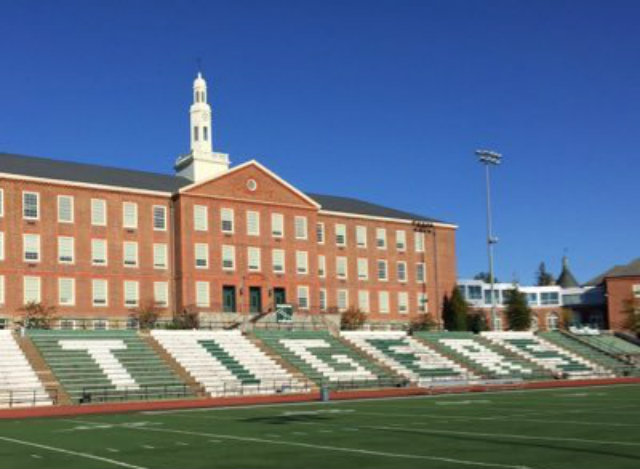
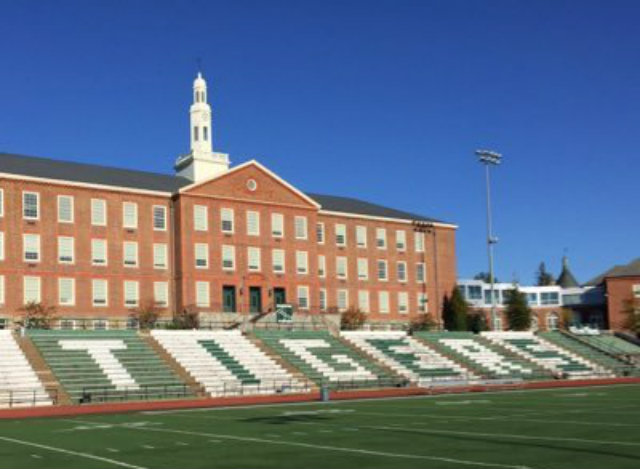
 Wilson High School (Photo via Twitter)
When Mayor Muriel Bowser presented her draft $13.8 billion city budget in April, critics said it didn’t have enough funding for the city’s public schools.
Bethany Nickerson, a parent of students at Woodrow Wilson High School, quickly began calling, writing letters, and sending emails to the mayor and D.C. Council. She wanted funding to restore an estimated 30 staff positions that had been cut from Wilson—D.C.’s largest public high school—in the past three years.
After a hearing in May, in which Nickerson wrote a letter of testimony, the council allotted an additional $11.5 million to D.C. Public Schools with the expectation that it would go toward restoring instructional staff and programs at schools.
But that’s not what’s happening, Nickerson told DCist.
DCPS Chancellor Antwan Wilson emailed Nickerson, who serves as the chair an advisory team that works directly with the principal, to outline his goals for the extra money. They include expanding city-wide investments in “social-emotional learning,” creating more experiential learning opportunities like studying abroad, and providing ways for schools to apply for grants “to support efforts to accelerate student achievement.”
He added that one of his goals is also restoring staff positions in schools that have the greatest need, pointing to the addition of one guidance counselor at Wilson.
But the school is grappling with the loss of at least two special education teachers, one art teacher, one social worker, a guidance counselor, and two administrative aides, compared to last year, according to budget estimates for Wilson’s upcoming school year provided to DCist by DCPS spokesperson Janae Hinson.
Last year, the school’s budget was $16 million for 1,783 students. This year, it shrunk to $15.7 million with DCPS estimating a loss of 38 students. Advocates like Nickerson say the school community is actually expecting an increase in students.
“There’s a concern among parents now whether they can continue to send their children to Wilson,” Nickerson says. “It’s the largest comprehensive high school in the District and it’s baffling why it’s not being supported by DCPS.”
Amy Hall, president of Wilson’s parent-teacher association who’s been working alongside Nickerson, says the cuts have made scheduling and administrative duties at the school much more difficult.
Last year, 90 percent of Wilson graduates attended college, according to DCPS data. Nickerson and Hall both had students who graduated in the spring who will attend colleges in Nashville and New York, respectively. Meanwhile, they each have another child enrolled at the high school for the upcoming year.
“Students can’t get in to see their counselors or get advice when they need to make a schedule change or decide what they’re supposed to be doing for college,” Hall says. “And the social worker position that was cut is arguably one of the most important positions in schools—cuts to social workers really impact students pretty negatively.”
Meanwhile, Hall said some teachers “don’t feel adequately supported,” and a lot of them left because they didn’t know if they would have a job the next year. So the school’s principal “had to scramble to fill new positions, fill new vacancies, as well to try manage the staffing cuts.”
When asked about restoring such positions at Wilson, DCPS spokesperson Hinson said that the system “is working to ensure that every school has the resources they need to effectively operate and provide an excellent and equitable learning experience for every student.”
The term “equitable” was one that the chancellor used with Ward 3 Councilmember Mary Cheh, who has sent two letters to him about Wilson High School.
“I don’t know if that’s education-speak for saying that Wilson has too much and they want to give money to other schools, but they should certainly rethink that because Wilson, though located in Ward 3, is a high school for the entire district and takes students from all around the district,” Cheh says. “If you think you’re just affecting Ward 3, you’re making a huge mistake.”
In a response letter to Cheh, Wilson wrote that the school has benefitted from investments over the past several years and he’s “confident that the priorities and investments we’ve identified with Principal Martin for the coming school year will keep the school on its successful path.”
“They want to put more money into social emotional intelligence, I say that’s great but how about teaching kids math and science and reading?” Cheh says. The high school saw a to a 28.9 percent decline in English proficiency scores on the annual PARCC exam in 2016.
“Let’s make sure they have all the basics they need to actually get a good education, then you can play games and do whatever it is you want with the fad of the day and the education establishment,” Cheh says. “That’s where I would come out” regarding the situation.
At-Large Councilmember David Grosso, chair of the education committee, has given Wilson a deadline of September 1 to submit his final budget.
“Additionally, he has requested a plan from the chancellor on how the DCPS budget can be made more transparent and easier to understand so communities can more effectively engage on these issues,” Grosso spokesperson Matthew Nocella told DCist.
Classes resume for students at Wilson on August 21. “It certainly would be helpful if the school had a full and complete understanding of where it stood before school started,” says Cheh, who doesn’t expect to hear from the chancellor again.
“This is my second letter to them,” she says. “The first one they took their sweet time to even respond to me and I don’t get a full answers anyway—it’s really disappointing to me, the Wilson community, and the parents.”