One of D.C.’s best-kept wine secrets is housed beneath Connecticut Avenue in an old luxury car service shop. And it’s not a flashy new wine bar or liquor store—it’s a storage facility.
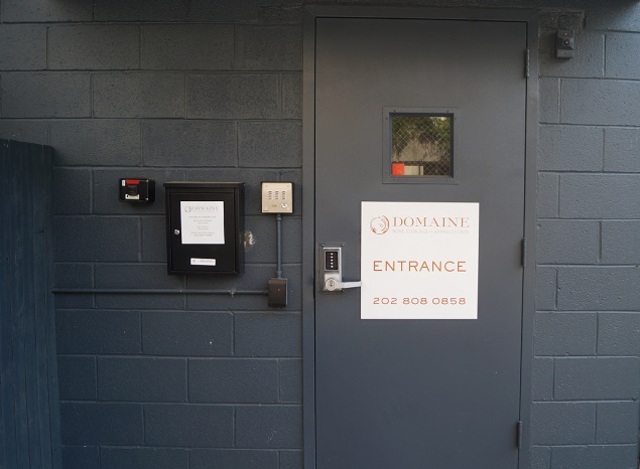
In Van Ness, there’s a back alley on Connecticut Avenue NW, sandwiched between a dated residential building and the backside of a nondescript retail park off Veazey Terrace. Keep going past an electric vehicle station and some loading docks, and there you’ll find the unassuming entrance to Domaine Wine Storage, which is nestled within one of the city’s most unusual business locations.
The underground warehouse long ago housed a service department for a family-run Rolls Royce and Pontiac dealership named Flood Pontiac.
The business was founded in 1933 and closed down in 1980 due to slumping sales. What was once a ground floor showroom now houses several shops, including a sushi restaurant. Below the surface, cars have been swapped out for vintage bottles of wine.
The D.C. location opened in 2012, a part of Domaine’s national network of facilities that stretches from coast to coast. The site caters to everything wine loves—no harmful sunlight and a thermostat that hovers around a cool 55 degrees Fahrenheit and 70 percent humidity.
Domaine co-founder Marc Lazar, who is originally from Silver Spring, says he spent a couple years scouting warehouse locations in D.C. The Connecticut Ave space looked essentially untouched when he began cleaning it out five years ago. No one had used that space in more than 30 years. But Lazar didn’t find any luxury cars left over—just a ton of grease, scrap metal, and hydraulic tanks.
“It was months of power washing and sand blasting,” he says, quipping that you could have set up a haunted house in there when he started cleaning.
The cavernous wine storage is a big deal for city-based onenophiles, who know that maintaining a collection beyond a weekend dinner party is tricky to pull off for a variety of reasons. Bottles take up valuable real estate in apartments and houses, and D.C.’s sun and heat both cause wine to deteriorate. That’s not good for expensive bottles that can easily be cellared for years or more.
Domaine also acts as a wholesale storage location. General Manager Amelia Harvey estimates there about 300,000 total bottles in the 10,000 square feet. Access is via a secured staircase as well as a back alley drive-in ramp, which was initially used to get cars in and out of the auto shop.
She says there is no “typical” client. Some use storage only when they’re moving to town, and others with smaller inventories split lockers with friends. A few clients don’t show up for years, while others are in weekly retrieving a favorite. Others just want peace of mind when household appliances go awry.
“I’ve seen too many of our clients end up in a panic when their home wine fridge suddenly goes down and they’re left scrambling to get hundreds of bottles to safety,” she says. “I’d say that’s one of the biggest differences between storing with us versus at home.”
Storage lockers come in 18-case (there are only 40, and they’re currently waitlisted) and 800 in a 28-case capacity size. They’re priced at $625 and $970 for a year for a standard level of service. That includes complimentary shipping and receiving, access to a member lounge, and seven-day access from 6 a.m. to 10 p.m. The most discerning customers can choose to pay for upgraded service, which includes perks like bottle inspection and inventory.
And there’s no need to pass any wine-knowledge quiz to get in either. You don’t have to know your Burgundy from your Bordeaux or your Malbec from your Merlot to get in. They’ll store just about anything you want to keep cool and safe.
“I do admit that we have run across the rogue bottle of Yellowtail once or twice,” Harvey says. “We’ve also seen plenty of beer, liquor, soda, and mixers.”
Of course, all that inventory gets costly, and security here is advanced to match. Think of it like a wine bank or sorts. Protections include layered security doors and alarm sensors for perimeter, motion, heat and smoke. Insurance is available for purchase, too.
There’s even a natural gas generator, which is tested weekly in case of a power loss.
“Basically, this is where I am coming if the zombie apocalypse hits,” Harvey says.
It’ll probably never come to that. But if it does, there will be plenty of well-aged wine to go around.