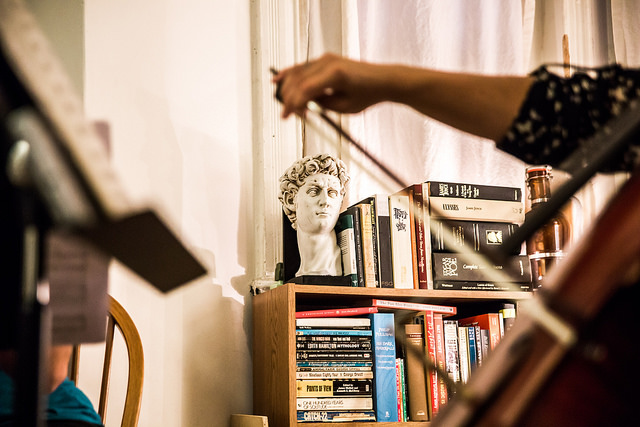
 Musicians play a cello and violin at a Groupmuse show in Shaw. (Photo by Peter Hershey)
By DCist Contributor Avery J.C. Kleinman
When you search “classical music” in Google, autocomplete has a few ideas for you. Type “why is classical music” and Google suggests you finish the suggestion with “boring”, “dying”, or “so boring”. Give “classical music is” a try and your options include “dead”, “dying”, and “boring”.
It certainly didn’t seem to be any of those things inside a narrow row house in Georgetown on a recent Friday night in July. In a dimly basement with exposed piping, shelves of old books, and a smattering of somewhat dusty antiques, two Julliard-trained professional musicians were playing Brahms’ Sonata No 1, Opus 78 in G major for a rapt audience. Space was limited, and people who had only met thirty minutes prior were squished knee-to-knee on couches, the ground, or whatever surface they could perch themselves on comfortably (or not). Ages ranged from 17 to 70, but averaged in the mid- to late-twenties. Some tapped their feet, others closed their eyes. Nobody was on their phone—well, aside from lifting it up to take a quick photo or to send a Snapchat.
The event was organized through Groupmuse, a startup that provides a platform for people to host small classical music concerts in their own homes, open to strangers and friends. Sam Bodkin, 27, launched Groupmuse in 2013, after discovering classical music for himself as a freshman in college.
“Classical music has an inherently social quality, and that social character could be its biggest asset,” Bodkin says. “We’re living in a moment lacking for opportunities to come together—to just be in space and time and share a moment. What better way to do that than by sharing masterworks?”
Groupmuse has been operating in D.C. since last year, but launched formally this summer. So far, there have been around 50 events in the District. Bodkin expects them to begin to operate more frequently in the fall.
In addition to incorporating community into classical music, Bodkin aims to diversify the genre’s listenership through his company—and especially make it more popular among people around his age.
“To put together a full orchestra is a very expensive undertaking and because of that, it’s dependent on the generosity of patrons who can support the arts at a high level,” he says. “That ends up affecting the social experience of classical music. You go and people dress fancy, there’s a chandelier, there’s lots of velvet. You need an establishment to keep alive a symphony orchestra. But it’s really hard for institutions to be cool. We say, what are you doing on a Friday night? We’ll come to you. Oh, you’re getting drinks with some friends? Stay right there. We’ve got some Schubert on the way.”
The upscale, inaccessible characterization isn’t without basis. According to the most recent data from the National Endowment of the Arts, in 2012, only 8.8 percent of U.S. adults said they attended a classical music concert at least once in the past month, and the highest rate of attendance (13.9 percent) was among people ages 65 to 74. The number dropped to 6.7 percent for people between ages 18 to 24. Classical music attendance also increased with income. More than a third of audiences were from families making more than $100,000 annually.
The established home of classical music in Washington, the Kennedy Center, is not unaware of the wealthy, older, and often white characterization. Over the past several years, the National Symphony Orchestra has actively looked to diversify its audience through its programming. The increasingly regular NSO Pops concerts, where the orchestra performs with musicians from other genres, have featured an eclectic variety of artists, including Kendrick Lamar, Trey Anastasio, Nas, and Common.
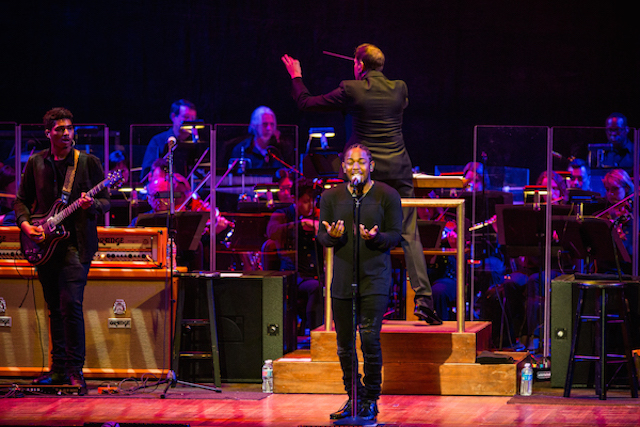 Kendrick Lamar performing with the NSO Pops in 2015 (Photo by Yassine El Mansouri, courtesy of the Kennedy Center).
Much of that programming has been the brainchild of 29-year-old artistic administrator Justin Ellis. He says he wants to see NSO audiences more accurately reflect the demographics of Washington, D.C., and that Pops concerts can serve as an entry-point for listeners who are not usually interested in symphonic music.
“The Kennedy Center had the really good intention of saying, we have people here who listen to hip-hop and it’s very musical, and it’s very orchestral, we should try to represent it,” Ellis says. “One of the first and only real questions I got from Kendrick was, ‘what will the audience look like?’ I told him it’s going to look like a whole different audience than either of us has ever seen before.”
In May, the NSO appointed pop musician Ben Folds as artistic advisor through the 2019-2020 season. In the role, he curates the DECLASSIFIED series, which he described to DCist as “me bringing in my rowdy pop friends and then we add classical programming into it.” A June iteration featured singer and guitarist Blake Mills and Cuban singer Danay Suárez.
“It’s a really good opportunity for me to go in and try programming with the eye to show what’s similar—what popular music has always had in common with a symphony orchestra,” Folds says. “It’s supposed to take the people who listen to my music, who I think are intelligent listeners, and have them come in and consider listening to something they didn’t consider.”
Ellis believes that musical evolution as central to the orchestra’s continued existence and prominence in the District.
“Orchestras got really comfortable with what they were doing and there wasn’t a lot of disruption on the market. The byproduct is that the orchestras that said we aren’t going to adapt, didn’t survive,” he says. “If you look at the success stories—San Francisco and L.A—what you find is that [they] have been really adventurous about how they’ve tried to get their audience and the music they perform.”
While the NSO and Groupmuse agree that disruption in the classical music world is necessary, they differ on the method of that disruption.
“The music is not the problem, the content is not the problem,” Bodkin says. “I don’t care where you are from or what your life experience has been, I believe Beethoven has the power to move anyone. If it has survived 200 years, it will survive 200 more. And that longevity is not something that any pop music can lay claim to. What’s important is that you meet people where they are.”
In fact, the NSO is increasingly meeting people where they are. Concerts are more frequently happening away from the Kennedy Center, at places like Echostage or in neighborhood settings.
But, aside from on a recording, it doesn’t regularly show up in District basements. Christopher Schmitt, 30, a pianist with the “President’s Own” U.S. Marine Band, hosted the recent Groupmuse in his home.
“Classical music can be cathartic, it’s able to express painful and profound emotions,” he says. “When you have this profound emotion two feet from someone else, something about that makes you connect quicker in a deeper way.”