Rachel Kurzius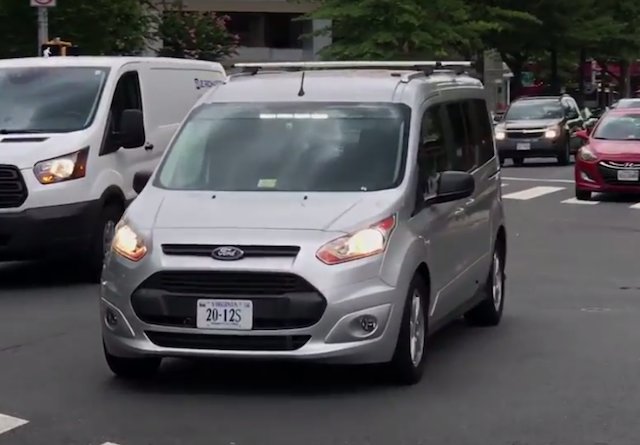
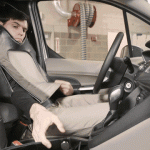
Update: There are indeed driverless cars on Virginia roads, but the above video doesn’t depict one. It seems to show something much stranger—a driver dressed as a car seat.
NBC Washington’s Adam Tuss found the van in Arlington.
Alert!!! We found the supposed self driving van in Arlington – and there’s a guy hiding behind the seat!!! @nbcwashington pic.twitter.com/EeI7rhQi1R
— Adam Tuss (@AdamTuss) August 7, 2017
This is one of the strangest things I’ve ever seen @nbcwashington @ARLnowDOTcom pic.twitter.com/8ipKEnkeiq
— Adam Tuss (@AdamTuss) August 7, 2017
I tried talking to the driver – but he blew through a red light and drove off. Could this all be a prank??? @nbcwashington pic.twitter.com/bn72daBNUA
— Adam Tuss (@AdamTuss) August 7, 2017
Here’s me trying to talk to a man in a car seat costume @nbcwashington pic.twitter.com/e5humOM7uS
— Adam Tuss (@AdamTuss) August 7, 2017
So not only does Virginia have self-driving cars, it also has people who dress up like the seat of a car before hitting the road.
Original: Apparently, Old Dominion has been the testing grounds for some new technology, namely driverless cars.
ARLnow seemingly discovered one said vehicle in Clarendon in the flesh (errrr … the metal?) on Thursday evening.
A video published by ARLnow shows a gray van with tinted windows, and no one inside, driving alongside other cars on Wilson and Clarendon Blvds. “Is that a self-driving car?” one passerby asks off-camera.
It sure looks like it. Nope, it’s not.
It wouldn’t be the first autonomous vehicle in the region. Olli, a self-driving machine equipped with IBM’s supercomputer Watson and 30 sensors, toted people around National Harbor.
Turns out, there are other driverless vehicles that are driving under the radar on Virginia roads. The state has designated part of the Beltway, I-95, I-66, U.S. 29, and U.S. 50, among other streets, as “designated automated and connected vehicle corridors,” according to WTOP, which adds that Virginia does not have legal restrictions on the technology.
But when such laws are crafted, what should they say?
This January, the District announced it was among five global cities that “will produce a set of principles and tools that cities around the world can use to chart their own paths forward with the new technology.”
“We understand autonomous vehicles are coming one way or another,” Andrew Trueblood, chief of staff to the D.C. Mayor of Planning and Economic Development, told DC Inno. “Thinking through the implications like what does it mean in terms of workforce and employment, or urban planning and parking are issues we’re excited to address with” Helsinki, London, Săo Paulo, and Tel Aviv.
D.C.’s Department of For-Hire Vehicles (formerly the D.C. Taxicab Commission) told DCist last summer that it was preparing for the advent of driverless cars in the District, including by integrating autonomous and semi-autonomous vehicles into the regulatory landscape.
“Next year will be a turning point,” said Ernest Chrappah, the director of the Department of For-Hire Vehicles, in August 2016. “Do you remember this lady Cleo? I don’t want to be her, but what I can tell you is that [autonomous cars] will be here next year. In what shape or form, I don’t know.”
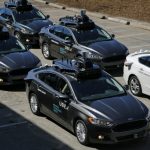
Ride-hailing app Lyft partnered with General Motors last year to develop a network of autonomous vehicles. Uber has rolled out fleets of driverless cars in Pittsburgh last August and in Phoenix this February, after removing its fleet from San Francisco streets last December because it lacked permission from the California Department of Motor Vehicles.
The co-founder of Lyft, John Zimmer, predicted last fall that autonomous vehicle fleets will make up the majority of its rides by 2021, calling the advent of driverless cars “the third transportation revolution.”