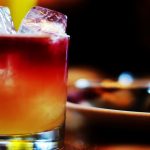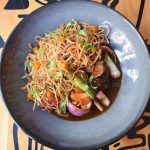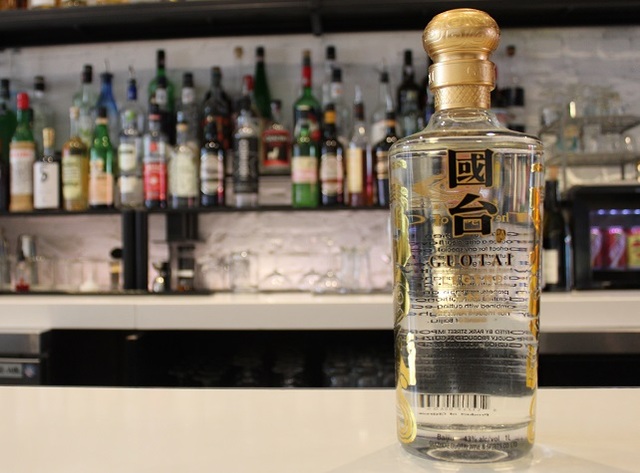
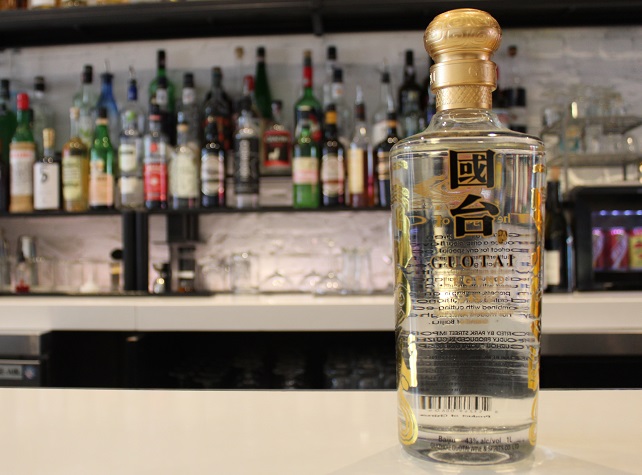
 Baijiu is starting to make inroads at D.C. bars. (Photo by Emily Walz)
By DCist contributor Emily Walz
Last year, the U.S. imported some $462.8 billion worth of goods from China. One thing virtually absent from those shipping containers stocked with Chinese products? Baijiu: China’s national alcohol. Outside China, baijiu languishes in obscurity. Inside China, baijiu sits at the center of drinking culture: wedding banquets, official government meetings, and business deals are all toasted with an endless stream of thimble-sized cups filled to the brim.
All told, baijiu is the most-drunk spirit in the world, primarily because China’s population pulls such weight. This explains how it can account for a third of all spirit sales and still be effectively unknown overseas.
In an attempt to change that, a Beijing-based writer has declared today, August 9, “World Baijiu Day,” a play on the Chinese words for “eight” (August) and “nine” (“ba” and “jiu” close to the pronunciation of “baijiu”).
The baijiu creep is slow for the most part for a simple reason: the taste. Those who want to be polite about it call it “acquired”. As high as 60 percent alcohol by volume, the sorghum-based spirit (occasionally other grains are used) soars beyond the proof of sake, shochu, and soju. Comparisons to rubbing alcohol and bad moonshine abound. Many quote Dan Rather, who compared baijiu to liquid razor blades while covering Nixon’s trip to China.
Regardless, Chinese baijiu makers are looking toward the U.S., determined to find a way into the market, even if it requires educating consumers first (as some consultants have advised). This westward vision took on a new urgency a few years ago, when Chinese President Xi Jinping’s crackdown on official corruption caused a dip in the luxury baijiu market.
One brand in particular, Guotai Legend, is seeing the result of this push in tentative inroads in the D.C. area. Their Guotai Legend baijiu, 43 percent alcohol by volume, has won over several local bar managers, gatekeepers to a key constituency of the U.S. cocktail kingdom. The group tends to be more forgiving of even the harshest baijius, favoring adjectives like “earthy” and “funky” where others might use less flattering terms.
Given that baijiu is traditionally drunk straight with meals, it doesn’t have much history in mixed drinks, nor does it play well with others. But several D.C. restaurants are making the leap of faith in bringing baijiu to their cocktail menus.
Start in Chinatown, where Reren Lamen (817 7th St. NW) rotates periodically through a special baijiu cocktail, all of which seem to favor Guotai products. Most recently, the pink “Peach Blossom” is on the restaurant’s menu for $7. It mixes the spirit with Bols peach schnapps, Triple Sec, tonic water, and cranberry juice.
Ten Tigers (3813 Georgia Ave. NW) bar manager Taylor Nelson first encountered baijiu when a friend brought a flask back from China, an experience he says was “like drinking a bale of hay.”
He played on the Guotai Legend’s notes of dried fruit and apricot to create “Tiger #9,” a light, summer seasonal cocktail that mixes baijiu, Dolin blanc vermouth, fresh lemon juice, and crème de cassis.
It’s been on the menu for a month or two now, and is selling better than expected, though Nelson admits it trails the other four cocktails on the current five-cocktail menu. The menu changes every three months, but Nelson plans to continue his baijiu cocktail experiment.
Max Yoon of Maketto (1351 H St. NE) is one of the faithful. He loves baijiu, and drinks it often, prizing its strong, funky flavor. People never ask of their own volition to taste the baijiu on his shelves, but sometimes he’ll persuade a few to try.
“’That’s interesting’ is what they’ll say when really what they mean is ‘I’m never going to drink this again,’” he says.
While he admits that baijiu is “difficult to play with,” the current Shanghai Club on Maketto’s menu has proven popular. That wasn’t the case with the last iteration of Maketto’s baijiu cocktail, which used Phoenix Gaoliang, a Taiwanese baijiu that comes at $10 a bottle, a third the price of Guotai Legend, and stronger, at 56 percent alcohol by volume.
“It’s Taiwanese, cheap, and I like it. And it’s strong as hell,” he says.
Yoon defends it as a good cocktail but concedes it was not approachable.
“It was sent back a few times,” he laughs.
Yoon played with attempts at a new cocktail for two weeks before landing on a twist on the Clover Club that uses one ounce of baijiu mixed with Strega, an Italian herbal aperitif with saffron that functions a bit like Yellow Chartreuse, and the strong and sweet Giffard Lichi-Li liqueur, made from Taiwanese lychees. Egg white mellows the baijiu, while Peychaud’s bitters decorate the foam.
Tiger Fork (922 N St. NW) carries a half-dozen different baijius. Its previous baijiu cocktail, the “PMQ,” combined an American-made baijiu from Oregon’s Vinn Distillery, vermouth, Luxardo, and orange bitters into something like a baijiu take on a negroni.
It was “on the boozier side,” says Tiger Fork general manager Will Fung.
They wanted to make something easier to get into and so recently introduced the “Tiger’s Tail,” a take on the Lion’s Tail that combines baijiu with all-spice dram from local distillers Cotton & Reed, honey, and chocolate bitters to bring out the baijiu notes. With the new drink, they’ve also switched to Guotai Legend. Fung compares baijiu’s taste spectrum to mezcal, where on one end are the milder varieties that are easier to get into and on the other end are the really funky ones.
While the PMQ is off the menu, Tiger Fork still carries Vinn baijiu, along with others like Luzhou Laojiao and Jian Nan Chun Chiew, both funkier baijius that Tiger Fork hasn’t yet used for a cocktail.
Normally, Tiger Fork’s baijiu cocktails contain between one and a half to two ounces of the liquor. Beverage director Ian Fletcher likes people to be able to taste the baijiu and the sweetness from the sorghum. It’s possible to mask baijiu entirely, but in Fung’s opinion, this misses the point.
While cocktails are swapped in and out of Tiger Fork’s menu, with a new one appearing every month or so, the restaurant is committed to keeping a slot in the cocktail menu for a baijiu cocktail.
Diners all seem very interested in learning more about the spirit, and when many are still being introduced to it, “having it in a cocktail helps nudge people along,” Fung says.
Previously on Menu Decoder:
Get To Know Uyghur Cuisine
Filipino Essentials
Turkish Essentials
Ethiopian Essentials
Boquerones
East Coast Oysters