 Rachel Sadon
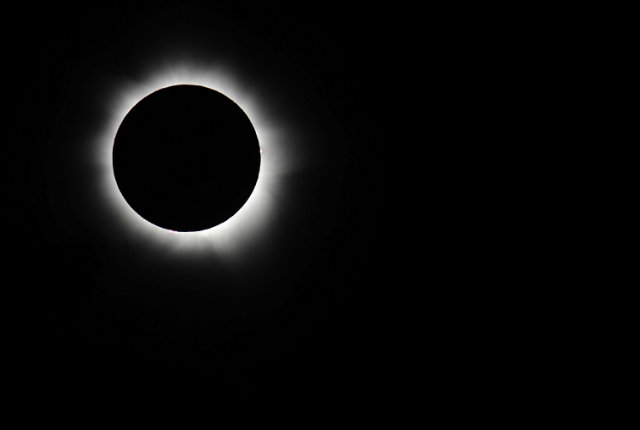 Totality is seen during the solar eclipse at Palm Cove on November 14, 2012 in Palm Cove, Australia. (Photo by Ian Hitchcock/Getty Images)
It stands to reason that 70 or 80 or 90 percent of something would be 70 or 80 or 90 percent as good. Not so with a solar eclipse.
The upcoming event passes through the continental U.S. on a diagonal, with a narrow band that hits the Northwest, the center of the Midwest, and the southern part of the East Coast. Outside of that area, most Americans will be treated to a partial eclipse.
“You will not see anything particularly spectacular unless you are in the path of totality,” explains Dr. Edwin Turner, a professor of astrophysical sciences at Princeton, in a Scientific American article. A seasoned eclipse watcher, he’s been explaining the difference to friends and family members for years. In fact, the article actually started out as a letter to a group of one of his son’s friends, who had lost interest in venturing to see the eclipse when they heard the predictions of apocalyptic traffic conditions. Why not just stay put for a partial eclipse, they wondered.
We had the same thought, assuming that D.C.’s 82 percent eclipse of the sun would be more than enough eclipse. But, experts say, it’s possible that Washingtonians who aren’t paying attention wouldn’t even notice anything is going on. Even at less than 20 percent, the sun is plenty powerful to light up the sky. What we’ll experience is something like modest cloud cover (assuming it’s not cloudy to begin with).
We spoke to Turner about eclipse chasers and why a partial eclipse is nowhere near as exciting as the eerie spectacle of a total eclipse.
“If you’re not in totality, and it’s a nice day, it’s certainly worth getting some glasses and getting a peek,” Turner says. “But don’t mistake it for the actual thing.”
You have a very impressive biography on Princeton’s website. Can you tell me a bit about your scientific work?
I’m 68, so I’ve worked on a lot of things over my career. I’m on the faculty in astrophysics. Most of my career, I was a cosmologist studying the origins of the universe. But in 2001, I sort of drifted over to studying exoplanets. Recently I’ve been doing some stuff on astrobiology and various other topics. But none of this has much to do with total solar eclipses. I don’t have actually any particular scientific interest in them.
I saw one in 1970 when I was an undergrad at MIT. I was very impressed and then took opportunities in 2006 and 2009 to lead groups of Princeton and MIT alumni to view eclipses in Egypt and the Pacific Ocean, on a cruise ship near Iwo Jima. I also tried to take my family and a bunch of friends who see an eclipse in Munich in 1999. But we had bad luck in a very irritating fashion, in that it was a clear day just before the eclipse and then the clouds arrived.
Would you describe yourself as an eclipse chaser? How many have you seen?
I have seen four total solar eclipses, or tried to see four, counting the one that was clouded out. I’ve also seen an annular solar eclipse, which a rare thing. It turns out the moon is just barely covers the sun. Like in the eclipse that’s coming up, it is less than 3 percent bigger in the sky. It just barely covers the sun; that’s why it lasts such a short time. But the orbit around the sun is not a perfect circle. Sometimes Earth is a little closer, which makes the sun look bigger. If things line up just right, the moon ends up being slightly smaller than the sun instead of slightly bigger. Then it appears in the middle of the annulus.
Anyway, I don’t know if you would call me an eclipse chaser. There are people who have seen 20 or more, who really make a major hobby of it. There are even clubs of people who plan years in advance; it’s a combination travel-astronomy hobby because they just occur at random places on the Earth. It’s like throwing a dart at the map—some are quite inaccessible places in the Arctic. I don’t think I quite qualify as a real eclipse chaser. I’m more like an eclipse enthusiast.
In a sense I’m not really acting as a scientist here; I’m acting as a tourist. I’m impressed by the splendor and the grandeur and the weirdness and the extraordinary experience of the total solar eclipse.
So we thought seeing a partial eclipse at 82 percent will be like 82 percent as good.
It’s super misleading; any reasonable person would reach the conclusion, but at 100 percent it’s just a very different experience.
The other thing that’s misleading is lunar eclipses can be seen over very wide areas, so most people have seen them if they have any interest at all. They’re certainly interesting, but very much less exciting and impressive. I think a lot of people think ‘oh I’ve seen a total lunar eclipse, that was nice but I’m not going to travel to the other side of the world to see it.’”
Maybe I should mention why I wrote the piece and how it came to be in Scientific American… it’s sort of odd, I didn’t actually write it for them.
I have two older sons, the older of whom was planning to see the total solar eclipse. He was with me in 1999 in Germany when we got clouded out, and he was planning to go with his friends. But they sort of lost interest because of the terrible traffic and crowds, so he asked me to write a little explanation.
After I wrote it, I sent it around to a bunch of friends and relatives to encourage them to see it, one of whom is the guest blog editor at Scientific American. In addition to that, a bunch of people sent it along and several people put it on Facebook that got shared further. I’ve had roughly 250 research articles published in my career, most of which are read by 30 people or something. I’m wondering if this letter to my son might wind up being the most-read thing I’ve ever written.
Where are you going to see the total eclipse?
It’s a place near Jackson Hole, Wyoming, just on the edge of Grand Teton National Park. Some parts of it are called Jackson, other parts are called Jackson Hole, I don’t know why. It’s a summer tourist destination, so it is in relatively good shape, but these small towns are worrying about food and water shortages and the local cellphone networks jamming up.
Is that unusual?
The eclipse brings big crowds to a very specific place at a very specific time. One of the most unusual things about this eclipse is how easy it’s going to be to view it. If you look at maps of where they fall around the world, often you’re talking about going somewhere in the ocean or some island somewhere. It’s quite unusual; if you picked some spot on Earth and waited for an eclipse to show up, on average you’d have to wait 385 years.
But there’s another one that’s coming to the U.S. in 2024. The two sort of make an X. This one goes from the Northwest to the Southeast U.S., the next one goes from the Southwest up to the Northeast.
So what is the experience of being in totality like?
The large majority of people seem to have a rather strong emotional or gut or visceral reaction. It is just a feeling of awe and strange weirdness. It looks like there’s some weird eyeball in the sky, some special effect or something. The color of everything around you sort of changes because you’re being illuminated by the sun’s corona, which is a very different hue of light. All of of the colors look a little strange.
Depending on the atmospheric conditions, you can often see something that looks like a really nice sunset around the sky. Just as the eclipse starts and right when the sun later reappears, you might see Baily’s beads, these small beams of sunlight.
You can sometimes see a lot of structure in the hot gas that’s moving along magnetic fields around the sun. It looks sort of like the sun is having a bad hair day.
There may also be shadow bands—dark and light bands flickering across the landscape. We don’t exactly understand where they come from, but they’re related to a fractal effect (if you’ve ever looked at the bottom of the swimming and seen light and dark patches of light, it’s related to that). It seems to be caused by waves in the atmosphere, but it’s not perfectly understood and appear depending on the atmospheric conditions. They can be invisible or visible, but they’re hard to see, as they flicker. I’ve never never seen them particularly well.
Often the wind and temperature react strangely. In D.C. you’re probably not going to get much of a temperature drop because the humidity is high, but in the desert it can drop 10 or 20 degrees. The wind blows a bit, but can’t seem to make up its mind about which direction to go in. Animals often exhibit strange behavior.
The combination of all these things gives you a strange feeling of like CGI or a druge experience. It’s a strange feeling, people often have strong reactions.
What can people who can’t make it into totality expect during a partial eclipse?
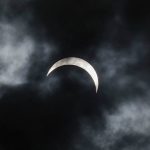
You can look at the sun, assuming the sky is clear, with eye protection like those gasses or a pinhole viewer and you’ll see the disk of the sun partially covered by a black circle, which is the moon or the moon’s shadow, and it’ll gradually increase and then gradually decrease the fraction of the sun that’s covered.
It will eventually cover 80-something percent of the sun. But if you weren’t paying attention, you might not even notice it. 80 percent sounds like a lot, but it’s like modest cloud cover. It’s not like it’s going to get dark or anything. And it moves fairly slowly over a couple of hours. It’s certainly worth looking at, but if you watched the whole time, you’d probably get bored. It’s actually a horrible thing that sometimes happens to people in the path of totality. They watch the partial phase, they get bored with it and go inside and miss totality.
It can be interesting to see it change slowly. You might want to look 10 or 20 minutes after it starts and then watch for 10 minutes around the peak. It depends on how into science and astronomy stuff you are, but it’s cool to think of all the things lining up in the sky. It’s basically you’re standing the moon’s shadow. For the average, non-nerd sort of person, you’re probably going to say it’s nice.
Sometimes people will tell me they’re not sure if they’ve seen a solar eclipse, and it’s a sure sign that they saw a partial one—it didn’t make enough of an impression to stick with them.
But I think if you’re there and you’re not in totality, and it’s a nice day, it’s certainly worth getting some glasses and getting a peek. But don’t mistake it for the actual thing.
Any advice?
I think most of your readership are going to be people who are not going to see totality this time because it is so close to the eclipse that it would be relatively inconvenient for people who haven’t already made their plans.
If I were in D.C. and suddenly wanted to see it, I would drive not toward a big city or a major place but try to look at a map and find some place that doesn’t stand-out as a place to go.
For 2024, it’s a good idea to make preparations and plans well in advance.
Previously:
What Will The Eclipse Look Like From D.C.?