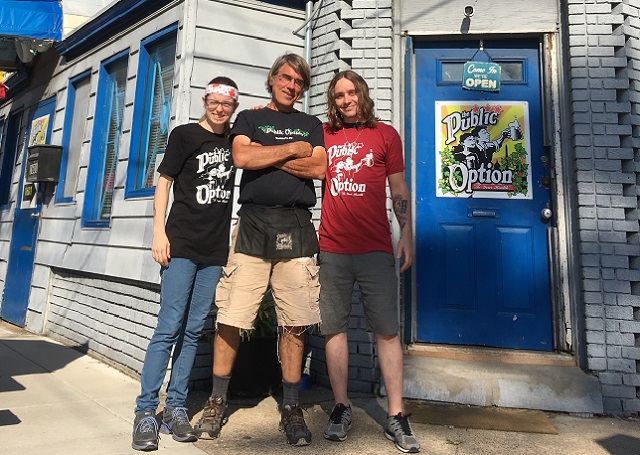
 Left to right: Taproom manager Sara Williams, owner Bill Perry, and lead brewer Tony Wood. (Photo by Sam Nelson)
By DCist contributor Sam Nelson
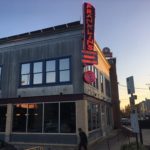
It’s easy to miss The Public Option’s blue door on the corner of Rhode Island and 16th Street NE. Many people walk or ride past it without noticing. But go inside and you’ve entered D.C.’s smallest brewpub.
Bill Perry opened The Public Option with his wife, Cathy Huben, in October 2015 with the idea of creating a neighborhood hangout with fresh beer. In a city full of new and expanding independent breweries, The Public Option continues to fulfill an important role as a small neighborhood bar that serves its own product.
While other breweries in D.C. boast larger, modern taprooms and distribute to neighboring states, The Public Option feels more like a homebrewer’s living room than a brewery. This isn’t a place for young professional happy hours; it’s a place people come to read and play board games. The walls are decorated with local art, black and white photographs of the neighborhood, and a Japanese boat flag gifted to Perry. There’s a couch that looks like it was bought from Goodwill. Outside there are four patio tables with umbrellas; inside is a one room-bar with casual seating and eight taps of small-batch traditional beers.
Perry decided to open a brewpub to begin a new phase in his life after working for more than thirty years as a photo archivist for National Geographic, where he met his wife. He bought the building in the Langdon neighborhood, blocks away from the new developments in Brookland and Edgewood, and he’s conscious and careful of his business’s role in a changing community.
“We are obviously part of a new wave of development in this area,” Perry says “I hope our impact will be positive. And we will attempt to tread lightly.”
The “tread lightly” approach is what marks The Public Option as distinct from other brewpubs, breweries, and new bars. Many customers like it’s personal feel because it’s casual, small, and relaxed, and because Perry and Huben were the only ones pouring the beers the first year.
“It’s the definition of a mom and pop shop. There’s no corporation behind it,” says Dan Henebery, a regular customer and Brookland resident.
Perry named the place after the “public option” debated in the American Healthcare Act years ago but that was ultimately removed from legislation. Perry himself carries a tone of relaxed liberalism. He doesn’t label himself politically but says he believes in a “managed capitalism.” The Public Option’s website has a full page about its no tipping policy, preceded by a contextual explanation of the policy as it relates to Perry’s philosophical interest in market economies. He put his philosophy to work when he hired two full-time staff: Sara Williams, taproom manager, and Tony Wood, Lead Brewer.
Perry hired Wood in September 2016 to both relieve Perry of brewing duties and increase product quality. Wood had previously worked at Tired Hands Brewing but left for personal reasons.
“My girlfriend was angry,” Wood says. “I didn’t have a job.” His unemployment lasted only “a couple hours.”
Wood walked to The Public Option that afternoon to get a beer and Perry hired him right then. Before Tired Hands Brewing, Wood worked at DC Brau Brewing Company, which he credits for teaching him a standard of practice he employs on a smaller scale at The Public Option.
“I got the utmost respect for Tony Wood. He’s a great guy and a great brewer,” says Brandon Skall, CEO of DC Brau Brewing Company, which opened in 2009 as D.C.’s first independent brewery in more than half a century.
Wood says he likes the job because “I can do what I want, make what I want.” Perry grants Wood autonomy over the brewing, but Perry also likes to maintain a traditional spectrum of beers and ales, including a porter, a brown ale, and a stout, to satiate his own taste for maltier English-style ales but also to ensure variety for customers with different preferences.
Wood prefers hoppy ales, and The Public Option’s more varied recipes reflect Wood’s interest—the oat pale ale is hoppy but not heavy, featuring a cascade single hop and oatmeal mixed right into the mash. The Rye IPA hits strong at 9.1% alcohol but remains balanced in taste. For summertime, they brew a refreshing Cream Ale (a big step up from cans of Genesee Cream Ale) and will soon release a Golden Ale.
All beers are $7 a pint, or $3.5 for half a pint. Most of the beers are traditional in flavor and profile; they aren’t as innovative as other craft breweries’ products, but Wood’s beers are well-executed and remarkably fresh. There are no bad beers on the menu.
One reason the beer is so fresh is that Wood brews only one barrel of beer (31 gallons) twice a week and sells 1.5 barrels on average each week, according to Perry, which keeps the taps moving.
In contrast, local manufacturing breweries like Atlas Brew Works brews about 80 barrels (2,480 gallons) a week and distributes as far as Tennessee, says CEO Justin Cox. DC Brau Brewing Company brews six to seven days a week using a 15 barrel brewhouse and is currently expanding to accommodate an additional 30 barrel brewhouse for use in 2018. These bigger—but staunchly independent—breweries fulfill important roles in the district’s craft beer community.
Public Option’s role is smaller but also important. It’s licensed as a tavern with an endorsement as brewpub, and it’s this tavern quality that helps distinguish it.
“We’re shooting for the pub part of the brewpub,” Perry says.
Most days there’s a food truck or guest chef in the kitchen, such as Odd BBQ or Indian Fusion pop-up Dhabalicious. On days without guest chefs, Wood buys easy-to-cook food from local groceries. On a recent visit, the menu on the blackboard read: “Eat a Hot Dog $3: It’s healthy!”
Perry admits the menu is a work in progress, but it doesn’t take away from the personal and relaxed living room ambiance customers like about it.
Rashad Simms, a regular customer and native of Northeast, lives nearby and comes to drink half-pints.
“It’s quiet, cozy, not a lot of commotion,” Simms says. He likes to come to listen to music and read. He’s also a regular at “Record Nights,” when customers bring their own vinyl records to play on every second Sunday of the month. Simms talked about attending the new weekly open-mic nights on Thursdays, too, now that Public Option has extended its schedule to be open four days a week. Wood is responsible for promoting and managing these events, which have led to more customers.
“I really respect what they’re doing outside of the beer, too,” says Skall. “They’re advancing the concept of what a small brewery can do as a cultural hub in its community.”
There is opportunity for more events through expansion. Perry owns the building, which used to be Mr. Y’s Jazz club. Previously, its owner James Yancey would sell food downstairs and host jazz nights in the upstairs attic. Perry has a permit to host live music and events in the same upstairs space, and Wood has already built a new bar from a single piece of oaktop and plywood.
Wood and Perry aren’t sure when they’ll open it, though.
“As soon as possible” Perry says.
He’s in no rush, though, and Wood and Perry both admit it might not be open this year. Opening the upstairs will mean more renovations, doubling beer production and hiring new employees outside Perry’s two full-time staff, changes that will challenge Perry’s small business philosophy.
The direction of The Public Option is uncertain and Perry is comfortable with that. As a national debate grows about the uptick of craft breweries selling out to larger corporations, Perry doesn’t express a need to expand his brand beyond these walls. His idea of distribution is selling a keg to the Dew Drop Inn.
Wood is youthfully ambitious; he says he wants to brew more, open five days a week, and open the upstairs. It seems likely to happen, but it’s this friendly tension between Perry and Wood that keeps The Public Option small but changing, relaxed but dynamic. It will change as it ages but will likely retain its character as D.C.’s smallest neighborhood brewpub.
“I’m not sure bigger is always better,” Perry says.