Capitol Hill is best known for the eponymous domed building that symbolizes American democracy. But the large neighborhood, which spans the quadrants of Northeast and Southeast, has a lot more going on than legislative dealings.
Here are 10 facts about the neighborhood that don’t show up on your average double-decker bus tour.
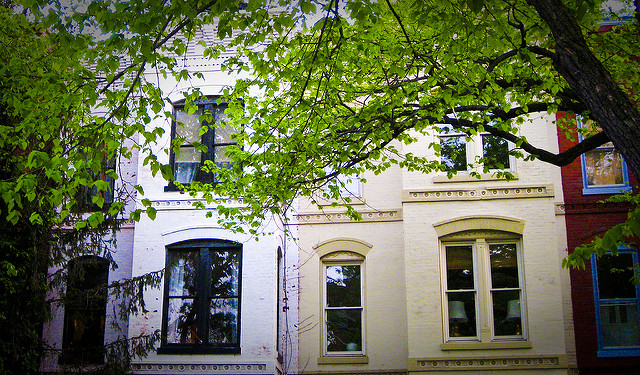 Rowhouses on Capitol Hill. Photo by Rebecca Schley.
1. It was not always called “Capitol Hill.”
According to Architect of the Capitol, an organization that maintains the grounds and many of the neighborhood’s government buildings, when city architect Pierre Charles L’Enfant found the area in the early 1790s, it was known as Jenkins’ Hill. That didn’t last much longer. L’Enfant proclaimed it “a pedestal waiting for a monument,” and construction atop Capitol Hill began in 1793.
The U.S. Capitol Building is located at East Capitol St NE and First St SE.
2. Christ Church (not the National Cathedral) is the city’s oldest Episcopal church.
The National Cathedral is one of the most famous churches in the United States. Loads of events and ceremonies occur there each year. President Woodrow Wilson is buried there. It’s reasonable for one to assume it’s the oldest Episcopal church in D.C., but not so. Capitol Hill’s Christ Church held its first service in 1807, according to the National Park Service. That’s a full 105 years before the cathedral opened its own doors in 1912. Christ Church has also such hosted famous worshippers as presidents James Madison and James Monroe, and famed marching band composer John Philip Sousa.
Christ Church is located at 620 G St SE.
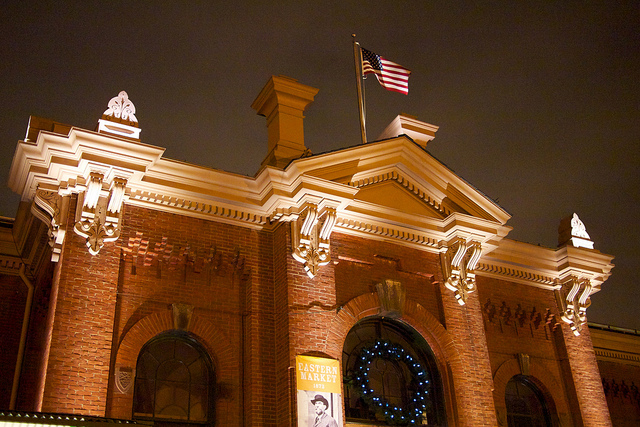 Eastern Market at Christmas. (Photo by Ian Coleman)
3. Eastern Market has been ravaged by fire—twice.
Eastern Market is a jewel in a neighborhood full of jewels. It stands out for its diverse crowds, diverse wares, and hometown vibe. Anyone who has lived in the area for a decade or more remembers the 2007 early-morning fire that ravaged the market and forced a two-year, $22 million renovation project. But that wasn’t the only time fire swept through the market. The last time was just a few years prior—1814, to be exact, when British troops burned a lot of Washington, including the market, during the War of 1812. The market wasn’t such a treasured landmark at that point, and it remained in a dilapidated condition for five decades. The “modern” Eastern Market opened in 1873.
Eastern Market is located at 225 7th St SE.
4. There’s a crypt in the Capitol, but no body,
Two stories below the Capitol Rotunda lies a room called “the crypt.” As Architect of the Capitol describes, it’s a popular room with visitors who navigate their way through the 40 columns packed into the relatively small space and gaze at the 13 statues, representing the original colonies. But it’s called the crypt for more reasons than the fact that it’s at the bottom of the building. Following George Washington’s death in 1799, Congress decreed that a space be made there for his remains and those of his wife, Martha. But it never came to pass; Washington requested that he be laid to rest in his Virginia home, Mount Vernon. That’s where he and Martha reside today.
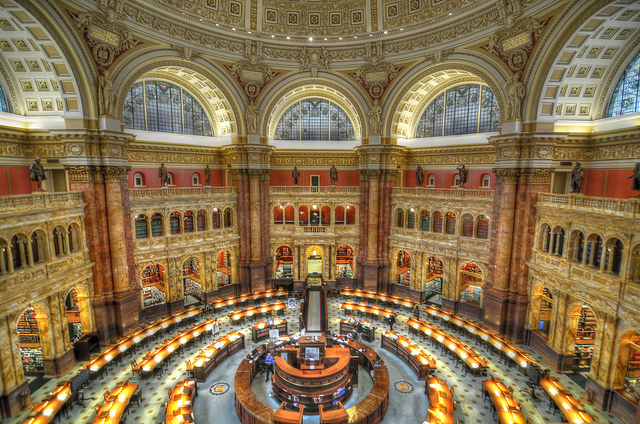 The Library of Congress reading room. (Photo by Brandon Kopp)
5. The Library of Congress has a great free program for kids.
The stats are staggering. According to the Library of Congress website, the massive facility contains about 164 million items on 838 miles of shelving. There are 38 million books and other printed materials, 3.6 million recordings, 14 million photographs, 5.5 million maps, and the list goes on. Even the hardest of hardcore scholars could feel daunted by that. But the library has a softer side, seemingly geared at least in part toward local children and families. The Young Readers Center is open during the week with featured readings and a rotating slate of events and activities for young children, teens, and young adults.
The Library of Congress Young Readers Center is located in the Library of Congress’ Thomas Jefferson Building, Room LJ G29 (ground floor), 10 First Street SE.
6. The city’s smallest house is here
Tiny houses have been trendy for a few years now, even if most people still probably like them most when other people live in them. They are typically between 100 to 400 square feet—the average American house is around 2,600—and aim to minimize homeowner costs and environmental footprint, among other things. On Capitol Hill, one house was way ahead of the curve. The 252-square-foot home is purportedly the smallest house in the city. Built around 1920, the one-room private residence is only nine feet wide and 28 feet long, but comes complete with a stove, washer and dryer, and bathroom. There’s even a small backyard. Your move, rest of the real-estate market.
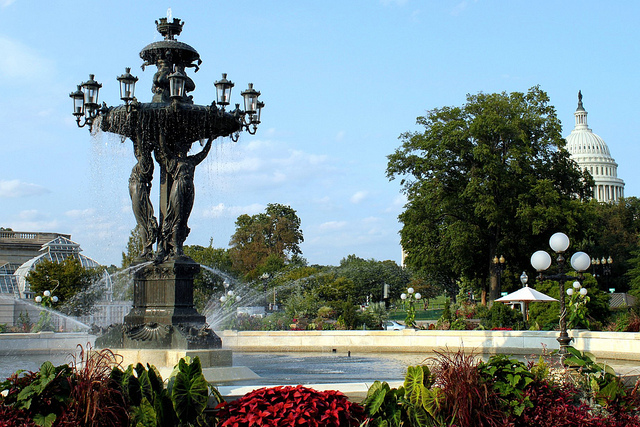 Bartholdi Fountain is part of the U.S. Botanic Garden. (Photo by Brian Allen)
7. The designer of the Statue of Liberty built a smaller monument here.
The fountain at Dupont Circle is probably the most iconic in the city. On Capitol Hill, there is stiff competition, even if it doesn’t reside in the average commuter’s sightlines. The Bartholdi Fountain is the centerpiece of Bartholdi Park. The park is across Independence Avenue from U.S. Botanic Garden Conservatory, and as such is not as widely visited as the gardens proper, but it is still a part of the USBG grounds. At 30 feet high, it towers by 14 feet over its Dupont counterpart, and may be more beautiful to boot. And how about history? The Dupont fountain was designed and created by Henry Bacon and Daniel Chester French—the same team that brought you the Lincoln Memorial. The Bartholdi fountain sees you that and raises you its own sculptor—Frédéric Auguste Bartholdi, the man who later created the Statue of Liberty. Winner probably varies by personal preference. In either case, the recently renovated, two-acre Bartholdi Park is currently welcoming any and all quiet strolls.
Bartholdi Park is located at 100 First St. SW.
8. The neighborhood is known for architectural diversity.
The stately brick rowhouse is sort Capitol Hill’s prevailing architectural archetype. But there are actually so many different styles on display throughout the neighborhood streets that the diversity in itself is architecturally remarkable. According to the Capitol Hill Restoration Society: “There is great variety of housing types, with elaborate ornamental pressed-brick structures adjacent to simple, unadorned frame buildings and small apartment houses. … The predominant architectural styles include Federal, Italianate, Second Empire, Romanesque, Queen Anne, and Classical Revival. There are approximately 8,000 primary contributing buildings dating from circa 1791-1945.” Sounds like a feast for the senses of any building buff.
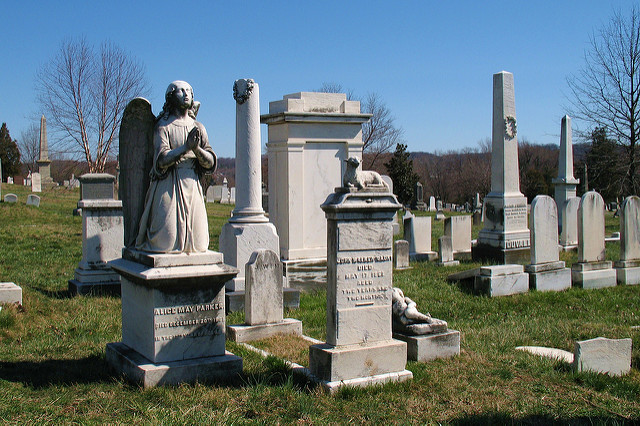 Congressional Cemetery is full of historic figures and intriguing tombstones. (Photo by Mr.TinDC)
9. You can take a walk through Historic Congressional Cemetery.
Located near the aforementioned Christ Church, Historic Congressional Cemetery is an attraction all its own. You know, if you’re into that sort of thing. Established in 1807, more than 65,000 individuals are now buried on the cemetery’s massive 35-acre grounds. (The church still owns the property, but the Association for the Preservation of Historic Congressional Cemetery has a long-term lease to operate the cemetery. People of note who are buried there include FBI Director J. Edgar Hoover, former president John Quincy Adams (well, temporarily—he is now interred in Massachusetts, though a marker remains at his original burial location), speaker of the house and Supreme Court justice Philip Barbour, band leader John Philip Sousa, and various other dignitaries from the three branches of government. Free, self-guided walking tours are available each day from dawn to dusk, with free guided tours also available every Saturday from April through October. Dog owner? Sign up for the Cemetery Dogs club, which allows members to take their dogs off the leash to run freely through the large but fenced-in grounds.
Historic Congressional Cemetery is located at 1801 E Street SE.
10. Barracks Row is the city’s oldest commercial center.
The portion of Eighth Street that moves through Capitol Hill became known as Barracks Row because of its proximity to the Washington Navy Yard and the Marine Barracks. It is well known for its charming series of shops, restaurants and the like. But it’s also the oldest commercial center in a city with more than a few commercial centers. According to Barracks Row Main Street, a preservation and advocacy group, the area received that distinction in 1799. Exactly 200 years later, it was chartered by the National Trust for Historic Preservation’s Main Street program.
Previously:
10 Facts You May Not Know About Brookland
10 Facts You May Not Know About Anacostia
10 Facts You May Not Know About Dupont Circle
Nine Facts You May Not Know About The Southwest Waterfront